Flood Design True or False
Written by Adi Ackerman, Head Teacher
"Flood Design True or False" is written for 3rd Grade (Ages 8-9), and it covers NGSS 3-ESS3-1. If your little one is a year younger but already steady on weather and climate, the page still works. You may just need to read the instructions out loud. And if they are older and design for weather hazards never quite stuck, this is a short review rather than busywork.
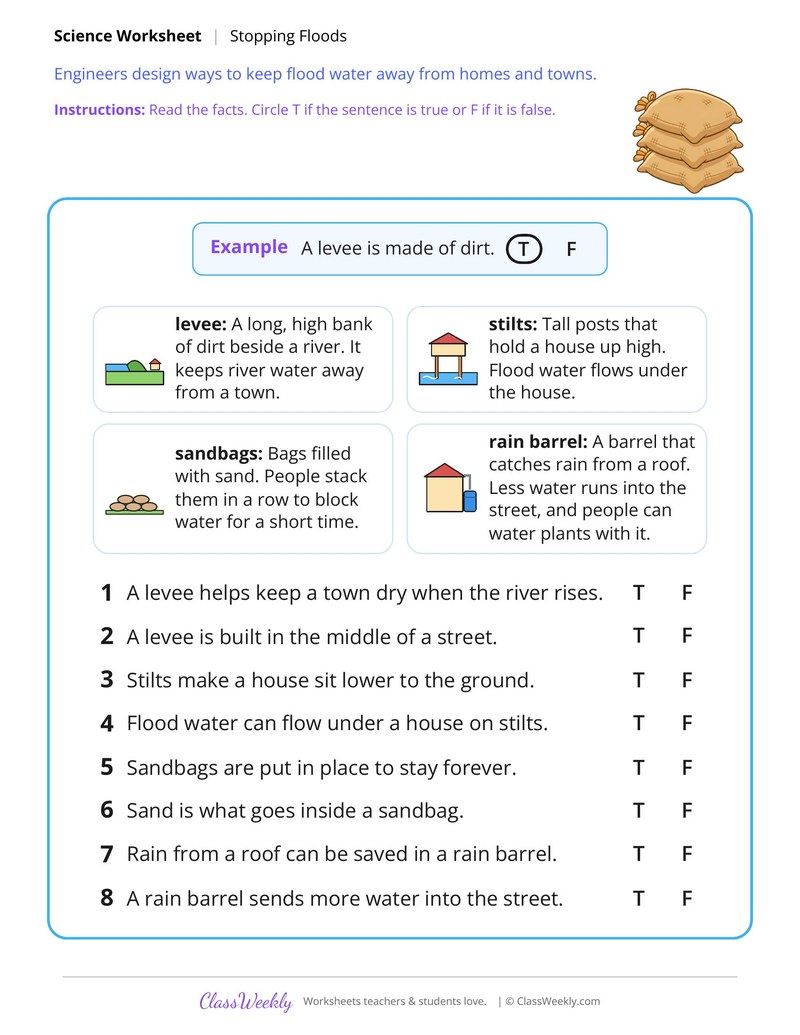
3rd grade science worksheet: read facts on levees, stilts, sandbags and rain barrels and circle T or F for each sentence. Answer key included. Part of our design for weather hazards collection. Aligned to NGSS standards.
How do I use this worksheet?
Ask your child which flood design would work best for a house by a river and why. Look for lightning rods on tall buildings or barns on your next drive.
What students will practice
- Students will read facts about 4 flood designs.
- Students will check each sentence against the facts.
- Students will circle T or F for each sentence.


Curriculum Links
Next Generation Science Standards
Science · 3rd Grade
Find this in the curriculum
Browse the grade, subject, and topic this belongs to.
FAQ
How do I use this design for weather hazards worksheet?
⌄
Ask your child which flood design would work best for a house by a river and why. Look for lightning rods on tall buildings or barns on your next drive.
What does this worksheet teach?
⌄
Read facts on levees, stilts, sandbags and rain barrels and circle T or F for each sentence. The directions on the page read: Read the facts. Circle T if the sentence is true or F if it is false. The page opens with a worked example, and an answer key is included.
Can I use this design for weather hazards worksheet for homeschool or classroom?
⌄
Yes, both. We made it for 3rd Grade weather and climate, and the page works the same whether it lands on a kitchen table or a center rotation. At home, most families go through it together and talk the answers out loud, and that talking is where most of the learning happens with design for weather hazards. In class it runs well as independent work while you pull a small group. Print one copy or thirty, whichever the day needs.
What does design for weather hazards teach third graders?
⌄
This topic teaches students that humans use engineering and design to reduce the impact of severe weather on communities. Third graders explore examples like levees, hurricane shutters, and reinforced roofs, and apply the engineering design process, identify the problem, brainstorm solutions, test, and improve, to weather-related challenges. It integrates science with creative, problem-solving thinking.
When do third graders learn about designing for weather hazards?
⌄
Design for weather hazards appears in Grade 3 as part of NGSS engineering and earth science integration, typically after students have studied weather hazards themselves. At ages 8-9, students are ready to engage with open-ended design challenges and understand that science knowledge is useful for solving real problems. It often culminates in a hands-on building activity.
How can I use these worksheets at home?
⌄
After completing a worksheet, try a quick at-home design challenge, can your child build a paper structure that can hold up against a hair dryer 'wind test'? The worksheets introduce the vocabulary and process that make such activities feel purposeful rather than just crafty. Connecting the science to hands-on building makes the engineering design process memorable and fun for third graders.
What is the difference between weather and climate?
⌄
Weather is what the air outside is like today or this hour, and it can change quickly. Climate is the usual weather of a region over many years, like hot summers every year. Children sort weather reports from climate reports and fill in sentences with words like forecast and region.
How do 3rd graders read a thermometer?
⌄
They find where the red line stops and count marks from the closest number. On these sheets each small mark can stand for 2 or 5 degrees, and children read both Fahrenheit and Celsius thermometers.
How do these sheets use climate data?
⌄
Children read bar graphs, picture graphs and tables of rain, snow and temperature for cities like Seattle, Phoenix, Miami and Anchorage. Then they describe each climate as wet or dry, mild or cold.
What weather hazard designs do kids study?
⌄
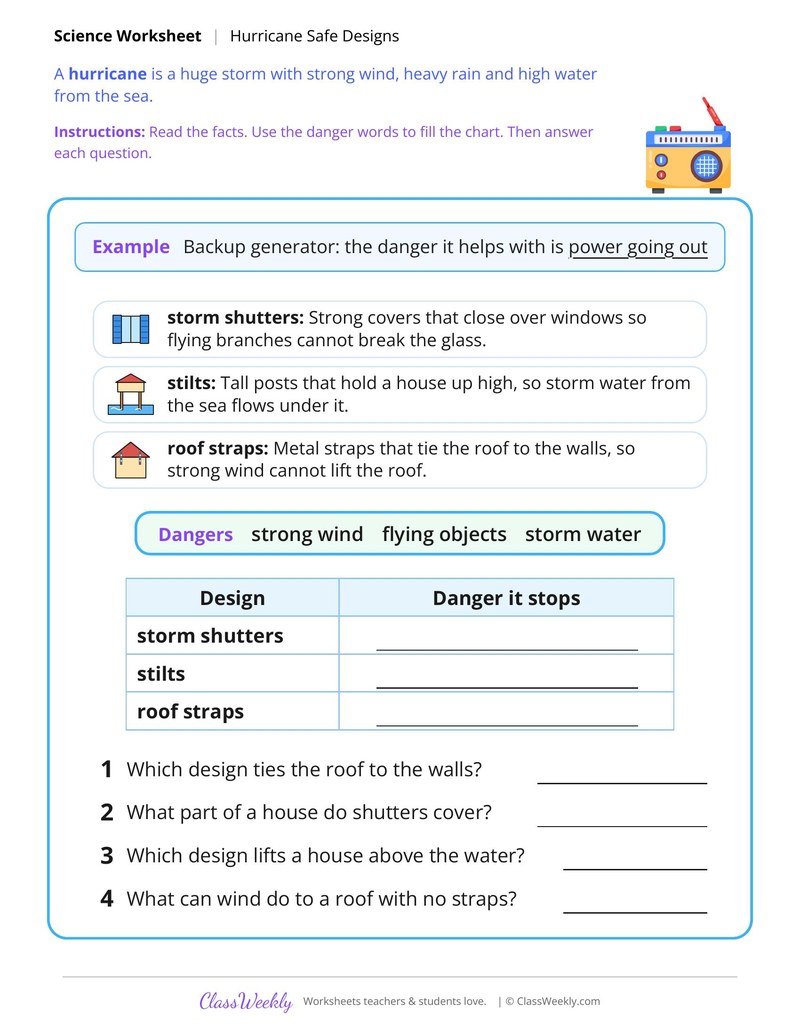
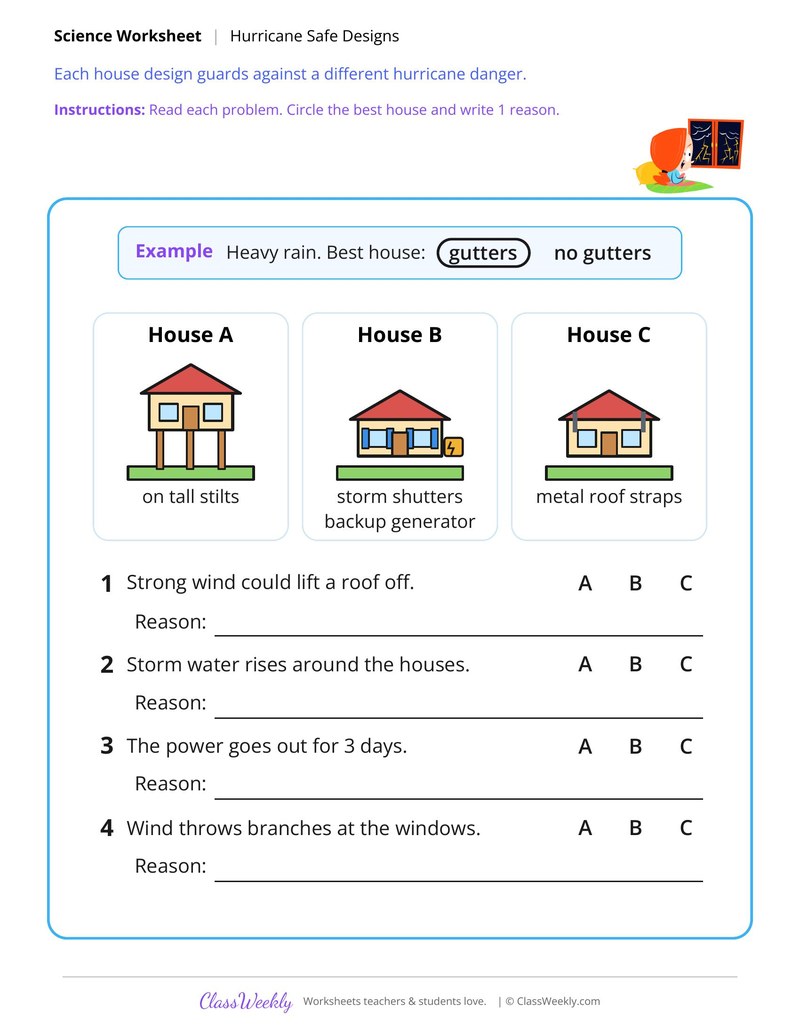
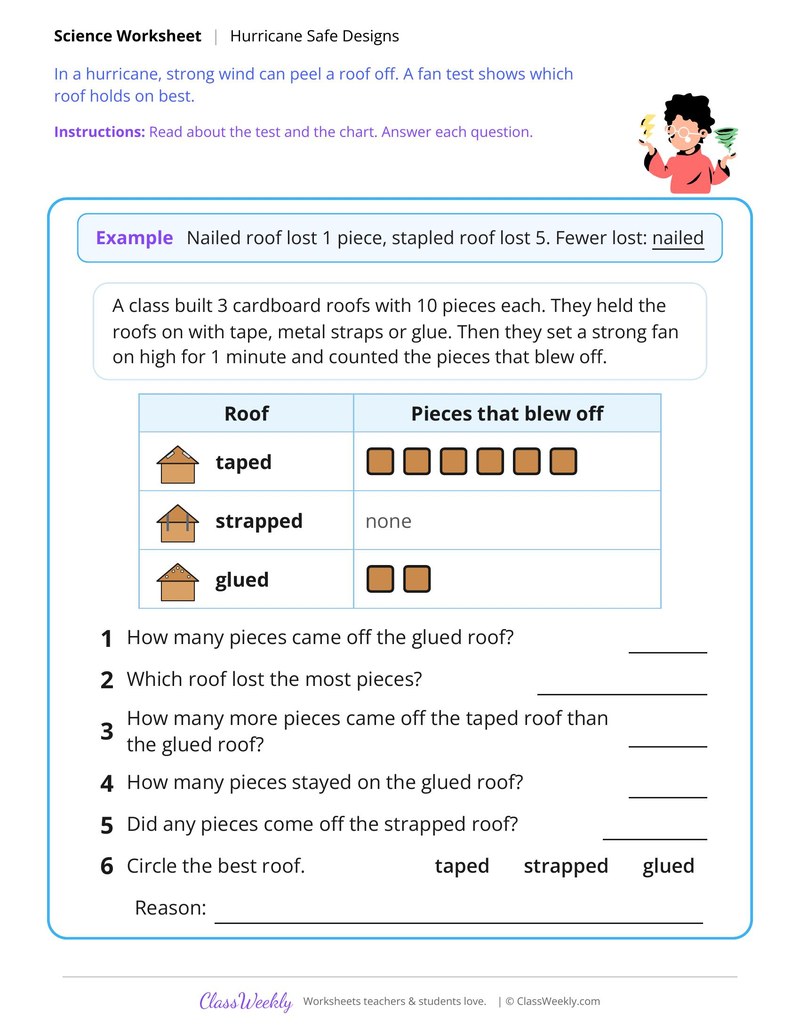
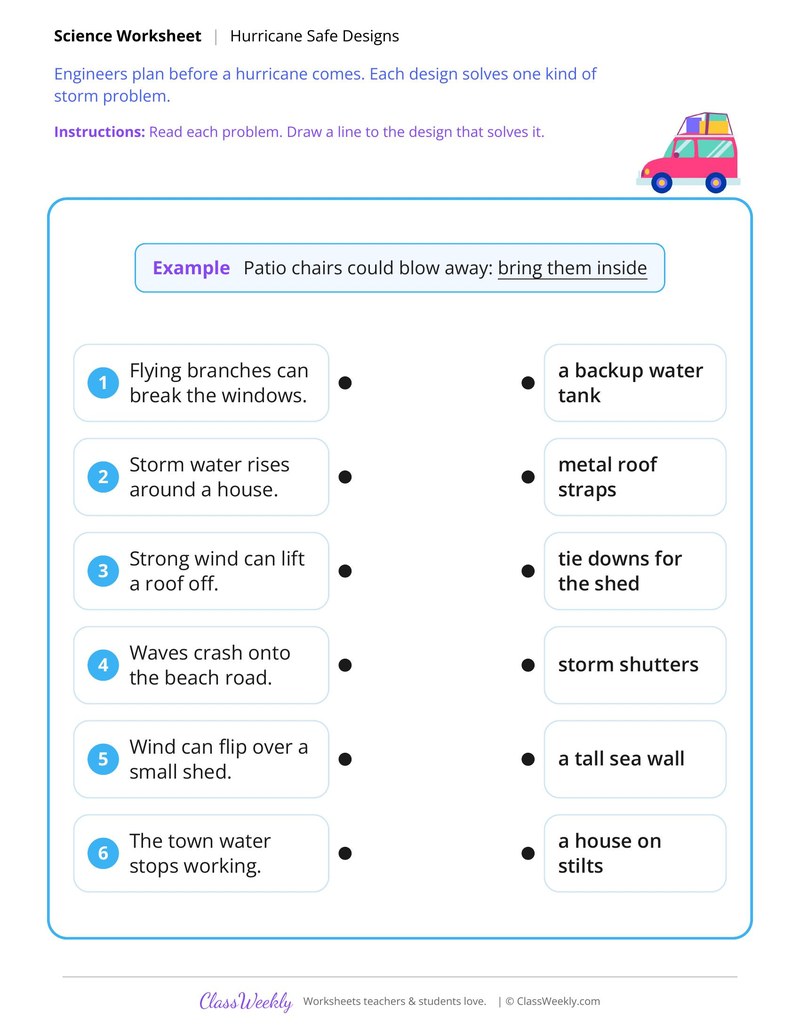
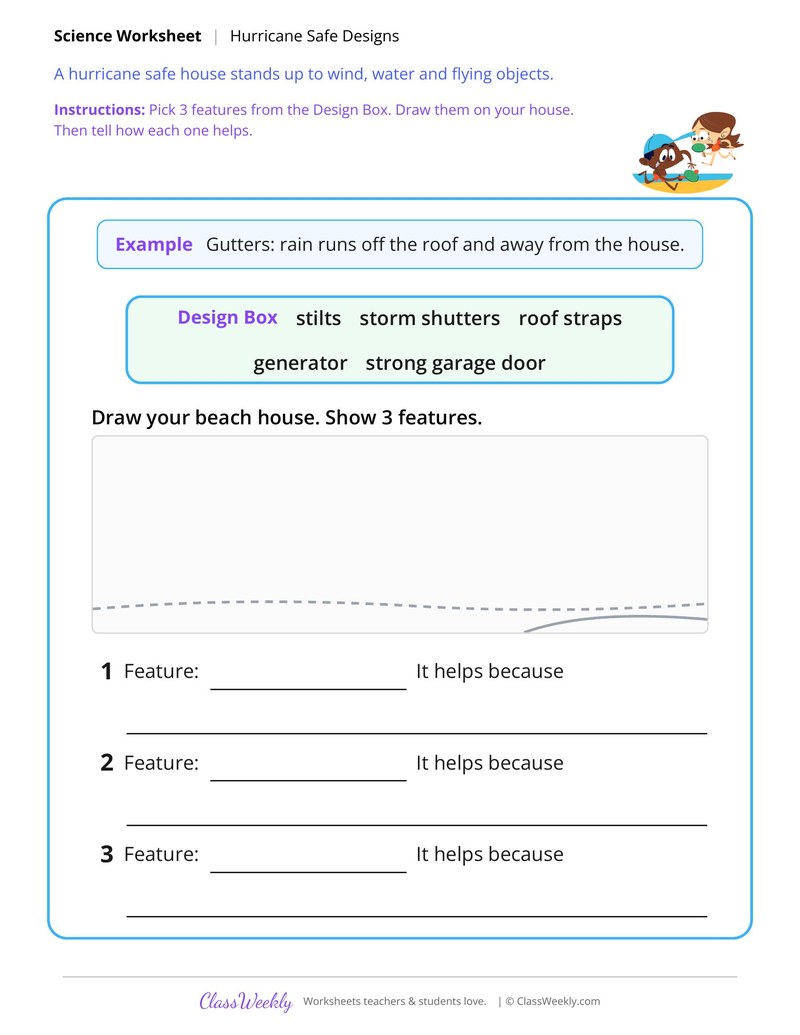
They compare rain gardens, ditches and flood walls, read a tub town flood test and match storm shutters, stilts and roof straps to the hurricane danger each one stops. Most sheets come with an answer key, and open plan pages let children design their own safe house.
Ratings & Reviews
No reviews yet. Be the first to share what you think.
Reviews are for ClassWeekly members.
Make a Request
Spotted something to fix, or want a worksheet we don't have yet? Tell us and we'll make it.
Worksheet Details
| Grade | 3rd Grade |
| Subject | Science |
| Topic | Weather and Climate |
| Standard | 3-ESS3-1 |
| Pages | 1 page |
| Difficulty | Medium |
What is ClassWeekly?
ClassWeekly offers free worksheets and printable learning resources for kids, from preschool up. All worksheets are aligned to Common Core, NGSS, and C3 Framework standards and designed by educators. We also have free online learning games for thousands of skills, and kids' answers turn into a progress report for the grown-up. Start a free 30-day trial to download the worksheets.