Add 2-digit and 1-digit numbers in columns
Written by Adi Ackerman, Head Teacher
"Add 2-digit and 1-digit numbers in columns - no carrying" is written for 1st Grade (Ages 6-7), and it covers Common Core 1.NBT.C.4. If your little one is a year younger but already steady on addition, the page still works. You may just need to read the instructions out loud. And if they are older and add 2-digit and 1-digit numbers in columns - no carrying never quite stuck, this is a short review rather than busywork.

Add a 2-digit and 1-digit number stacked in columns, no carrying Part of our add 2-digit and 1-digit numbers in columns - no carrying addition collection. Aligned to Common Core standards.
How do I use this worksheet?
Before handing out the worksheet, briefly introduce the concept with a short oral warm-up or a visual model on the board. Let students work through the first item together as a class, then finish the rest independently or with a partner, encouraging them to talk through their thinking: "What strategy are you using? How do you know that is right?" After completing the worksheet, review any missed problems together and discuss the reasoning rather than just the answer. For extra support, let students use manipulatives or draw pictures alongside the written problems. These add 2-digit and 1-digit numbers in columns - no carrying worksheets work well as daily practice, homework, or a focused review activity.
What students will practice
- Students will recognize and apply add 2-digit and 1-digit numbers in columns - no carrying concepts using number lines, ten-frames, and drawn models.
- Students will solve problems involving add 2-digit and 1-digit numbers in columns - no carrying with increasing accuracy and confidence.
- Students will connect add 2-digit and 1-digit numbers in columns - no carrying skills to real-world situations and explain their reasoning clearly.
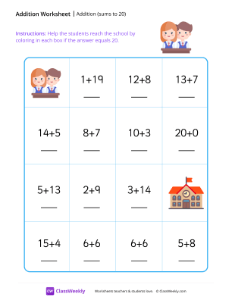
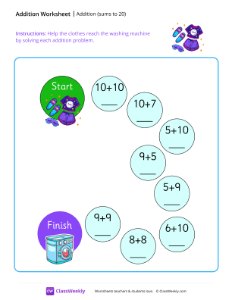
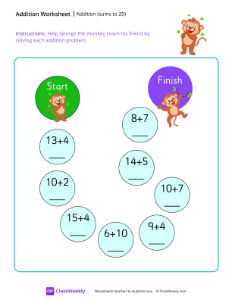
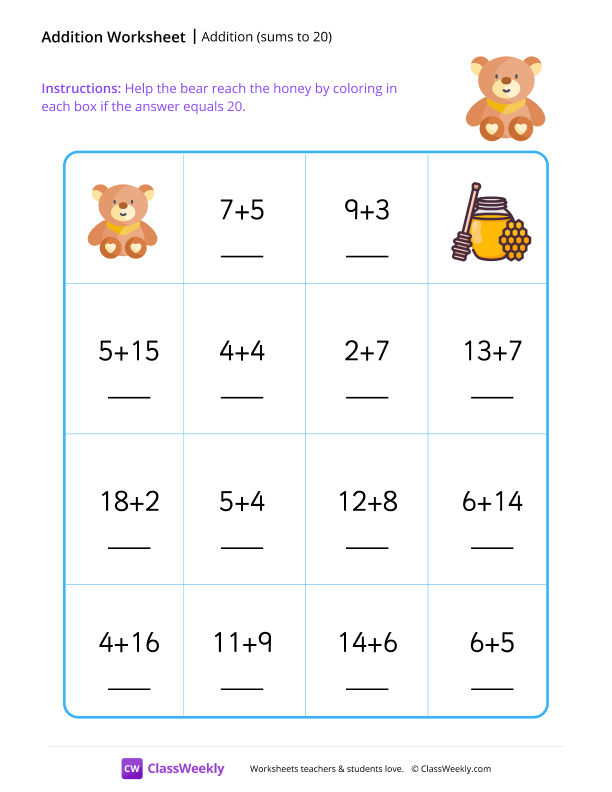
Curriculum Links
Common Core State Standards
Number and Operations in Base Ten · 1st Grade
Standard: Add within 100, including adding a two-digit number and a one-digit number, and adding a two-digit number and a multiple of 10, using concrete models or drawings and strategies based on place value.
View all 1.NBT.C.4 worksheets →Find this in the curriculum
Browse the grade, subject, and topic this belongs to.
FAQ
How do I use this add 2-digit and 1-digit numbers in columns - no carrying worksheet?
⌄
Before handing out the worksheet, briefly introduce the concept with a short oral warm-up or a visual model on the board. Let students work through the first item together as a class, then finish the rest independently or with a partner, encouraging them to talk through their thinking: "What strategy are you using? How do you know that is right?" After completing the worksheet, review any missed problems together and discuss the reasoning rather than just the answer. For extra support, let students use manipulatives or draw pictures alongside the written problems. These add 2-digit and 1-digit numbers in columns - no carrying worksheets work well as daily practice, homework, or a focused review activity.
What does this worksheet teach?
⌄
These add 2-digit and 1-digit numbers in columns - no carrying worksheets for 1st grade give students the structured, hands-on practice they need to build confidence and fluency. Students work through a range of problem formats, from visual models and diagrams to written equations and word problems, so they encounter add 2-digit and 1-digit numbers in columns - no carrying from every angle. Each worksheet is designed to build on prior knowledge while introducing the level of challenge appropriate for 1st grade. Practicing add 2-digit and 1-digit numbers in columns - no carrying at this stage strengthens the mathematical foundations that support more advanced concepts in later grades.
Can I use this add 2-digit and 1-digit numbers in columns - no carrying worksheet for homeschool or classroom?
⌄
Yes, both. We made it for 1st Grade addition, and the page works the same whether it lands on a kitchen table or a center rotation. At home, most families go through it together and talk the answers out loud, and that talking is where most of the learning happens with add 2-digit and 1-digit numbers in columns - no carrying. In class it runs well as independent work while you pull a small group. Print one copy or thirty, whichever the day needs.
What does 'no carrying' mean in column addition, and why start with it?
⌄
No carrying means the ones column sum stays below 10, so no regrouping is needed - students can focus on column alignment and basic addition before adding regrouping complexity.
Why is column alignment important in two-digit plus one-digit addition?
⌄
Misaligning the one-digit number with the tens instead of ones column is a common error that produces wildly wrong answers - alignment practice prevents it.
What is the correct procedure for adding a 2-digit and 1-digit number in columns?
⌄
Write the ones digit of the 2-digit number above the 1-digit number, leave the tens column with only the tens digit, then add ones first and bring down the tens.
What addition facts should a first grader know?
⌄
By the end of first grade, students should fluently add within 10 (CCSS 1.OA.C.6) and solve addition problems within 20 using strategies like counting on, making ten, and decomposing numbers. They should also add within 100 using place value understanding (1.NBT.C.4).
How do you teach first graders to add double-digit numbers?
⌄
Start with adding a two-digit number and a one-digit number, then progress to two two-digit numbers. Use place value understanding: add the tens first, then the ones. Base-ten blocks and place value worksheets make this concrete before moving to abstract equations.
What are addition strategies for first grade?
⌄
Key strategies include counting on from the larger number, making a ten (e.g., 8+5 becomes 8+2+3), using doubles (6+6=12) and near-doubles (6+7=6+6+1), and decomposing to known facts. Worksheets that practice each strategy separately help students build fluency.
Ratings & Reviews
No reviews yet. Be the first to share what you think.
Reviews are for ClassWeekly members.
Make a Request
Spotted something to fix, or want a worksheet we don't have yet? Tell us and we'll make it.
Learn More
What is ClassWeekly?
ClassWeekly offers free worksheets and printable learning resources for kids in preschool to grade 5. All worksheets are aligned to Common Core, NGSS, and C3 Framework standards and designed by educators. Become a member to access the full library and download unlimited PDFs.