Anti-Bullying Week 2026
Taught in US schools

Key Takeaways
- Anti-Bullying Week offers a structured entry point for building empathy, perspective, and global awareness in students
- Students in Kindergarten–Grade 5 can connect this theme to history, science, social studies, and the arts
- Interactive activities and discussions help students understand why this observance matters, and what they can do
- In the classroom, Anti-Bullying Week connects to: Kindness, empathy, standing up for others
What’s Taught
Kindness, empathy, standing up for others
About Anti-Bullying Week: Origins and Significance
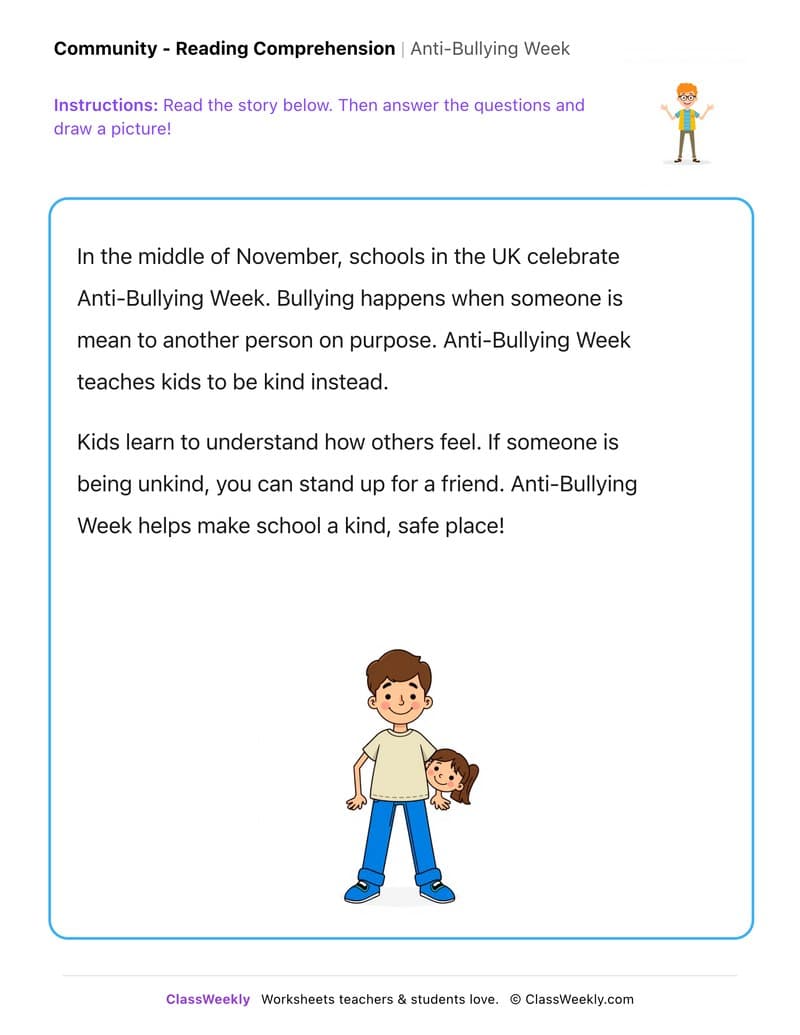
Anti-Bullying Week was established to draw attention to an issue of global importance. Anti-Bullying Week builds empathy and courage with activities about standing up for others. Worksheets cover kindness, allyship, and what to do if you see bullying happen. Since its founding, this observance has grown into an international moment for reflection, education, and action.
The movement behind Anti-Bullying Week gained momentum through grassroots advocacy, research, and policy change. By 2026, it has become one of the most recognized awareness events on the teaching calendar.
Understanding the history of this event helps students develop critical consciousness, the ability to recognize challenges in the world and imagine solutions. That's not just good citizenship. It's rigorous thinking.
Why Anti-Bullying Week Matters for Every Classroom
Awareness events give teachers a structured, meaningful way to address complex topics in age-appropriate ways. For students in Kindergarten–Grade 5, exploring real-world issues builds critical thinking, empathy, and civic responsibility.
Students who learn to connect classroom content to real-world challenges become stronger readers, writers, and thinkers. They develop a sense of agency, an understanding that their learning matters, and that they can contribute to something meaningful.
Anti-Bullying Week also opens rich cross-curricular connections: informational reading, persuasive writing, data literacy, and oral communication can all be anchored to the themes of this day.
How to Teach Anti-Bullying Week by Grade Level
Kindergarten
For kindergarteners, make Anti-Bullying Week concrete and sensory. Use picture books, puppets, songs, and simple art activities to introduce the key concept. Focus on one big idea, "we are all connected" or "the world is changing", and return to it throughout the day through different experiences.
Anti-Bullying Week Worksheets for Kindergarten
1st Grade
First graders are ready for simple explanations and structured discussion. Anchor Anti-Bullying Week with a shared read-aloud, then use sentence frames ("I notice… I wonder… This makes me think…") to guide responses. Drawing and labeling lets emergent writers participate fully.
2nd Grade
Second graders thrive with short informational texts paired with graphic organizers. For Anti-Bullying Week, have students identify the main idea and two supporting details, then share with a partner. A class anchor chart captures key vocabulary and builds shared knowledge.
3rd Grade
Third graders can tackle research tasks connected to Anti-Bullying Week. Set up a "learning station" with two or three curated sources. Students take notes, discuss findings in small groups, and synthesize information into a paragraph or poster. Introduce multiple perspectives where relevant.
4th Grade
Fourth graders are ready to explore complexity. For Anti-Bullying Week, use a structured discussion protocol, Socratic seminar, four corners, or philosophical chairs, to examine different viewpoints. Assign a short written reflection that asks students to take and defend a position.
5th Grade
Fifth graders can engage with primary sources, data, and big-picture thinking around Anti-Bullying Week. Assign an essay, multimedia presentation, or debate that asks: why does this matter? What are the different perspectives? What would you do? These questions build the critical thinking that defines college and career readiness.
Anti-Bullying Week Classroom Activities
Awareness Campaign Posters
Students design informational posters using a key fact, a strong visual, and a clear call to action. This integrates research, writing, and design thinking, and creates authentic products students are proud of.
Kindergarten–Grade 5Perspective-Taking Circles
Divide students into small groups, each representing a different stakeholder connected to Anti-Bullying Week. Groups prepare a brief statement from their perspective and share with the class. A debrief conversation surfaces nuance and builds empathy.
Grades 3–5Before and After Charts
Students use a T-chart to compare what life looked like before awareness of this issue grew versus what it looks like today. What changed? What still needs to change? A powerful structure for historical and critical thinking.
Grades 2–5Interview a Community Member
Students brainstorm questions and (with family support) interview someone in their community about Anti-Bullying Week. They share what they learned in a brief oral report or illustrated page for a class book.
Kindergarten–Grade 5Action Planning
After learning about Anti-Bullying Week, students brainstorm one action they could take in their school, home, or community. They set a specific goal and a deadline. Even small actions build agency and civic identity.
Grades 2–5
Anti-Bullying Week Games & Interactive Ideas
Myth vs. Fact Sorting Game
Create a set of statement cards, some accurate facts about Anti-Bullying Week's theme, some common misconceptions. Teams sort them into "Myth" and "Fact" piles, then share their reasoning. A powerful tool for building critical thinking.
Grades 2–5Agree/Disagree Spectrum
Read aloud statements related to Anti-Bullying Week. Students physically move to different spots in the room to show where they stand on an agree-to-disagree spectrum, then explain their position. Builds respectful debate skills.
Grades 2–5Awareness Jeopardy
Build a Jeopardy-style game with categories related to Anti-Bullying Week: History, Key People, Vocabulary, True/False, and Action Steps. Teams compete to answer questions and win points while building their knowledge base.
Grades 3–5Problem-Solution Relay
In relay fashion, teams pass a paper where each member adds one problem related to Anti-Bullying Week's theme and one possible solution. Teams read their completed relay papers aloud and discuss the most creative or practical solutions.
Kindergarten–Grade 5Frequently Asked Questions
When is Anti-Bullying Week in 2026?
Anti-Bullying Week runs from November 16, 2026 through November 20, 2026.
How do I teach Anti-Bullying Week to elementary students?
For kindergarteners, make Anti-Bullying Week concrete and sensory. Use picture books, puppets, songs, and simple art activities to introduce the key concept. Focus on one big idea, "we are all connected" or "the world is changing", and return to it throughout the day through different experiences. A good starting activity: awareness campaign posters, where students design informational posters using a key fact, a strong visual, and a clear call to action. This integrates research, writing, and design thinking, and creates authentic products students are proud of.
What are the best Anti-Bullying Week activities for kids?
Awareness Campaign Posters (Kindergarten–Grade 5): Students design informational posters using a key fact, a strong visual, and a clear call to action. This integrates research, writing, and design thinking, and creates authentic products students are proud of. Another option, Perspective-Taking Circles (Grades 3–5): divide students into small groups, each representing a different stakeholder connected to Anti-Bullying Week. Groups prepare a brief statement from their perspective and share with the class. A debrief conversation surfaces nuance and builds empathy.
Why is Anti-Bullying Week important for students to learn about?
Anti-Bullying Week builds empathy and courage with activities about standing up for others. Worksheets cover kindness, allyship, and what to do if you see bullying happen. Teaching students about Anti-Bullying Week builds cultural literacy, historical thinking, and empathy, skills that support learning across every subject and prepare students to be thoughtful, informed community members.
What grade levels is Anti-Bullying Week appropriate for?
With the right scaffolding, Anti-Bullying Week can be explored at every grade level from PreK through Grade 5. The content is the same; the depth, text complexity, and task demand shift by grade. ClassWeekly offers differentiated resources for Kindergarten–Grade 5.
What specific topics does Anti-Bullying Week cover in the classroom?
Anti-Bullying Week lessons typically cover Kindness, empathy, standing up for others. Teachers can build a full lesson around these specific topics rather than a generic overview.
Free Teaching Resources for Every Occasion
#1 Curriculum aligned resource library (K‑5) with teacher-made materials.