Find the End Time on a Number Line
Written by Adi Ackerman, Head Teacher
"Find the End Time on a Number Line" is written for 3rd Grade (Ages 8-9), and it covers Common Core 3.MD.A.1. If your little one is a year younger but already steady on telling time, the page still works. You may just need to read the instructions out loud. And if they are older and what time was it / will it be (5 min intervals) never quite stuck, this is a short review rather than busywork.
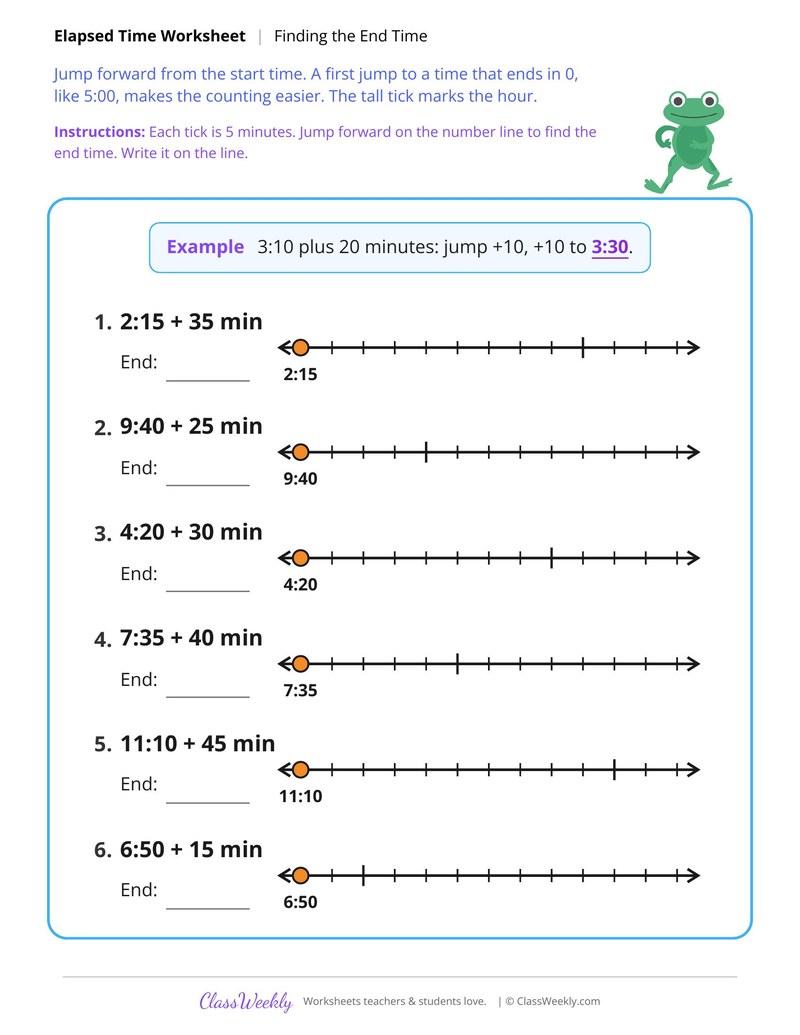
3rd grade math worksheet: jump forward by 5 minute ticks on number lines to find end times, like adding 35 minutes. Answer key included. Part of our what time was it / will it be (5 min intervals) collection. Aligned to Common Core standards.
How do I use this worksheet?
Before handing out the worksheet, briefly introduce the concept with a short oral warm-up or a visual model on the board. Let students work through it independently, using a partner or small group only if they want to talk through their thinking, encouraging them to talk through their thinking: "What strategy are you using? How do you know that is right?" After completing the worksheet, review any missed problems together and discuss the reasoning rather than just the answer. For extra support, let students use manipulatives or draw pictures alongside the written problems. These what time was it / will it be (5 min intervals) worksheets work well as daily practice, homework, or a focused review activity.
What students will practice
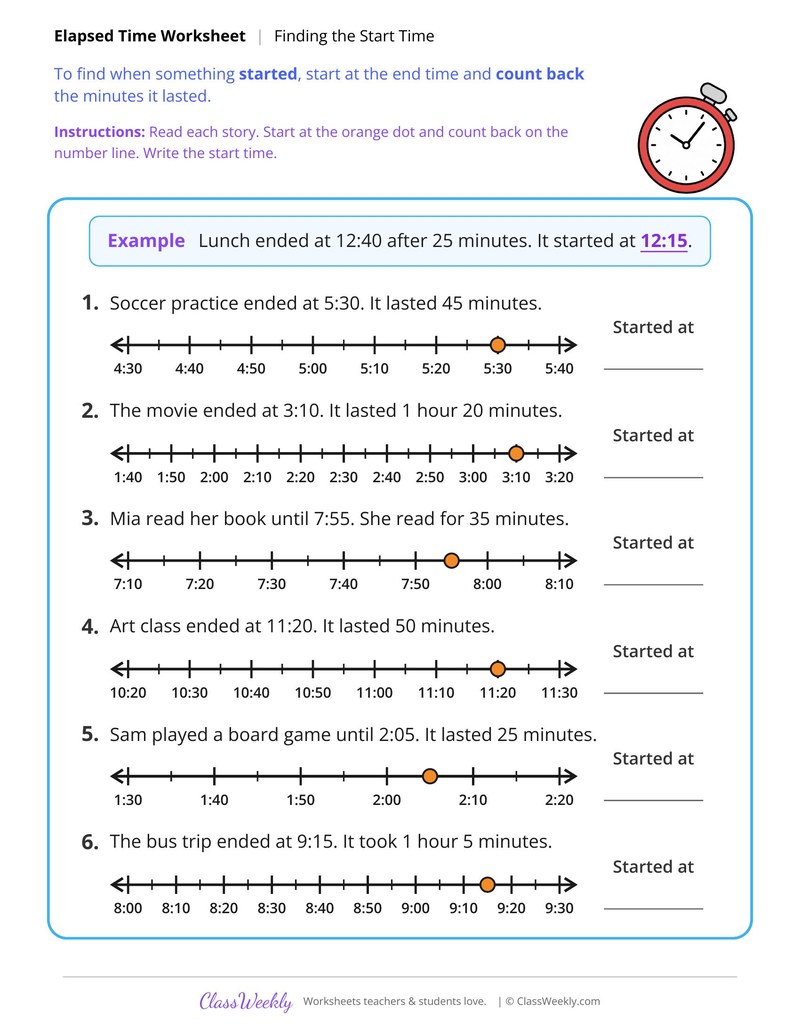
- Students will start at a time on a number line with 5 minute ticks.
- Students will jump forward to a time that ends in 0 first.
- Students will write the end time for 6 problems.
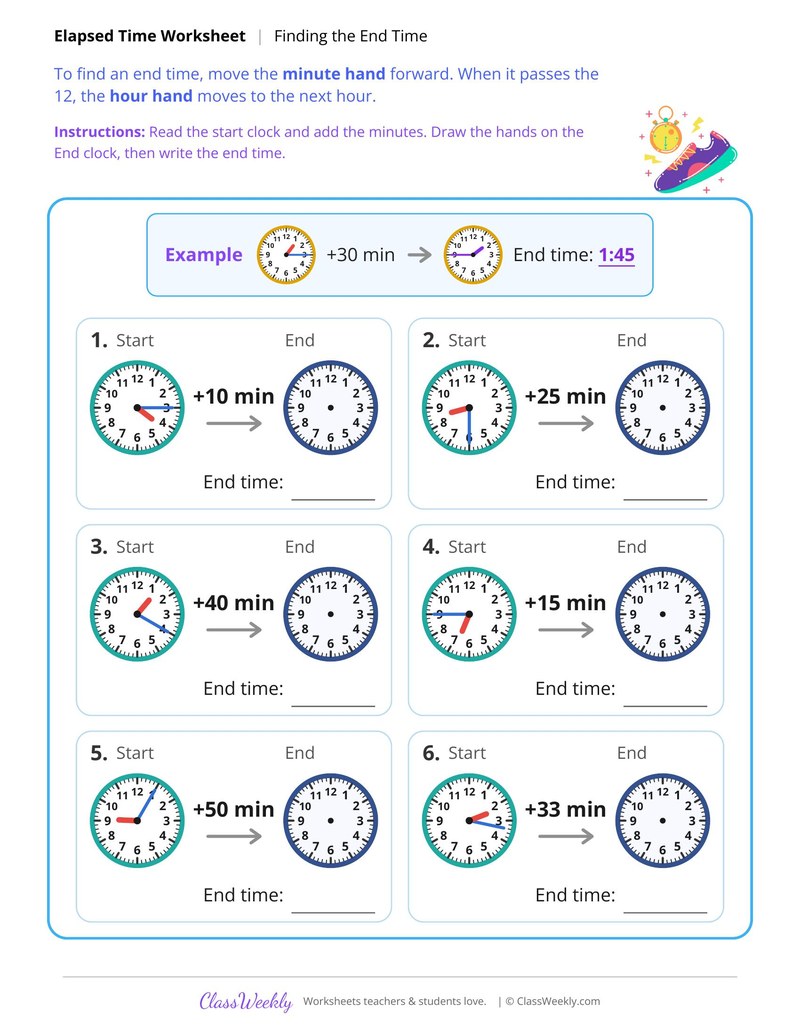
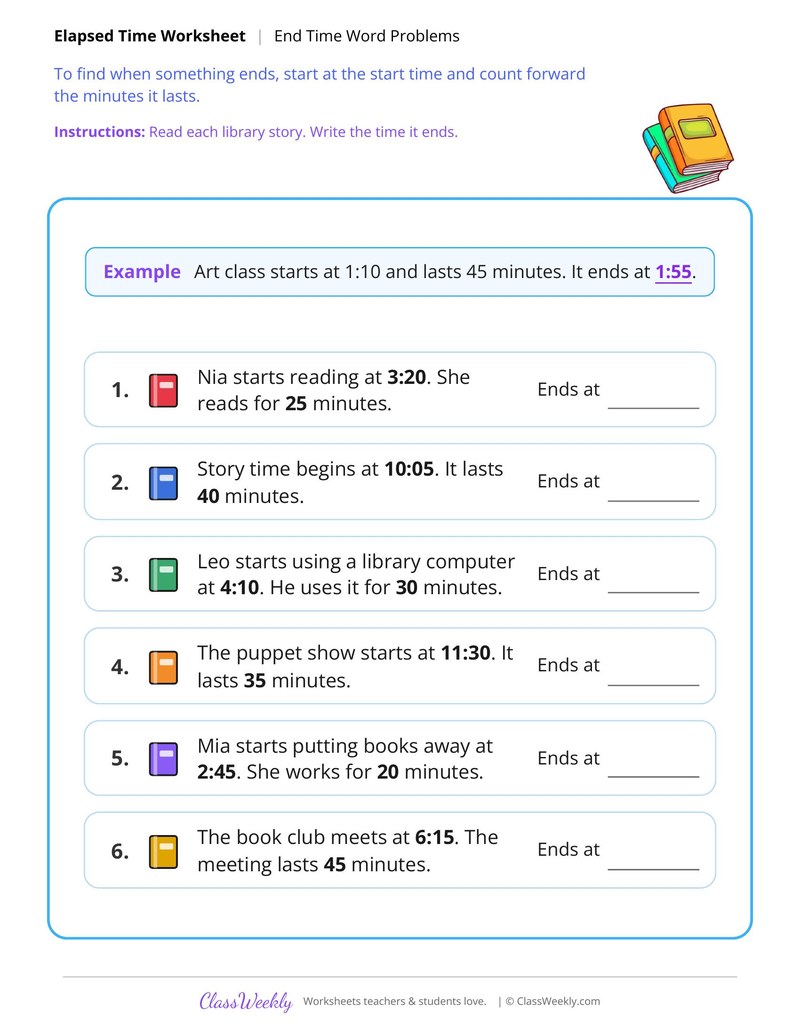
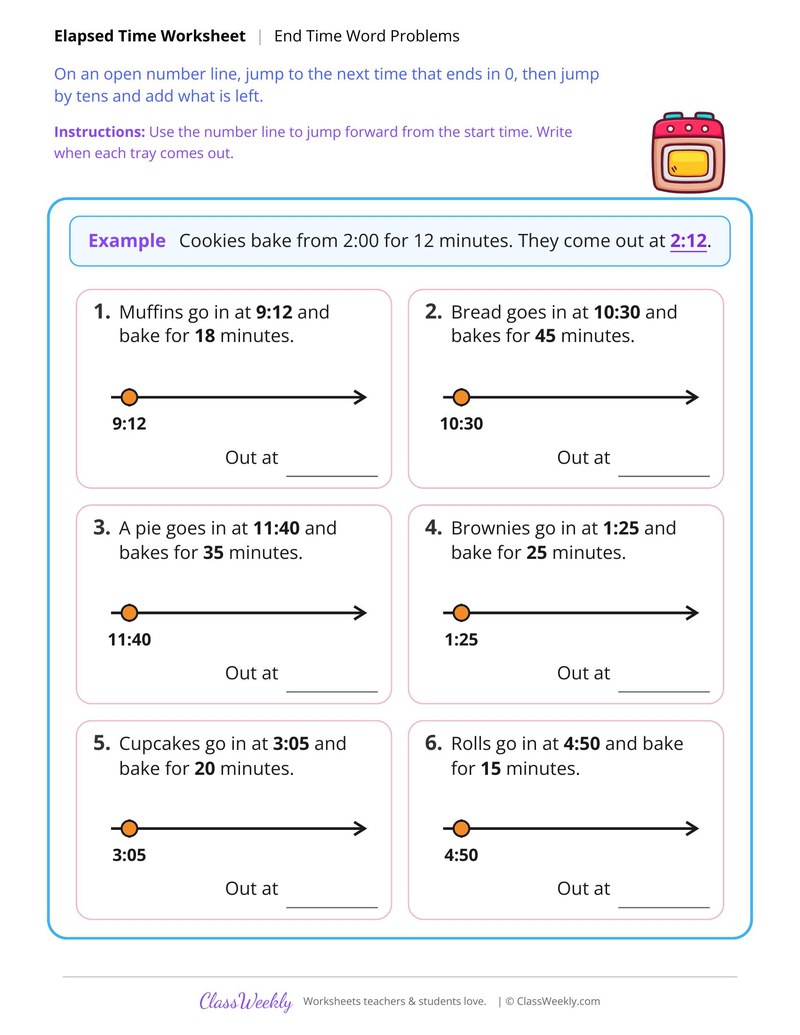
Curriculum Links
Common Core State Standards
Measurement and Data · 3rd Grade
Standard: Tell and write time to the nearest minute and measure time intervals in minutes.
View all 3.MD.A.1 worksheets →Find this in the curriculum
Browse the grade, subject, and topic this belongs to.
FAQ
How do I use this what time was it / will it be (5 min intervals) worksheet?
⌄
Before handing out the worksheet, briefly introduce the concept with a short oral warm-up or a visual model on the board. Let students work through it independently, using a partner or small group only if they want to talk through their thinking, encouraging them to talk through their thinking: "What strategy are you using? How do you know that is right?" After completing the worksheet, review any missed problems together and discuss the reasoning rather than just the answer. For extra support, let students use manipulatives or draw pictures alongside the written problems. These what time was it / will it be (5 min intervals) worksheets work well as daily practice, homework, or a focused review activity.
What does this worksheet teach?
⌄
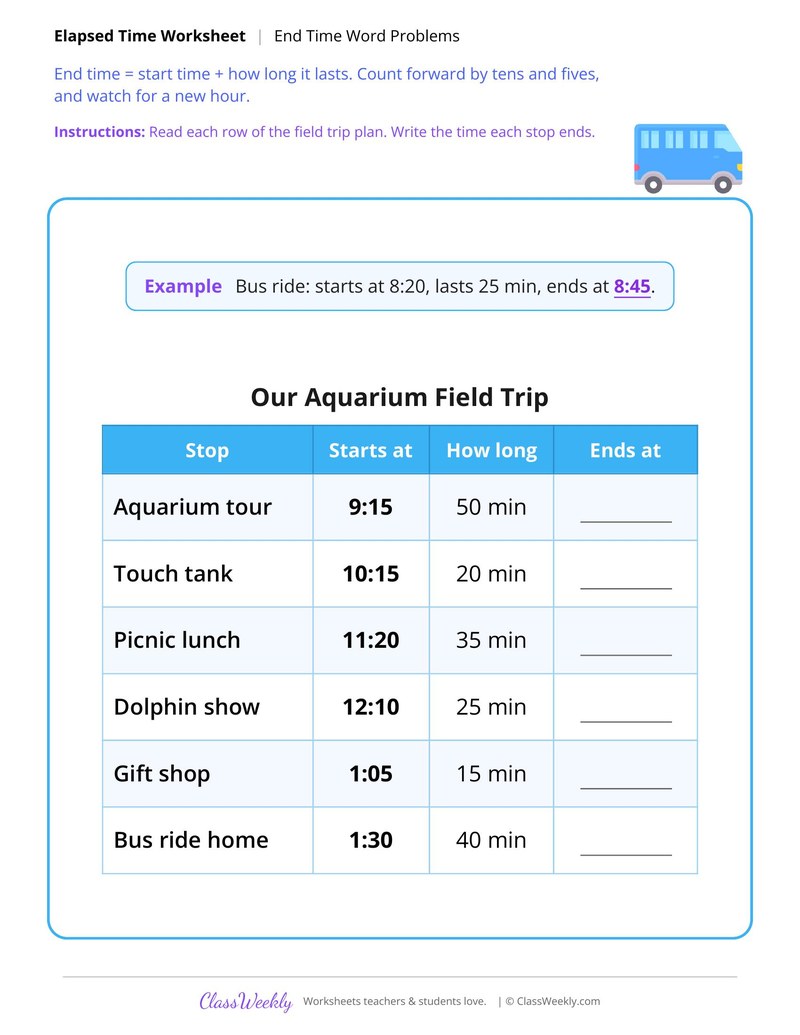
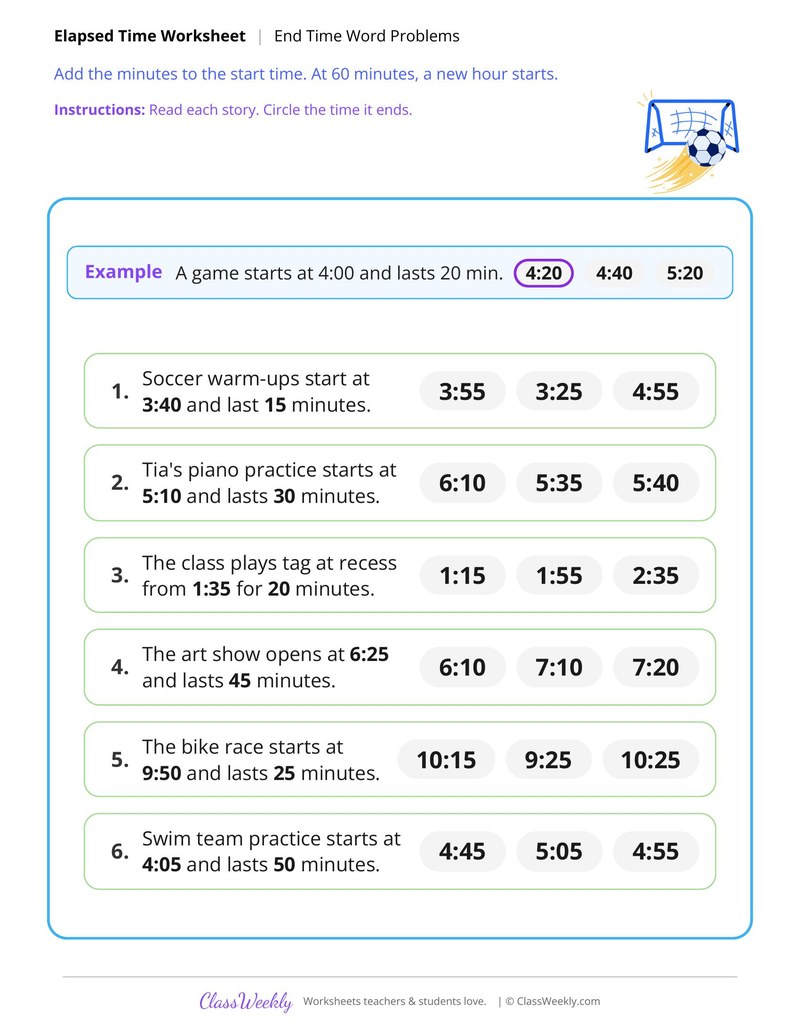
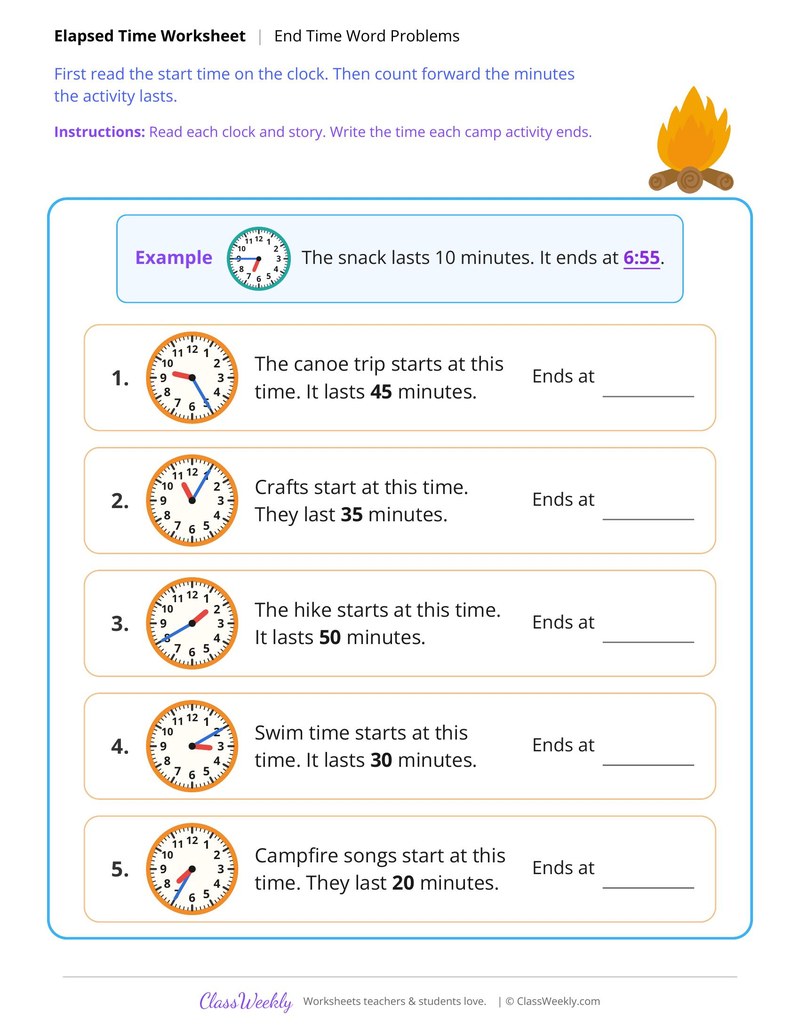
Jump forward by 5 minute ticks on number lines to find end times, like adding 35 minutes. The directions on the page read: Each tick is 5 minutes. Jump forward on the number line to find the end time. Write it on the line. The page opens with a worked example, and an answer key is included.
Can I use this what time was it / will it be (5 min intervals) worksheet for homeschool or classroom?
⌄
Yes, both. We made it for 3rd Grade telling time, and the page works the same whether it lands on a kitchen table or a center rotation. At home, most families go through it together and talk the answers out loud, and that talking is where most of the learning happens with what time was it / will it be (5 min intervals). In class it runs well as independent work while you pull a small group. Print one copy or thirty, whichever the day needs.
How do I introduce a number line to a five year old?
⌄
Treat it as a path rather than a picture: your child puts a finger on a number and hops along it, saying each number as they land. Hopping physically is what makes the line make sense. Reading it as a diagram comes much later.
Why use a number line instead of counting objects?
⌄
Objects show how many. A number line shows order and distance, which objects cannot. It is the first tool that makes the gap between numbers visible, and it becomes essential for skip counting, comparison, and later for negative numbers and fractions.
My child counts the marks instead of the hops. Is that a problem?
⌄
It is the classic number line mistake and worth correcting gently. Count the jumps between numbers, not the numbers themselves. Saying "hop" out loud with each move usually fixes it within a session or two.
What mental math skill does working with 5-minute intervals reinforce?
⌄
Students practice skip-counting by 5s in the context of time, which reinforces both multiplication readiness and clock fluency simultaneously.
How are 'what time was it / will it be' problems different from elapsed time problems?
⌄
These problems give students a start time and ask them to find a new time after a specified interval, while elapsed time problems typically ask how much time passed between two known times.
At what skill level are 5-minute interval time problems appropriate?
⌄
These are best suited for students who can already read clocks to the nearest 5 minutes and are ready to apply that skill in a simple addition or subtraction format.
How do 3rd graders read a clock to the minute?
⌄
Read the hour from the short hand. Then count the long hand by fives to the last number it passed and count on by ones. Just before the 12 the minutes are in the 50s, so the hour hand has not reached the next hour yet.
What is the difference between a.m. and p.m.?
⌄
Every clock time comes twice a day. Times from midnight to noon are a.m., and times from noon to midnight are p.m. Children use clues like breakfast, the sunrise or bedtime to choose.
How do you find the end time or start time?
⌄
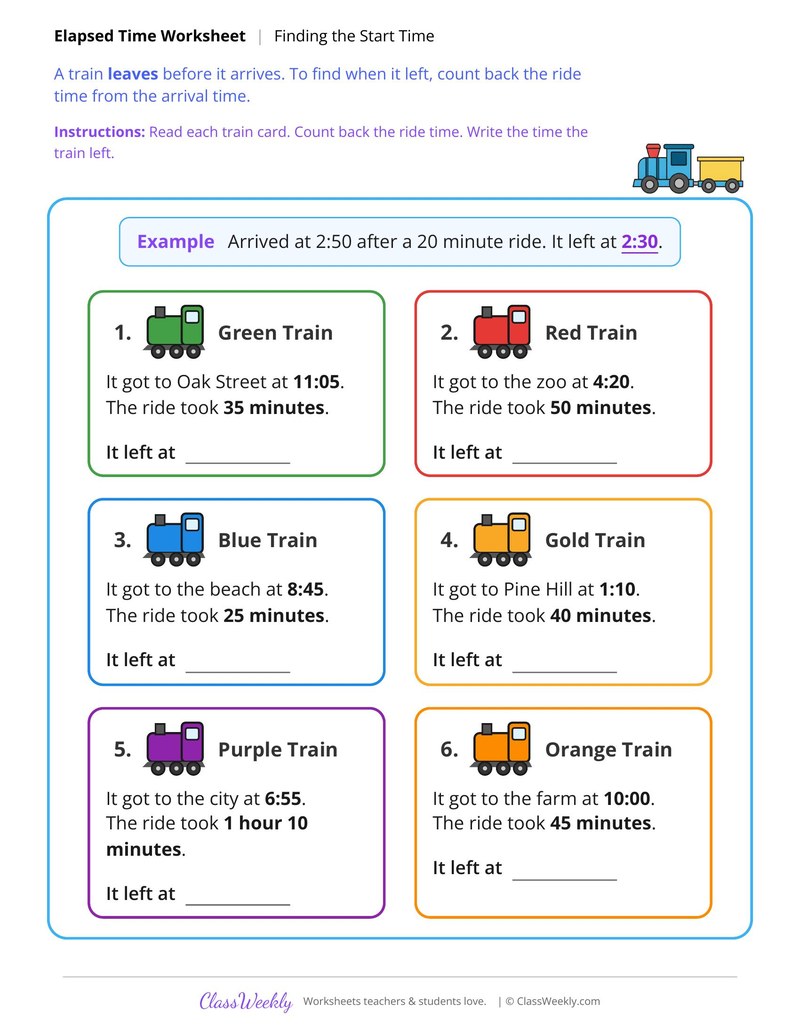
To find the end time, start at the start time and count forward the minutes. To find the start time, start at the end time and count back. A number line that jumps to a time ending in 0 first makes both easier.
What is a two step elapsed time problem?
⌄
It has two activities in a row, like tag for 20 minutes and then the swings for 15 minutes. Children solve one part at a time, adding both times to go later or counting back both to go earlier.
Do these worksheets have answer keys?
⌄
Most sheets come with an answer key.
Ratings & Reviews
No reviews yet. Be the first to share what you think.
Reviews are for ClassWeekly members.
Make a Request
Spotted something to fix, or want a worksheet we don't have yet? Tell us and we'll make it.
Worksheet Details
| Grade | 3rd Grade |
| Subject | Math |
| Topic | Telling Time |
| Standard | 3.MD.A.1 |
| Pages | 1 page |
| Difficulty | Medium |
Learn More
What is ClassWeekly?
ClassWeekly offers free worksheets and printable learning resources for kids, from preschool up. All worksheets are aligned to Common Core, NGSS, and C3 Framework standards and designed by educators. We also have free online learning games for thousands of skills, and kids' answers turn into a progress report for the grown-up. Start a free 30-day trial to download the worksheets.