Look Inside the Animal, X-Ray Pictures
Written by Adi Ackerman, Head Teacher
"Look Inside the Animal, X-Ray Pictures" is written for 3rd Grade (Ages 8-9). If your little one is a year younger but already steady on living things, the page still works. You may just need to read the instructions out loud. And if they are older and classification of living things never quite stuck, this is a short review rather than busywork.
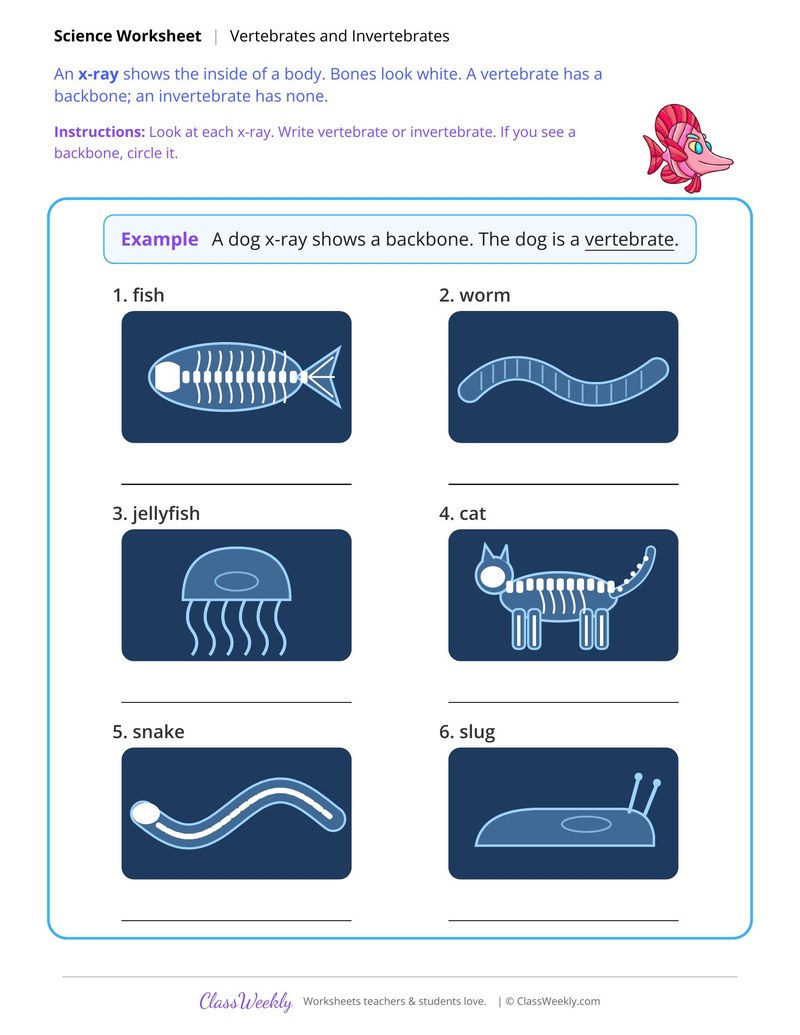
3rd grade science worksheet: look at x-rays of a fish, a jellyfish and a snake and write vertebrate or invertebrate. Answer key included. Part of our classification of living things collection.
How do I use this worksheet?
Before reading, have your child list the traits of a pet or a bird outside, like fur or feathers. After each page, ask which trait decided the group. Check with the answer key.
What students will practice
- Students will learn that bones look white on an x-ray.
- Students will look at x-rays of a fish, a worm, a jellyfish, a cat, a snake and a slug.
- Students will write vertebrate or invertebrate and circle any backbone they see.
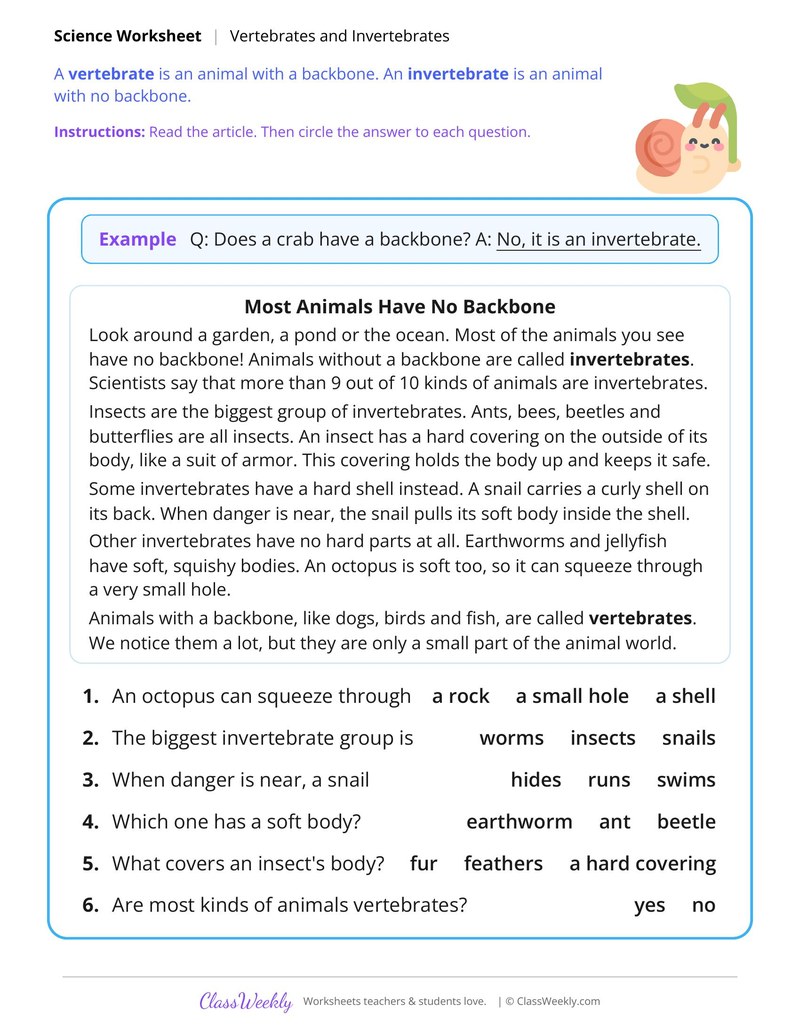
Curriculum Links
Find this in the curriculum
Browse the grade, subject, and topic this belongs to.
FAQ
How do I use this classification of living things worksheet?
⌄
Before reading, have your child list the traits of a pet or a bird outside, like fur or feathers. After each page, ask which trait decided the group. Check with the answer key.
What does this worksheet teach?
⌄
Look at x-rays of a fish, a jellyfish and a snake and write vertebrate or invertebrate. The directions on the page read: Look at each x-ray. Write vertebrate or invertebrate. If you see a backbone, circle it. The page opens with a worked example, and an answer key is included.
Can I use this classification of living things worksheet for homeschool or classroom?
⌄
Yes, both. We made it for 3rd Grade living things, and the page works the same whether it lands on a kitchen table or a center rotation. At home, most families go through it together and talk the answers out loud, and that talking is where most of the learning happens with classification of living things. In class it runs well as independent work while you pull a small group. Print one copy or thirty, whichever the day needs.
How do scientists classify animals?
⌄
They sort animals into groups by the traits they share. Mammals have hair or fur and feed their babies milk, birds have feathers, beaks and wings, and crustaceans like lobsters have a hard outer shell, jointed legs and two pairs of antennae.
Why is a whale a mammal and not a fish?
⌄
A whale breathes air through a blowhole instead of gills, its babies are born live and drink their mother's milk, and it has a few stiff hairs. Its tail also moves up and down, while a fish's tail moves from side to side.
Which standard covers classifying animals in 3rd grade?
⌄
NGSS has no 3rd grade performance expectation for classifying animals, so these pages do not claim one. They practice reading a passage for evidence and sorting by traits, which leads into the 3rd grade work on inherited traits.
Is there an answer key for each worksheet?
⌄
Yes. Every classification sheet has an answer key.
Ratings & Reviews
No reviews yet. Be the first to share what you think.
Reviews are for ClassWeekly members.
Make a Request
Spotted something to fix, or want a worksheet we don't have yet? Tell us and we'll make it.
Worksheet Details
| Grade | 3rd Grade |
| Subject | Science |
| Topic | Living Things |
| Pages | 1 page |
| Difficulty | Medium |
Learn More
What is ClassWeekly?
ClassWeekly offers free worksheets and printable learning resources for kids, from preschool up. All worksheets are aligned to Common Core, NGSS, and C3 Framework standards and designed by educators. We also have free online learning games for thousands of skills, and kids' answers turn into a progress report for the grown-up. Start a free 30-day trial to download the worksheets.