Reading, The Cookie Swap
Written by Adi Ackerman, Head Teacher
"Reading, The Cookie Swap - Christmas" is written for 1st Grade (Ages 6-7), and it covers Common Core RL.1.1. If your little one is a year younger but already steady here, the page still works. You may just need to read the instructions out loud. And if they are older and reading comprehension never quite stuck, this is a short review rather than busywork.
2 pages in this set
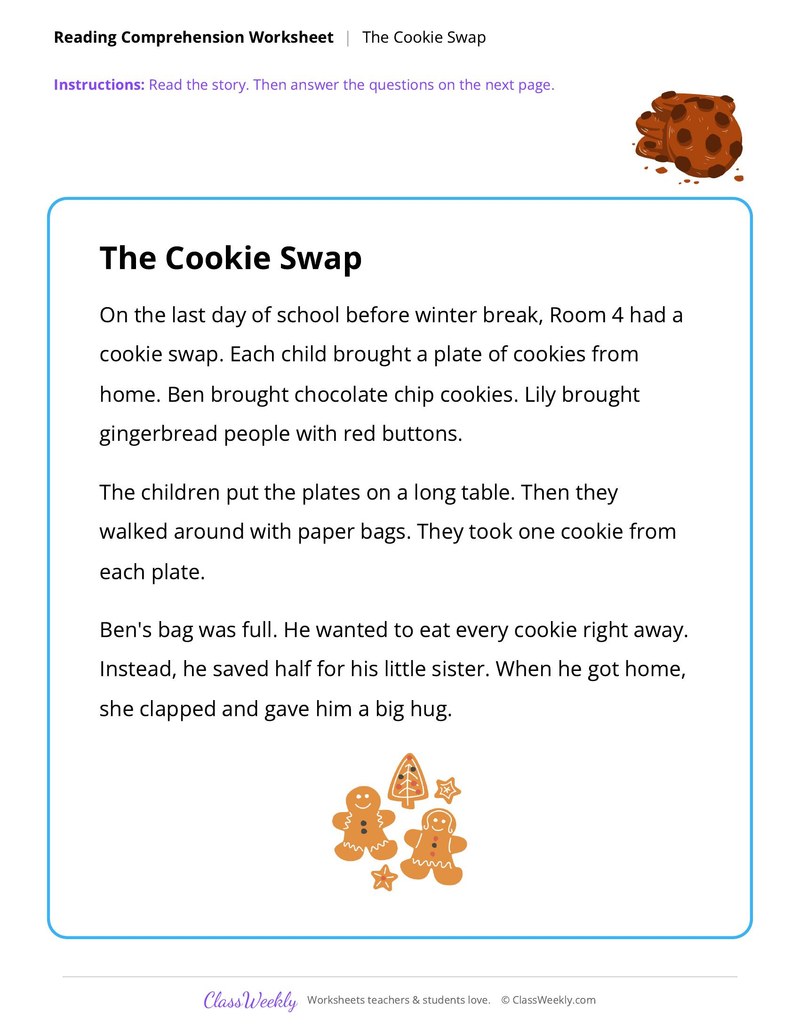
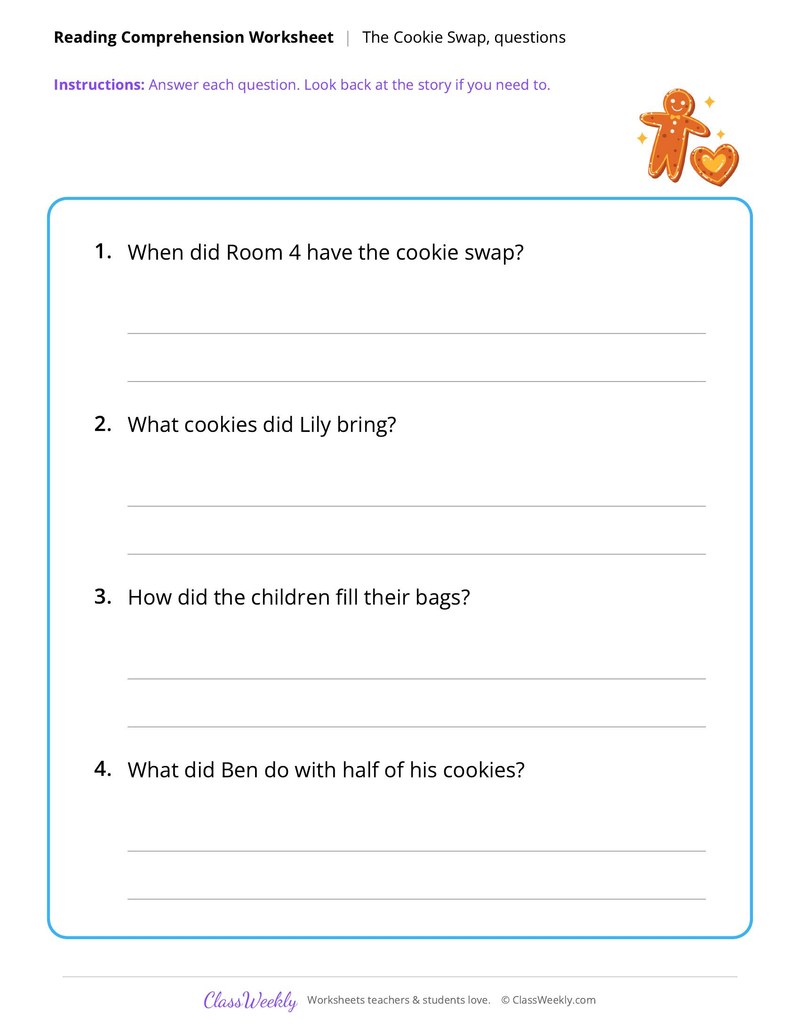
1st grade reading worksheet: The Cookie Swap. Read the story. Then answer the questions on the next page. Part of the Christmas worksheet pack. Part of our reading comprehension collection. Aligned to Common Core standards.
How do I use this worksheet?
Begin with a shared reading or oral warm-up that highlights reading comprehension so students hear and see the skill in context before practicing it independently. Have students work through the first item together as a class, then finish the rest independently or with a partner, especially for phonics-based tasks where saying an answer aloud first helps. After completing the worksheet, use one or two examples from the page to start a discussion: "Where else have you seen this in your reading?" These reading comprehension worksheets are ideal for use during small group reading time, as independent center work, or as a homework activity.
What students will practice
- Students will identify and apply reading comprehension knowledge to decode and comprehend grade-level text.
- Students will recognize patterns and rules related to reading comprehension in spoken and written language.
- Students will build fluency and confidence with reading comprehension through guided and independent decoding.

Curriculum Links
Common Core State Standards
Reading: Literature · 1st Grade
Standard: Ask and answer questions about key details in a text.
View all RL.1.1 worksheets →Find this in the curriculum
Browse the grade, subject, and topic this belongs to.
FAQ
How do I use this reading comprehension worksheet?
⌄
Begin with a shared reading or oral warm-up that highlights reading comprehension so students hear and see the skill in context before practicing it independently. Have students work through the first item together as a class, then finish the rest independently or with a partner, especially for phonics-based tasks where saying an answer aloud first helps. After completing the worksheet, use one or two examples from the page to start a discussion: "Where else have you seen this in your reading?" These reading comprehension worksheets are ideal for use during small group reading time, as independent center work, or as a homework activity.
What does this worksheet teach?
⌄
These reading comprehension worksheets for 1st grade give students focused practice with one of the key skills in early literacy. Students read, identify, and respond to reading comprehension through a variety of activities designed for their grade level. Our reading comprehension worksheets build both decoding skills and reading comprehension, helping students connect what they practice on paper to the books they read every day. Regular practice with reading comprehension strengthens the reading skills that 1st grade students need to become confident, independent readers.
Can I use this reading comprehension worksheet for homeschool or classroom?
⌄
Yes, both. We made it for 1st Grade reading comprehension, and the page works the same whether it lands on a kitchen table or a center rotation. At home, most families go through it together and talk the answers out loud, and that talking is where most of the learning happens. In class it runs well as independent work while you pull a small group. Print one copy or thirty, whichever the day needs.
What does reading comprehension mean for first graders?
⌄
Reading comprehension at this level means a child can retell a story with key details, identify the main topic of a passage, and answer who, what, where, and why questions. It goes beyond simply decoding words - the child must understand the meaning of what they read.
When do children start developing strong comprehension skills?
⌄
Basic comprehension skills emerge in kindergarten through read-alouds, and first grade is when children begin applying them independently to simple texts. Teachers typically introduce comprehension strategies like previewing pictures and making predictions early in the school year.
How can I use comprehension worksheets at home?
⌄
Have your child read the passage aloud, then answer the questions in their own words before writing. Discuss any wrong answers together rather than simply correcting them - this builds deeper understanding and vocabulary.
Which Common Core standards address first-grade reading comprehension?
⌄
Common Core standards RI.1.1 and RL.1.1 require first graders to ask and answer questions about key details in both literary and informational texts, forming the core of comprehension work at this grade level.
What reading level should a first grader achieve by year's end?
⌄
By the end of first grade, most students should read at Guided Reading level I or J (Fountas and Pinnell), which corresponds to early chapter books and longer picture books with more complex sentences. CCSS RF.1.4 expects students to read grade-level text with purpose, understanding, accuracy, and fluency. A fluency benchmark of 40 to 60 words correct per minute is typical by spring of first grade. Worksheets with short passages followed by comprehension questions help assess whether children are not only reading the words but understanding the content. Children who fall significantly below these benchmarks may benefit from targeted intervention. Regular progress monitoring through comprehension worksheets helps teachers and parents identify struggling readers before the gap widens in second grade.
How can I improve my first grader's reading comprehension at home?
⌄
Read together daily for 15 to 20 minutes, choosing books slightly above your child's independent reading level (you read the hard parts, they read the easier parts). Pause every few pages to ask questions: "What just happened?" "What do you think will happen next?" "How did that character feel?" After reading, have your child retell the story in their own words. Worksheets with short reading passages and comprehension questions provide structured practice that complements at-home reading. Building vocabulary through conversation and varied reading material is equally important. Research shows that children whose parents engage in dialogic reading (interactive reading with questions and discussion) show significantly greater comprehension gains than children who are simply read to passively.
What types of reading comprehension worksheets are most effective for first graders?
⌄
The most effective first-grade comprehension worksheets include a passage at the appropriate reading level (Guided Reading D through J), a mix of literal and inferential questions, space for written or drawn responses, and text evidence prompts ("How do you know?"). Passages should be 50 to 150 words, covering both fiction and nonfiction topics. Worksheets that include a vocabulary preview (defining two or three key words before the passage) improve comprehension outcomes. Avoid worksheets that only test recall of details without asking children to think critically. Including at least one question that asks children to connect the text to their own experience builds engagement. Passages about high-interest topics (animals, space, sports, friendships) motivate reluctant readers to engage with the comprehension practice.
Ratings & Reviews
No reviews yet. Be the first to share what you think.
Reviews are for ClassWeekly members.
Make a Request
Spotted something to fix, or want a worksheet we don't have yet? Tell us and we'll make it.
Worksheet Details
| Grade | 1st Grade |
| Subject | Reading |
| Topic | Reading Comprehension |
| Standard | RL.1.1 |
| Pages | 1 page |
| Difficulty | Medium |
Learn More
What is ClassWeekly?
ClassWeekly offers free worksheets and printable learning resources for kids in preschool to grade 5. All worksheets are aligned to Common Core, NGSS, and C3 Framework standards and designed by educators. Become a member to access the full library and download unlimited PDFs.