
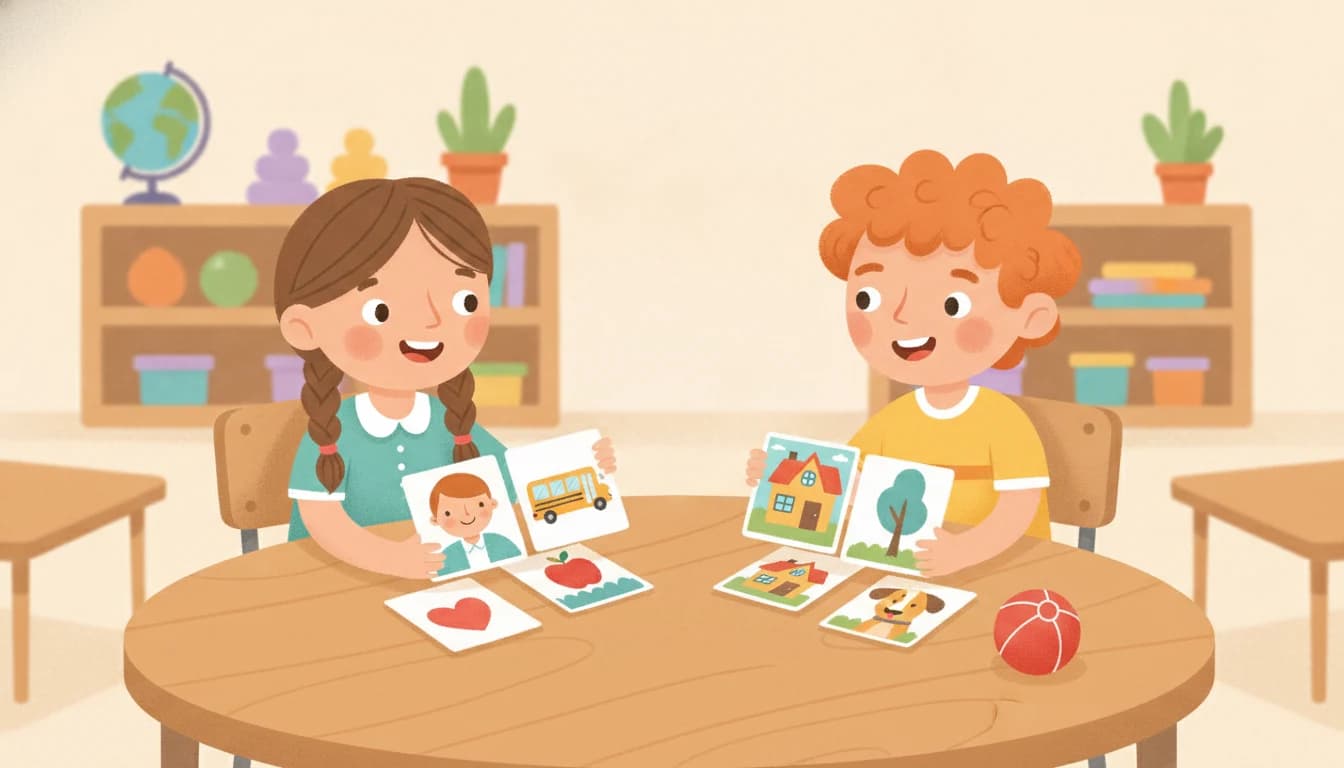
Nouns for Kids: Types of Nouns With 100 Examples
Get 30 days of free worksheet downloads
Key Takeaways
- A noun is a word that names a person, place, thing or idea. Teacher, park, pencil and kindness are all nouns.
- There are 7 types students meet in grades 1-3: common, proper, concrete, abstract, collective, plural and possessive. One noun can belong to several types at once.
- Proper nouns name one specific person, place or thing and always start with a capital letter: Maria, Texas, Lincoln Elementary.
- Plurals and possessives cause the most errors. Plurals never need an apostrophe (apples), while possessives always do (the apple's color).
- Short noun hunts around the room, in a read-aloud or on the playground give students far more practice than a single long list.
A noun is a word that names a person, place, thing or idea. "Teacher," "park," "pencil" and "kindness" are all nouns.
Nouns are usually the first part of speech students learn, and for good reason: nearly every sentence has at least one. By 2nd grade, your students are sorting nouns into types, fixing tricky plurals and learning that a "flock" and a "herd" are nouns too. Our 2nd grade nouns worksheets cover each of those skills, and below you'll find the 7 types, charts for each one, and 100 examples to pull from.
What Is a Noun?
The easiest way to explain it: a noun is a naming word. Everything around you has a name, and that name is a noun.
| Nouns name... | Examples |
|---|---|
| A person | teacher, firefighter, grandma, Mr. Ortiz |
| A place | school, kitchen, beach, Ohio |
| A thing | pencil, bike, sandwich, rainbow |
| An idea or feeling | kindness, fear, freedom, friendship |
Animals count as nouns too. Some teachers make them their own group ("person, place, thing or animal"), and that's a fine way to start with 1st graders.
Quick tip: if you can put a, an or the in front of a word, it's often a noun. "The backpack" works. "The jump" works too, which is a good reminder that some words can be nouns or verbs depending on the sentence.
Free Nouns Worksheets for 2nd Grade


The 7 Types of Nouns
One noun can belong to more than one type. "Puppies" is a common noun, a concrete noun AND a plural noun. That overlap confuses your students at first, so it helps to teach the types one at a time.
1. Common Nouns
A common noun names any person, place or thing. It starts with a lowercase letter unless it begins a sentence.
| Common noun | Used in a sentence |
|---|---|
| girl | The girl kicked the ball. |
| city | We drove to the city. |
| dog | My dog snores. |
2. Proper Nouns
A proper noun names one specific person, place or thing. It always starts with a capital letter.
| Common noun | Proper noun |
|---|---|
| girl | Emma |
| city | Denver |
| school | Lincoln Elementary |
| day | Tuesday |
3. Concrete Nouns
A concrete noun names something you can see, hear, touch, taste or smell.
| Concrete noun | Sense you use |
|---|---|
| apple | taste, see, touch |
| drum | hear, see |
| flower | smell, see |
4. Abstract Nouns
An abstract noun names an idea, feeling or quality you can't touch. These are the hardest type for younger students, so save them for 3rd grade.
| Abstract noun | Used in a sentence |
|---|---|
| courage | It took courage to jump off the high dive. |
| honesty | Thank you for your honesty. |
| patience | Waiting in line takes patience. |
5. Collective Nouns
A collective noun names a group as one unit.
| Collective noun | Group of... |
|---|---|
| a flock | birds |
| a herd | cows |
| a school | fish |
| a team | players |
6. Plural Nouns
A plural noun names more than one. Most just add -s, but English has a few rules students need:
| Rule | Singular | Plural |
|---|---|---|
| Most nouns: add -s | cat, book | cats, books |
| Ends in s, x, z, ch, sh: add -es | bus, box, lunch, dish | buses, boxes, lunches, dishes |
| Consonant + y: change y to i, add -es | baby, city | babies, cities |
| Vowel + y: add -s | toy, day | toys, days |
| Many f or fe endings: change to -ves | leaf, knife | leaves, knives |
| Irregular: new word | child, mouse, tooth, foot | children, mice, teeth, feet |
| Same both ways | sheep, deer, fish | sheep, deer, fish |
7. Possessive Nouns
A possessive noun shows that something belongs to someone. It uses an apostrophe.
| Rule | Example |
|---|---|
| One owner: add 's | the dog's bone |
| More than one owner, ending in s: add ' | the dogs' bowls |
| Irregular plural owner: add 's | the children's books |
100 Noun Examples by Type
Use these for sorting games, word walls or a quick "is it a noun?" warm-up.
People (15): teacher, student, mom, dad, grandma, baby, doctor, nurse, firefighter, farmer, chef, pilot, coach, neighbor, friend
Places (15): school, library, park, kitchen, beach, farm, zoo, hospital, playground, city, forest, store, museum, bedroom, airport
Things (15): pencil, crayon, backpack, book, chair, ball, bike, lunchbox, clock, shoe, kite, cup, computer, umbrella, sandwich
Animals (10): dog, cat, horse, frog, rabbit, elephant, turtle, butterfly, shark, owl
Ideas and feelings, or abstract nouns (15): love, kindness, courage, fear, joy, honesty, friendship, freedom, patience, hope, anger, curiosity, peace, fun, luck
Proper nouns (15): Maria, Dr. Patel, Texas, Canada, Chicago, Mississippi River, Monday, July, Thanksgiving, Lincoln Elementary, Pacific Ocean, Mount Everest, Abraham Lincoln, Earth, Main Street
Collective nouns (15): a pack of wolves, a pride of lions, a swarm of bees, a pod of whales, a litter of puppies, a colony of ants, a gaggle of geese, a bunch of grapes, a deck of cards, a bouquet of flowers, a band of musicians, a choir of singers, a fleet of ships, a crowd of people, a class of students
That's 100. Not sure your students will love every one (a gaggle of geese gets giggles every time, a fleet of ships less so), but the mix gives them practice with every type.
How to Teach Nouns: 5 Noun Hunt Steps
Teach the steps in this order, one or two a week, so your students are looking for nouns instead of just reading about them.
- Classroom noun hunt. Give each student a clipboard and 5 minutes to list every noun they can see. Then sort the lists into person, place, thing.
- Read-aloud freeze. During a picture book, say "Freeze!" and ask for the nouns on that page. It's quick, and it connects grammar to real reading.
- Proper noun upgrade. Write common nouns on the board (girl, city, dog). Students "upgrade" each one to a proper noun with a capital letter (Ava, Miami, Rocket).
- Plural relay. Teams race to write the plural of each word you call out. Throw in a few irregulars (mouse, foot, sheep) to keep it interesting.
- Collective noun match. Write groups on one set of cards (pack, swarm, herd) and animals on another. Students find the pairs.
Common Mistakes With Nouns
Using an apostrophe for plurals. "Apple's for sale" is one of the most common errors anywhere, not just in 2nd grade. Teach the rule plainly: plurals never get an apostrophe. Possessives always do.
Forgetting capitals on proper nouns. Students write "my dog max went to florida." A quick check helps: "Is this the name of ONE special person, place or thing? Then it gets a capital."
Adding -s to irregular plurals. "Mouses," "childs" and "tooths" show up a lot. A small anchor chart of irregular plurals on the wall saves you from correcting them one paper at a time.
Thinking nouns are only objects. Students happily circle "dog" and "chair" and skip "Grandma" or "happiness." Remind them of all four groups: person, place, thing, idea.
Missing that one word can be two parts of speech. "We play in the park" (noun) versus "Dad will park the car" (verb). The job a word does in the sentence decides what it is.
Practice Nouns by Grade
Worksheets give students the independent practice that makes all of this stick. Start with the grade that fits:
- 1st grade nouns worksheets: identifying nouns, common and proper nouns, plurals and possessive nouns
- 2nd grade nouns worksheets: common and proper nouns, collective nouns, plurals ending in y and irregular plurals
- 3rd grade nouns worksheets: concrete vs abstract nouns, collective nouns and irregular plurals
Teaching a younger group? Our grade guides go deeper on the first steps: how to teach nouns to kindergartners and teaching nouns and verbs to first graders.
FAQ
What is a noun in simple words? A noun is a naming word. It names a person (teacher), a place (park), a thing (pencil) or an idea (kindness). If you can put "a", "an" or "the" in front of a word, it is often a noun.
What are the 7 types of nouns? The 7 types of nouns taught in elementary school are common nouns (city), proper nouns (Chicago), concrete nouns (apple), abstract nouns (love), collective nouns (team), plural nouns (dogs) and possessive nouns (the dog's bone).
What are 10 examples of nouns? Ten examples of nouns are teacher, mom, school, park, pencil, backpack, dog, Florida, team and happiness. They name people, places, things, animals and ideas.
What is the difference between a common noun and a proper noun? A common noun names any person, place or thing, like girl, city or dog. A proper noun names one specific person, place or thing, like Emma, Denver or Biscuit, and it always starts with a capital letter.
Is love a noun? Yes, love can be an abstract noun when it names a feeling: "Her love for animals is clear." It can also be a verb when it shows an action: "I love animals." How a word is used in the sentence decides its part of speech.
Keep Reading
Nouns are the building blocks of every sentence your students will ever write. Give them a few weeks of hunting, sorting and upgrading, and you'll hear "Wait, that's a proper noun!" during read-aloud. That's the moment you know it landed 🙌

Adi Ackerman
Head Teacher
Adi is the Head Teacher at ClassWeekly, with years of experience teaching elementary students. She designs our curriculum-aligned worksheets and writes practical guides for teachers and parents.
Keep Reading
Ready to download? Try ClassWeekly free for 30 days.
Unlimited worksheets for PreK through 5th grade. Cancel anytime.