
Ecosystems for Kids: What They Are + 10 Examples
Get 30 days of free worksheet downloads
Key Takeaways
- An ecosystem is all the living things in one place (plants, animals, fungi, bacteria) plus the nonliving things around them (sunlight, water, air, soil, rocks), all working together.
- Every ecosystem has three jobs: producers make food from sunlight, consumers eat other living things, and decomposers break down dead material and return nutrients to the soil.
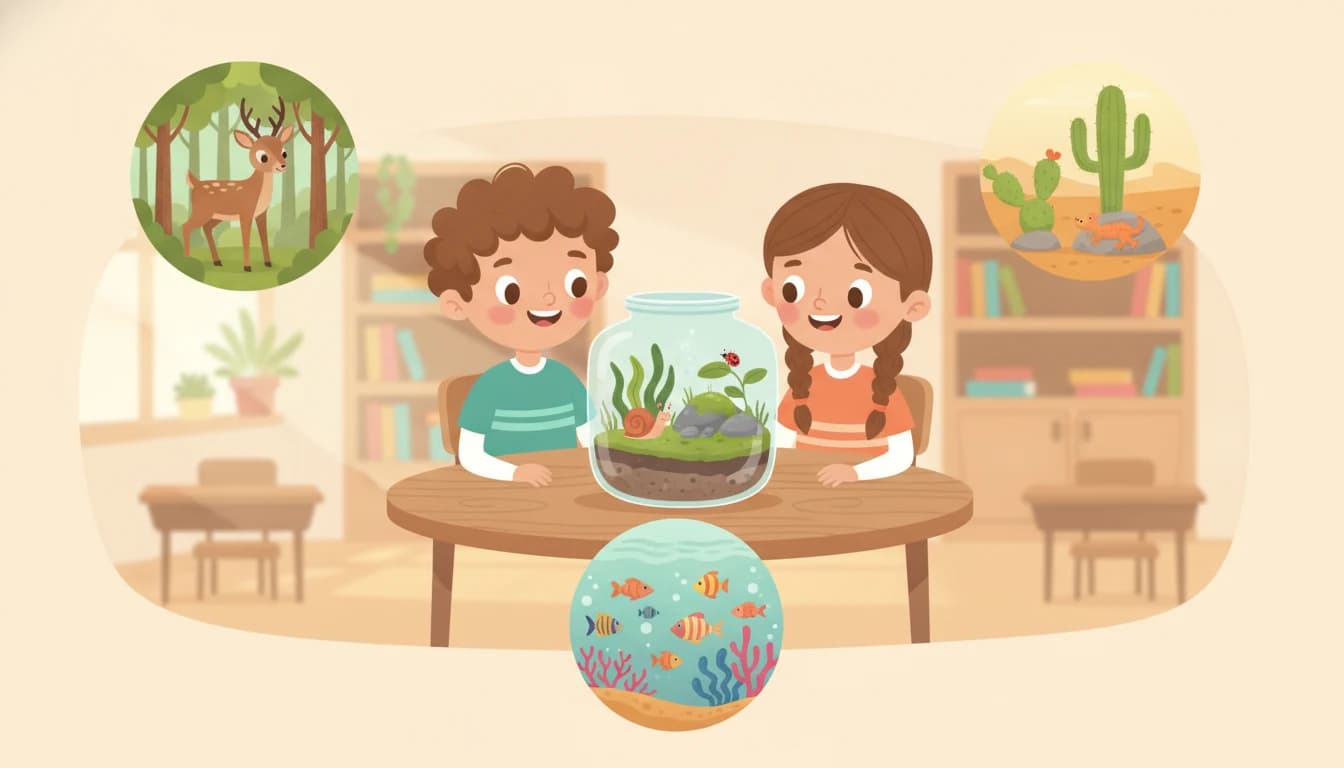
- Ecosystems come in every size. An ocean is an ecosystem, and so is a pond, a rotting log or a sealed jar on a classroom windowsill.
- In a food chain, the arrow points from the living thing that gets eaten to the one that eats it. The arrow shows where the energy goes.
- A biome is a huge region with a similar climate, like a desert. One biome contains many smaller ecosystems.
An ecosystem is a place where living things (like plants and animals) and nonliving things (like water, sunlight and soil) all work together. A pond, a forest and an ocean are all ecosystems.
Your students already know more about ecosystems than they think. They know squirrels live in trees, fish need water and plants need sun. Ecosystems tie all of that together into one big idea: everything in a place depends on everything else. Our 3rd grade ecosystems worksheets turn that idea into hands-on practice, and below you'll find 10 ecosystem examples, each with a food chain, plus a mini ecosystem your class can build in a jar.
What Is an Ecosystem?
Every ecosystem has two kinds of parts.
| Living parts (biotic) | Nonliving parts (abiotic) |
|---|---|
| Plants | Sunlight |
| Animals | Water |
| Fungi, like mushrooms | Air |
| Bacteria (too small to see) | Soil and rocks |
| Temperature and weather |
The living parts can't survive without the nonliving parts. A tree needs sunlight, water and soil. A deer needs the tree for food and shade. A wolf needs the deer. Take one piece away, and the rest of the ecosystem feels it.
Here's what we tell students: an ecosystem is like a team. Every player has a job, and the team only works when everyone shows up.
Free Ecosystems Worksheets for 3rd Grade


Producers, Consumers and Decomposers
Every living thing in an ecosystem has one of three jobs.
Producers make their own food. Plants and algae use sunlight, water and air to make food in a process called photosynthesis. Grass, trees, cactus and seaweed are all producers. Almost every food chain starts with the sun shining on a producer.
Consumers eat other living things. They can't make their own food, so they get energy by eating. There are three kinds:
- Herbivores eat only plants (rabbit, deer, caterpillar).
- Carnivores eat only animals (lion, shark, hawk).
- Omnivores eat plants and animals (bear, raccoon, people).
Decomposers break down dead things. Fungi and bacteria break down fallen leaves, dead animals and waste, and they return nutrients to the soil so new plants can grow. Many elementary units add earthworms to this group. (Scientists call worms detritivores, since they eat dead material rather than break it down from the outside, but the job in the ecosystem is close enough for 3rd grade.)
Without decomposers, the forest floor would be buried in dead leaves. Your students will probably find that idea a little gross and very memorable.
10 Ecosystem Examples With Food Chains
Each example below includes one simple food chain. The arrow means "is eaten by," and it shows where the energy goes.
1. Forest
Tall trees, shady ground and lots of fallen leaves. Forests have rain throughout the year and seasons that change.
Food chain: acorns (oak tree) → squirrel → red-tailed hawk
2. Desert
Very little rain, hot days and often cold nights. Plants and animals here are experts at saving water.
Food chain: grass seeds → kangaroo rat → rattlesnake
3. Ocean
Oceans cover about 71% of Earth's surface, so this is the biggest kind of ecosystem by far. Tiny floating producers called phytoplankton feed almost everything else.
Food chain: phytoplankton → zooplankton → sardine → dolphin
4. Pond
A small body of fresh water, often shallow enough for sunlight to reach the bottom.
Food chain: algae → tadpole → bass → great blue heron
5. Arctic Tundra
Cold, windy and treeless, with ground that stays frozen most of the year. The short summer brings a burst of plants.
Food chain: lichen → caribou → gray wolf
6. Grassland (Prairie)
Wide, open land covered in grasses, with few trees. North American prairies were once home to huge herds of bison.
Food chain: grass → prairie dog → black-footed ferret
7. Tropical Rainforest
Hot, wet and green all year. Rainforests hold more kinds of plants and animals than almost anywhere else on land.
Food chain: leaves → three-toed sloth → harpy eagle
8. Coral Reef
Warm, shallow ocean water around colorful reefs built by tiny animals called coral.
Food chain: algae → parrotfish → reef shark
9. Savanna
A grassland with scattered trees, a long dry season and a rainy season. Think of the plains of Africa.
Food chain: grass → zebra → lion
10. Wetland (Swamp or Marsh)
Land that stays soaked with water, like Florida's Everglades. Wetlands filter water and protect coasts from floods.
Food chain: algae → apple snail → snail kite
Not sure which one to start with? Pick the ecosystem closest to your school. Students connect fastest to a place they can actually visit, even if it's just the creek behind the playground.
How to Teach Ecosystems in 4 Steps
Here's the order we like for a 2-3 week unit.
Step 1: Sort Living and Nonliving
Take your students outside with a clipboard. They list 10 things they see, then sort them into living and nonliving. Expect debates about dead leaves and acorns. Those debates are the lesson.
Step 2: Act Out the Three Jobs
Give each student a card: producer, consumer or decomposer. Call out a living thing ("mushroom!") and everyone holding the matching job stands up. It's quick, a little noisy and it sticks.
Step 3: Build Food Chains With Paper Links
Students write one living thing on each paper strip and link them into a chain, with the sun as the first link. Hang the chains by ecosystem around the room. Later, connect chains that share an animal, and your students have built a food web.
Step 4: Ask "What If?"
What if all the rabbits disappeared from a forest? What if a pond dried up? These questions are the heart of the 3rd grade standard on how living things survive when their habitat changes. Honestly, we're never sure which question will grab a class, but one always does, and the conversation takes off from there.
Build a Mini Ecosystem in a Jar
This is one of our favorite class activities, and it takes about 30 minutes to set up.
You'll need: a large clear jar with a lid, small pebbles, potting soil, a few small plants (moss and tiny ferns work well), a spray bottle of water, and activated charcoal (optional, it helps keep the jar fresh).
- Add a 1-inch layer of pebbles to the bottom. This is where extra water drains.
- Sprinkle a thin layer of charcoal on top, if you have it.
- Add 2-3 inches of soil.
- Plant the moss and ferns. Press the soil gently around the roots.
- Mist everything with water until the soil is damp, not soggy.
- Close the lid and place the jar in bright, indirect light (not direct sun).
Over the next week, students will see water droplets form on the glass, slide down and soak back into the soil. That's a tiny water cycle, and a great way to show how the nonliving parts keep the living parts alive.
Quick tip: keep an observation journal next to the jar. Students draw and write one thing they notice every few days. If you add pill bugs or a snail for a short observation, return them outside afterward.
Common Mistakes When Learning About Ecosystems
Drawing food chain arrows backward. Students often point the arrow from the hawk to the squirrel ("the hawk eats the squirrel"). The arrow should point from the squirrel to the hawk, because it shows energy moving to the eater.
Forgetting the nonliving parts. Ask students to list what's in a pond, and you'll get fish, frogs and lily pads. Remind them that water, sunlight, mud and air are part of the ecosystem too.
Thinking ecosystems have to be huge. A rotting log, a puddle or that jar on your windowsill all count.
Mixing up habitat, ecosystem and biome. A habitat is one living thing's home. An ecosystem is a whole community plus its surroundings. A biome is a giant region with a similar climate (like all the world's deserts), and it contains many ecosystems.
Leaving out decomposers. Students build food chains that end with the top predator. Ask, "What happens when the wolf dies?" That question brings fungi and bacteria back into the picture.
Practice Ecosystems With Worksheets
Worksheets help students review vocabulary and practice reading food chains on their own. Pick the grade that fits:
- 3rd grade ecosystems worksheets: needs of living things, producers and consumers, herbivores, carnivores and omnivores, food chains and adaptations
- 4th grade ecosystems worksheets: producers, consumers and decomposers, food webs, energy in food chains and ecosystem vocabulary
- 5th grade ecosystems worksheets: biomes, energy pyramids, ocean food webs, predators and prey, invasive species and how matter cycles
FAQ
What is an ecosystem in simple words? An ecosystem is a place where living things, like plants and animals, and nonliving things, like water, sunlight and soil, all work together. A pond is an ecosystem: fish, frogs and plants live there, and they all need the water, air and sunlight to survive.
What are 5 examples of ecosystems? Five examples of ecosystems are a forest, a desert, an ocean, a pond and the Arctic tundra. Each one has its own mix of plants, animals, weather, water and soil.
What are the living and nonliving parts of an ecosystem? The living parts (also called biotic factors) are plants, animals, fungi and bacteria. The nonliving parts (abiotic factors) are things like sunlight, water, air, soil, rocks and temperature. Living things depend on the nonliving parts to survive.
What is the difference between an ecosystem and a habitat? A habitat is the home of one kind of living thing, the place where it finds food, water and shelter. An ecosystem is the whole community of living things in an area plus their nonliving surroundings. A frog's habitat is the edge of a pond. The pond ecosystem includes the frog, the fish, the plants, the water and everything else.
What grade do students learn about ecosystems? Ecosystem ideas usually start in 3rd grade, when students study habitats and how living things survive in them (NGSS 3-LS4-3). In 5th grade, students model how matter moves among plants, animals, decomposers and the environment (NGSS 5-LS2-1). Many 4th grade classes cover food chains and food webs in between.
Keep Reading
- Science Experiments for Kids: Hands-On Learning at Home
- Fun Animal Facts for Kids: Learning About the Animal Kingdom
Ecosystems teach one of the biggest ideas in science: everything is connected. Once your students see that a hawk depends on an acorn, they start looking at every park, puddle and backyard a little differently 🌱

Adi Ackerman
Head Teacher
Adi is the Head Teacher at ClassWeekly, with years of experience teaching elementary students. She designs our curriculum-aligned worksheets and writes practical guides for teachers and parents.
Keep Reading
Ready to download? Try ClassWeekly free for 30 days.
Unlimited worksheets for PreK through 5th grade. Cancel anytime.