Mixed Fractions and Decimals Review
Written by Adi Ackerman, Head Teacher
"Mixed Fractions and Decimals Review" is written for 4th Grade (Ages 9-10), and it covers Common Core 4.NF.C.6. If your little one is a year younger but already steady on decimals, the page still works. You may just need to read the instructions out loud. And if they are older and decimals and fractions never quite stuck, this is a short review rather than busywork.
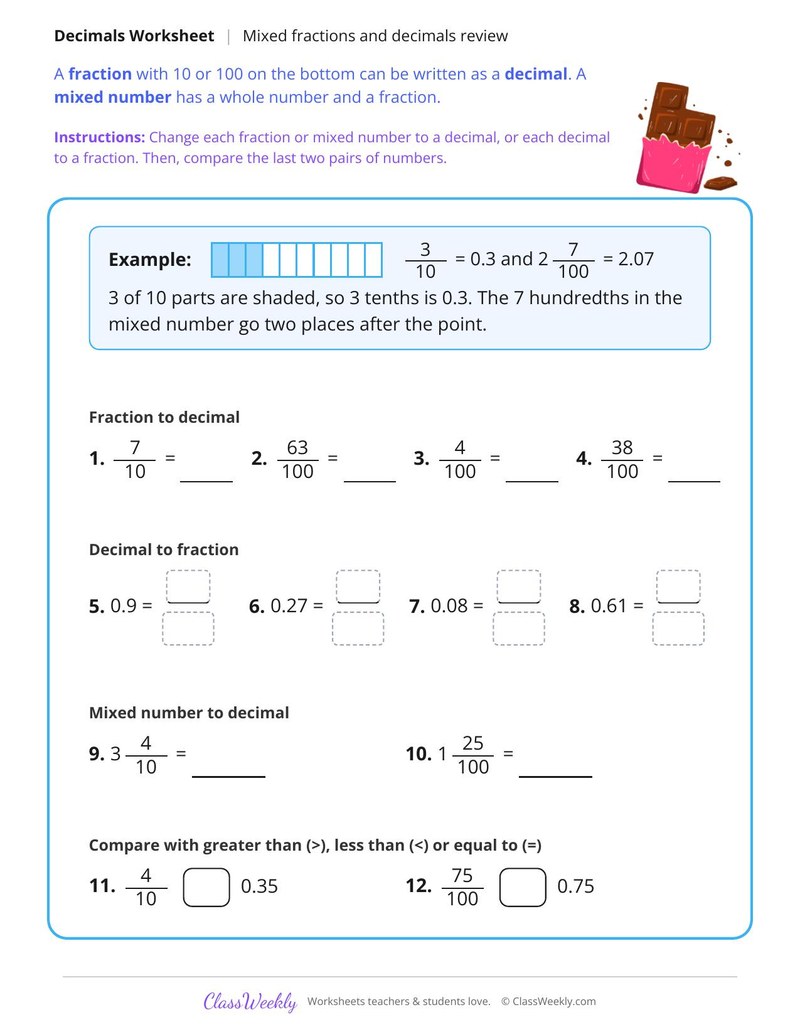
4th grade math worksheet: review fractions, mixed numbers and decimals, then compare two pairs. Answer key included. Part of our decimals and fractions collection. Aligned to Common Core standards.
How do I use this worksheet?
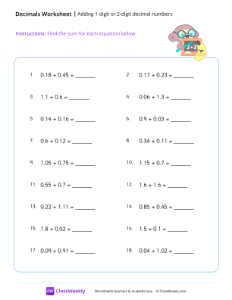
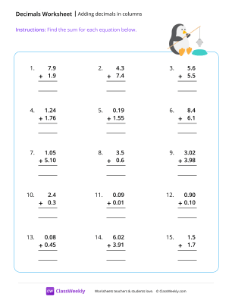
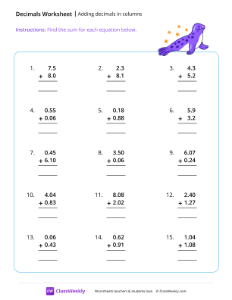
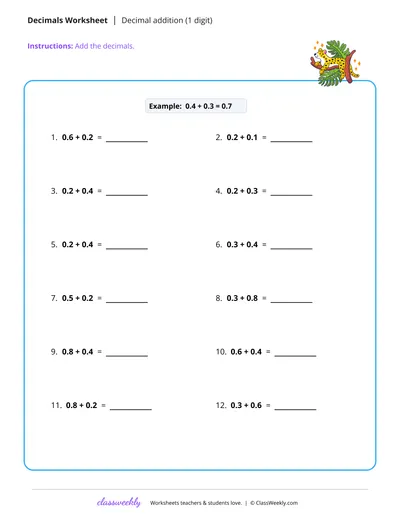
Begin with the tenths page and say each decimal as a fraction out loud: 0.7 is seven tenths. Move to hundredths once tenths feel easy, and keep a 100-square grid nearby so your child can shade a decimal before writing it. Check each page with the answer key.
What students will practice
- Students will write tenths and hundredths as decimals from pictures, grids and number lines.
- Students will change fractions with denominators 10 and 100 to decimals and back.
- Students will match decimals to equal fractions and mixed numbers.


Curriculum Links
Common Core State Standards
Number and Operations-Fractions · 4th Grade
Standard: Use decimal notation for fractions with denominators 10 or 100.
View all 4.NF.C.6 worksheets →Find this in the curriculum
Browse the grade, subject, and topic this belongs to.
FAQ
How do I use this decimals and fractions worksheet?
⌄
Begin with the tenths page and say each decimal as a fraction out loud: 0.7 is seven tenths. Move to hundredths once tenths feel easy, and keep a 100-square grid nearby so your child can shade a decimal before writing it. Check each page with the answer key.
What does this worksheet teach?
⌄
Review fractions, mixed numbers and decimals, then compare two pairs. A fraction with 10 or 100 on the bottom can be written as a decimal. A mixed number has a whole number and a fraction. The directions on the page read: Change each fraction or mixed number to a decimal, or each decimal to a fraction. Then, compare the last two pairs of numbers. The page opens with a worked example, and the answer key shows every answer.
Can I use this decimals and fractions worksheet for homeschool or classroom?
⌄
Yes, both. We made it for 4th Grade decimals, and the page works the same whether it lands on a kitchen table or a center rotation. At home, most families go through it together and talk the answers out loud, and that talking is where most of the learning happens with decimals and fractions. In class it runs well as independent work while you pull a small group. Print one copy or thirty, whichever the day needs.
How do 4th graders connect fractions and decimals?
⌄
They start with tenths and hundredths, the two fractions that have a decimal name: 7/10 is 0.7 and 7/100 is 0.07. Shaded strips and 100-square grids show that both forms name the same part of a whole, before students convert with numbers alone.
How do you write a fraction as a decimal in 4th grade?
⌄
If the bottom number is 10, write the top number one place after the point (3/10 = 0.3). If it is 100, use two places (3/100 = 0.03). A fraction like 4/5 is first rewritten with 10 on the bottom (8/10), then written as 0.8.
What is the difference between 0.3 and 0.03?
⌄
0.3 is 3 tenths and 0.03 is 3 hundredths, so 0.3 is ten times as much. Shading both on a 100-square grid (30 squares and 3 squares) is the quickest way to see it.
Which standard do these worksheets support?
⌄
They support CCSS 4.NF.C.6, using decimal notation for fractions with denominators 10 or 100, and lead into 4.NF.C.7, comparing decimals to hundredths.
What decimal skills do 4th graders learn?
⌄
4th graders learn decimals as another way to write tenths and hundredths (CCSS 4.NF.C.6). They write fractions like 7/10 and 37/100 as 0.7 and 0.37, place decimals on number lines and grids, and compare two decimals to hundredths using >, < and = (4.NF.C.7). Money and metric lengths give the decimals everyday meaning.
How do you compare decimals in 4th grade?
⌄
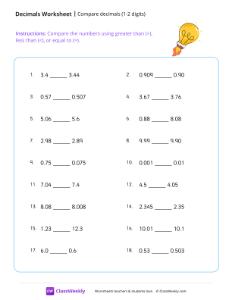
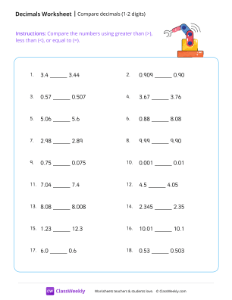
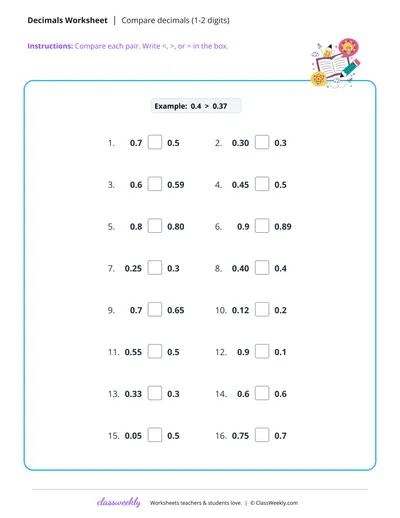
Line up the decimal points and compare place by place from the left: ones, then tenths, then hundredths. Writing 0.5 as 0.50 makes it easy to see that 0.5 is greater than 0.47.
Do 4th graders add decimals?
⌄
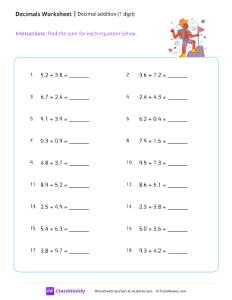
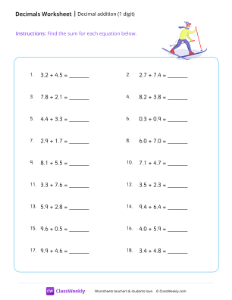
Yes, in a limited way. They add tenths and hundredths by writing tenths as hundredths (3/10 + 4/100 = 34/100), which is 4.NF.C.5. Adding and subtracting decimals with the standard method is a 5th grade skill.
Is there an answer key for each worksheet?
⌄
Yes. Every one of the 30 new decimals sheets has an answer key, and the two page sheets have a two page key.
Ratings & Reviews
No reviews yet. Be the first to share what you think.
Reviews are for ClassWeekly members.
Make a Request
Spotted something to fix, or want a worksheet we don't have yet? Tell us and we'll make it.
What is ClassWeekly?
ClassWeekly offers free worksheets and printable learning resources for kids in preschool to grade 5. All worksheets are aligned to Common Core, NGSS, and C3 Framework standards and designed by educators. Become a member to access the full library and download unlimited PDFs.