Using prepositions
Written by Adi Ackerman, Head Teacher
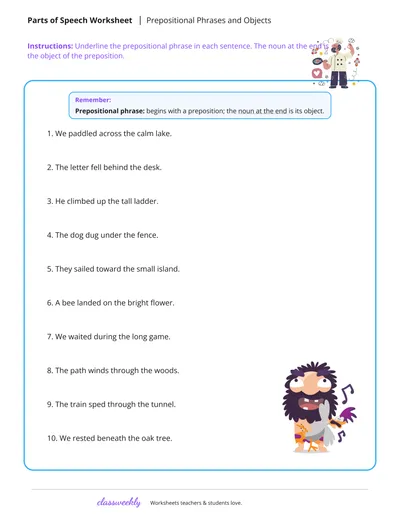
"Using prepositions - Workout" is written for 4th Grade (Ages 9-10), and it covers Common Core L.4.1.E. If your little one is a year younger but already steady here, the page still works. You may just need to read the instructions out loud. And if they are older and parts of speech never quite stuck, this is a short review rather than busywork.
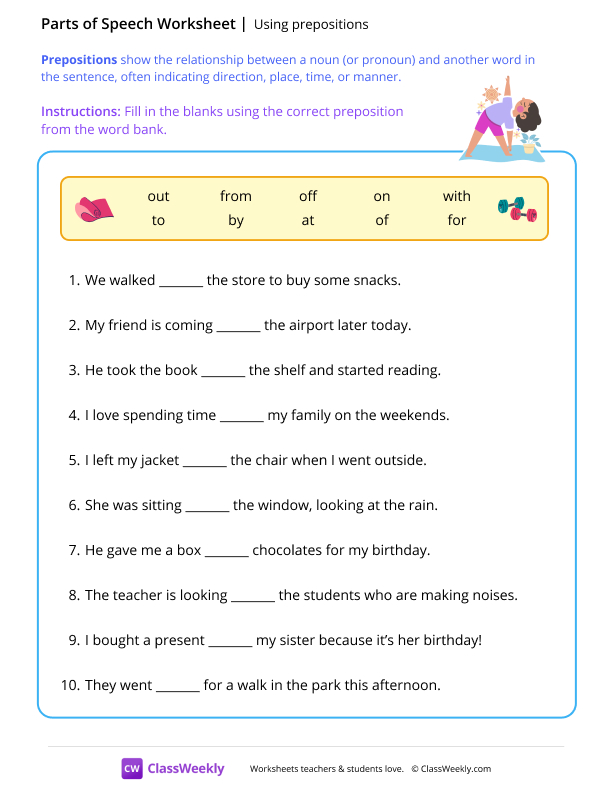
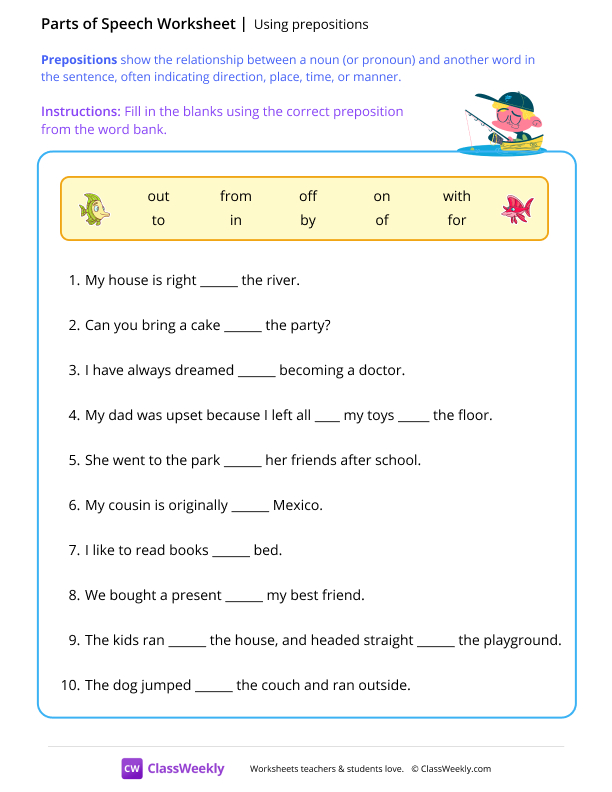
2 pages in this set
Free printable using prepositions (workout) worksheet for 4th grade students. Part of our parts of speech collection. Aligned to Common Core standards.
How do I use this worksheet?
Introduce the skill with a brief whole-class activity, such as calling out examples and asking students to give a thumbs up when they hear parts of speech in a sentence. Then let students work through it independently, since students at this age benefit more from productive struggle than from being walked through each step, referring to a class anchor chart if one is available. When reviewing answers, ask students to explain why an answer is correct rather than just confirming it. These parts of speech worksheets work well as a focused practice activity, a homework assignment, or a warm-up at the start of a language arts lesson.
What students will practice
- Students will identify and correctly use parts of speech in sentences and short passages.
- Students will distinguish parts of speech from related language concepts and apply rules consistently.
- Students will demonstrate understanding of parts of speech through independent reading and discussion, in both reading and their own writing.
Curriculum Links
Common Core State Standards
Language · 4th Grade
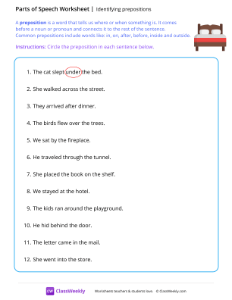
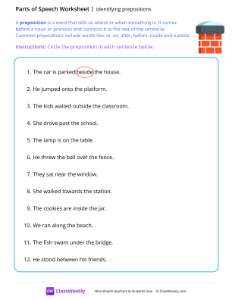
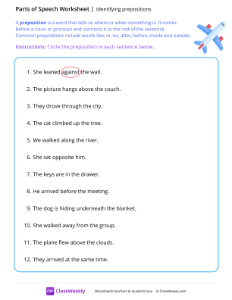
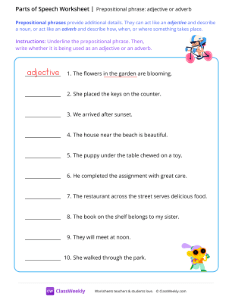
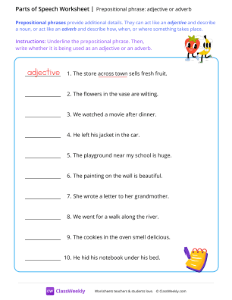
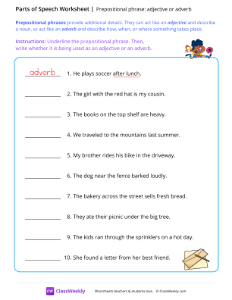
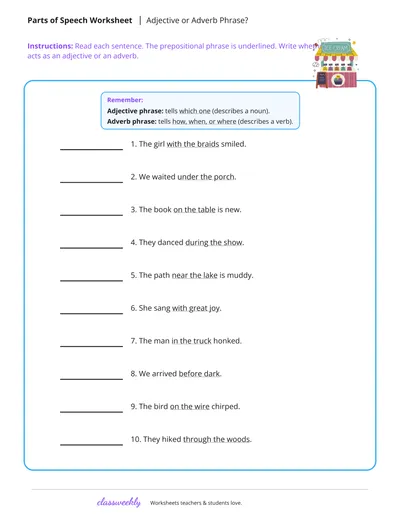
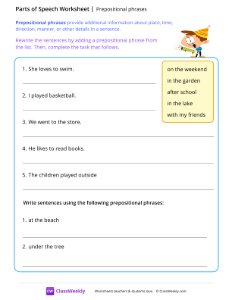
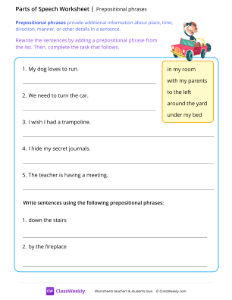
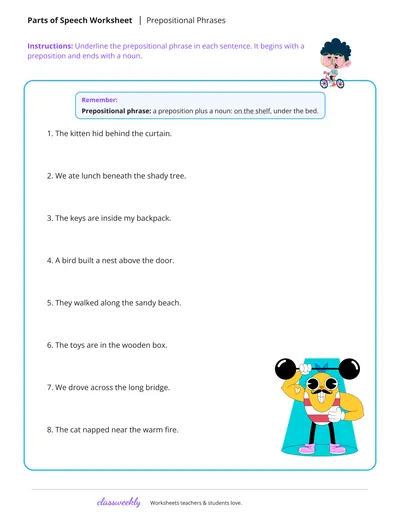
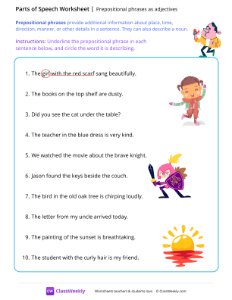
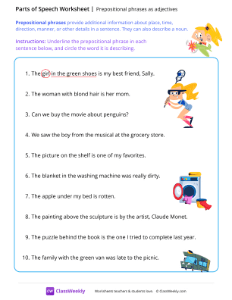
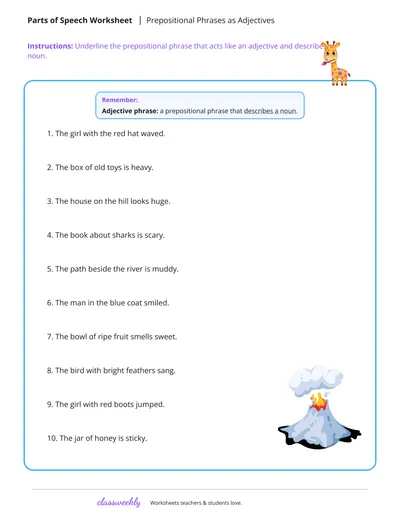
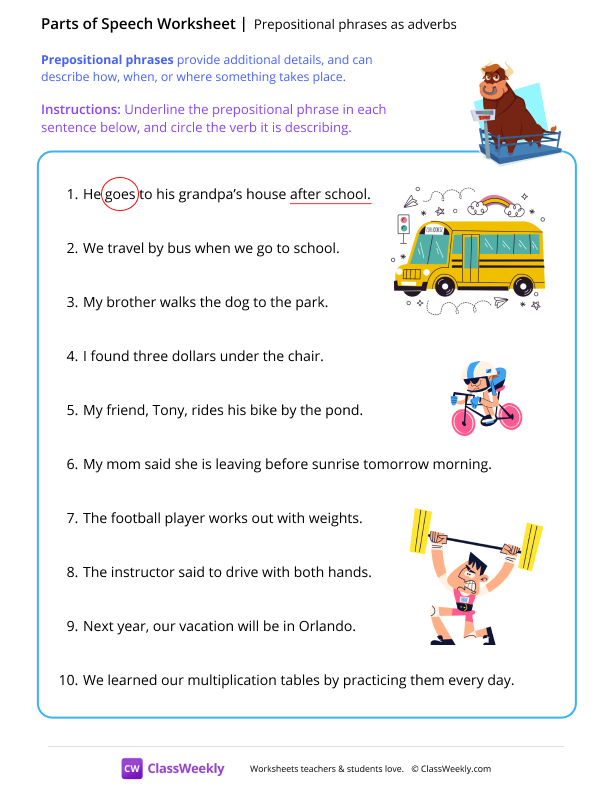
Standard: Form and use prepositional phrases.
View all L.4.1.E worksheets →Find this in the curriculum
Browse the grade, subject, and topic this belongs to.
FAQ
How do I use this parts of speech worksheet?
⌄
Introduce the skill with a brief whole-class activity, such as calling out examples and asking students to give a thumbs up when they hear parts of speech in a sentence. Then let students work through it independently, since students at this age benefit more from productive struggle than from being walked through each step, referring to a class anchor chart if one is available. When reviewing answers, ask students to explain why an answer is correct rather than just confirming it. These parts of speech worksheets work well as a focused practice activity, a homework assignment, or a warm-up at the start of a language arts lesson.
What does this worksheet teach?
⌄
These parts of speech worksheets for 4th grade give students the targeted language arts practice they need to master this important grammar skill. Students identify, sort, complete, and write using parts of speech through a variety of exercises designed to reinforce both recognition and application. Our parts of speech worksheets connect grammar practice to reading and writing so students see how parts of speech works in real language. Building a solid understanding of parts of speech in 4th grade sets students up for stronger writing and clearer communication in every subject.
Can I use this parts of speech worksheet for homeschool or classroom?
⌄
Yes, both. We made it for 4th Grade parts of speech, and the page works the same whether it lands on a kitchen table or a center rotation. At home, most families go through it together and talk the answers out loud, and that talking is where most of the learning happens. In class it runs well as independent work while you pull a small group. Print one copy or thirty, whichever the day needs.
Which parts of speech are covered in 4th grade grammar?
⌄
4th graders work with all eight parts of speech: nouns, pronouns, verbs, adjectives, adverbs, prepositions, conjunctions, and interjections - in both isolation and within sentences.
How do parts of speech worksheets improve writing quality in 4th grade?
⌄
Identifying and using specific parts of speech intentionally - like vivid verbs and precise adjectives - gives students the vocabulary to talk about craft and improve their own word choices.
What is the best way to assess parts of speech understanding in 4th grade?
⌄
Context-based exercises where students identify parts of speech in real sentences (rather than isolated word lists) give a much more accurate picture of grammatical understanding.
What are coordinating and subordinating conjunctions, and when do fourth graders learn them?
⌄
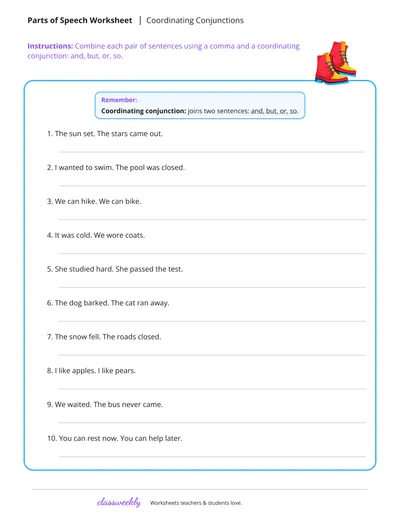
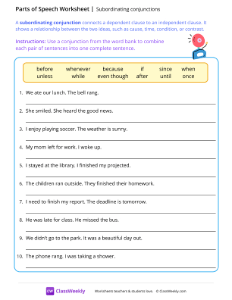
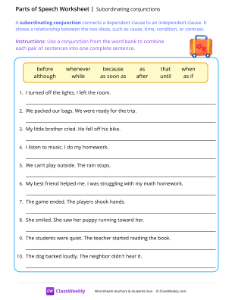
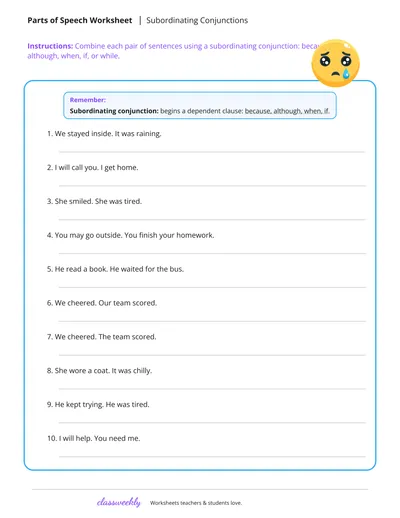
Conjunctions are joining words, and fourth graders use both kinds to connect ideas into clearer, longer sentences. Coordinating conjunctions (and, but, or, so, for, nor, yet) join two equal parts, such as two complete sentences: "I wanted to go, but it was raining." When they join two full thoughts, a comma comes before the conjunction (CCSS L.4.2c). Subordinating conjunctions (because, although, when, since, if, while, after) attach a dependent idea to a main one: "We stayed inside because it was raining." The difference matters. Coordinating conjunctions link equals, while subordinating conjunctions make one idea depend on the other and often show cause, time, or contrast. Fourth grade is where students move from writing short, choppy sentences to combining them on purpose, which is part of producing complete, varied sentences under CCSS L.4.1. Prepositional phrases fit here too, adding detail to the ideas being joined. Worksheets that ask students to combine two short sentences with the right conjunction, and to place the comma correctly, give the practice these standards expect and make the choppy-writing problem disappear.
How do conjunctions and prepositional phrases help fourth graders build longer, clearer sentences?
⌄
They are the tools that turn short, choppy writing into smooth, detailed sentences. Conjunctions join ideas: a coordinating conjunction like and or but links two equal thoughts ("The plan was risky, but it worked"), while a subordinating conjunction like because or although shows how one idea depends on another ("Although the plan was risky, it worked"). Prepositional phrases add the where, when, and how ("during the storm," "across the river"), giving readers the detail a bare sentence leaves out. Together they let a fourth grader combine "The team practiced. It rained." into "The team practiced during the storm because the coach wanted to win." Teaching them side by side helps students see that good sentences are built, not just written. Remember to place a comma before a coordinating conjunction that joins two full sentences (CCSS L.4.2c). Worksheets that give students two short sentences to combine, or a plain sentence to expand with a prepositional phrase, build this skill directly. This work supports CCSS L.4.1 and L.4.1e and shows up right away in stronger, more varied paragraphs.
What conjunction and phrase mistakes do fourth graders make, and how do worksheets help?
⌄
Three mistakes show up most. First, the comma splice: joining two complete sentences with only a comma ("It was late, we went home") instead of a comma plus a coordinating conjunction ("It was late, so we went home"), which CCSS L.4.2c addresses. Second, choosing a conjunction that does not match the meaning, like using "and" when the ideas contrast and "but" is needed, or using "because" when there is no real cause. Third, comma trouble with introductory phrases and clauses: students either forget the comma after an opening phrase ("After the game we ate") or drop one in where it does not belong. A quieter issue is overusing "and" to string everything together, which makes one long, run-on-sounding sentence. Worksheets help by having students combine two short sentences with the best conjunction, fix comma splices, and add or remove commas around phrases and clauses. Practicing one join at a time, then editing a short passage that mixes them, builds the judgment these standards (L.4.1, L.4.2c) expect. Reading the combined sentence aloud is the fastest way to hear whether the join actually makes sense.
Ratings & Reviews
No reviews yet. Be the first to share what you think.
Reviews are for ClassWeekly members.
Make a Request
Spotted something to fix, or want a worksheet we don't have yet? Tell us and we'll make it.
Worksheet Details
| Grade | 4th Grade |
| Subject | Grammar & Writing |
| Topic | Parts of Speech |
| Standard | L.4.1.E |
| Pages | 1 page |
| Difficulty | Medium |
What is ClassWeekly?
ClassWeekly offers free worksheets and printable learning resources for kids in preschool to grade 5. All worksheets are aligned to Common Core, NGSS, and C3 Framework standards and designed by educators. Become a member to access the full library and download unlimited PDFs.