Write a Strong Conclusion
Written by Adi Ackerman, Head Teacher
"Write a Strong Conclusion" is written for 4th Grade (Ages 9-10), and it covers Common Core W.4.2.E. If your little one is a year younger but already steady on writing topics, the page still works. You may just need to read the instructions out loud. And if they are older and introductions, conclusions and transitions never quite stuck, this is a short review rather than busywork.
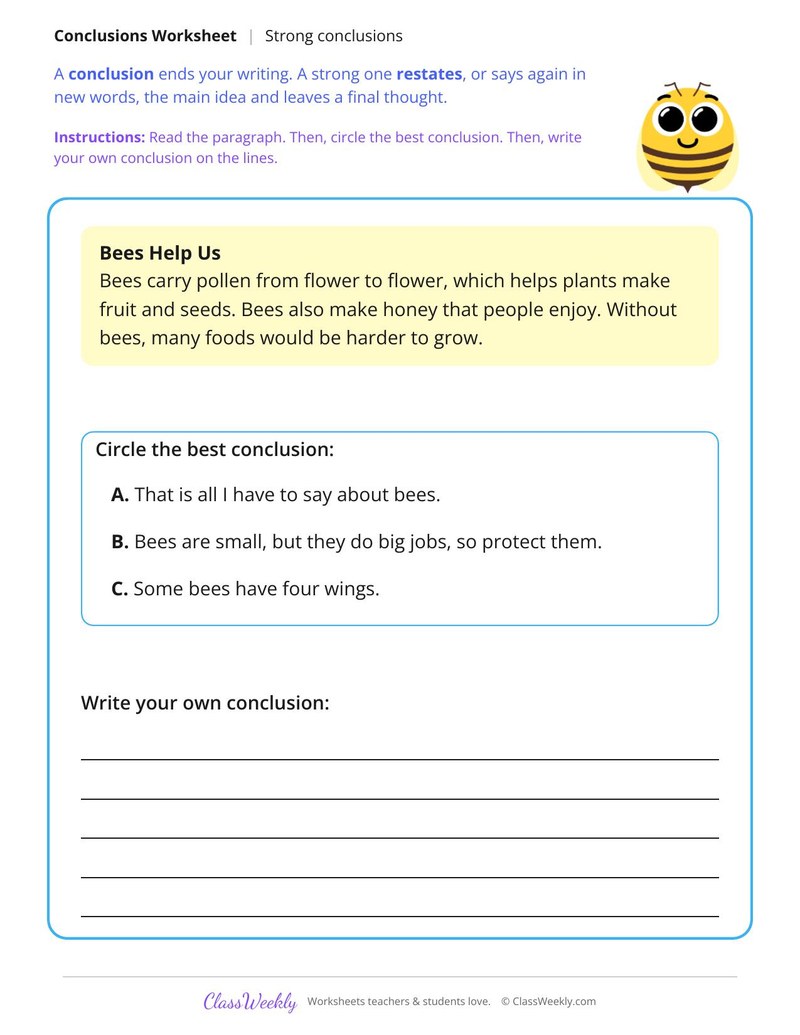
4th grade writing worksheet: read the paragraph, circle the best conclusion and write your own conclusion on the lines. Answer key included. Part of our introductions, conclusions and transitions writing topics collection. Aligned to Common Core standards.
How do I use this worksheet?
Read the strong and weak examples aloud and ask which one makes you want to read more. For transitions, have your child read each sentence with and without the phrase. Compare with the answer key afterward.
What students will practice
- Students will rewrite a weak opening as a strong introduction.
- Students will write a conclusion that restates the main idea.
- Students will use transition phrases with commas.


Curriculum Links
Common Core State Standards
Grammar & Writing · 4th Grade
Find this in the curriculum
Browse the grade, subject, and topic this belongs to.
FAQ
How do I use this introductions, conclusions and transitions worksheet?
⌄
Read the strong and weak examples aloud and ask which one makes you want to read more. For transitions, have your child read each sentence with and without the phrase. Compare with the answer key afterward.
What does this worksheet teach?
⌄
4th grade writing page: write a strong conclusion. A conclusion ends your writing. A strong one restates, or says again in new words, the main idea and leaves a final thought. The directions on the page read: Read the paragraph. Then, circle the best conclusion. Then, write your own conclusion on the lines. The answer key gives a marking guide and a model answer, since answers will vary.
Can I use this introductions, conclusions and transitions worksheet for homeschool or classroom?
⌄
Yes, both. We made it for 4th Grade writing topics, and the page works the same whether it lands on a kitchen table or a center rotation. At home, most families go through it together and talk the answers out loud, and that talking is where most of the learning happens with introductions, conclusions and transitions. In class it runs well as independent work while you pull a small group. Print one copy or thirty, whichever the day needs.
What makes a strong introduction in 4th grade?
⌄
A strong introduction starts with a hook, such as a question, a surprising fact or a short scene, and introduces the topic clearly (W.4.2.A). The introduction sheet gives weak openings to rewrite.
How do I write a strong conclusion?
⌄
A conclusion restates the main idea in new words and leaves the reader with a final thought (W.4.2.E). The conclusion sheet asks students to circle the best conclusion and then write their own.
What are transition phrases?
⌄
Transition phrases such as for example, in addition and as a result link sentences and ideas (W.4.2.C). A comma follows many of them. The transition sheet gives a bank of phrases to use once each.
Do these worksheets have answer keys?
⌄
Yes. All three sheets include a key with a marking guide and model answers.
What additional writing skills do fourth graders practice beyond essays?
⌄
Beyond narratives and essays, fourth graders build the practical writing skills that support every subject. One is restating the question, answering a prompt in a complete sentence that repeats key words from the question (a strategy often called RACE), which draws on using evidence to support a written response (CCSS W.4.9). Another is paraphrasing: reading a source and putting the idea into their own words instead of copying, part of gathering and recording information (W.4.8). Students also learn to revise and edit their work with help, strengthening a draft rather than settling for the first try (W.4.5). They practice writing for a specific task, purpose, and audience (W.4.4), noticing that a note to a friend and a report for a teacher sound different. Fourth grade also introduces real-world formats like news articles and how-to instructional writing. Worksheets that isolate each skill, one for restating a question, one for paraphrasing a short passage, one for proofreading a paragraph, give students focused practice on the writing moves they will use across reading, science, and social studies. These skills quietly power everything else students write.
How do you teach a fourth grader to restate a question and paraphrase a source in their own words?
⌄
For restating the question, teach a simple move: turn the question into the start of your answer by borrowing its key words. If the prompt asks "Why did the settlers move west?" the answer begins "The settlers moved west because," then adds the reason with evidence (CCSS W.4.9). This gives students a complete, on-topic first sentence every time and stops one-word answers. Practice by having them flip several questions into answer starters before adding any content. For paraphrasing, the rule is read it, cover it, say it your way. Have your fourth grader read a sentence or two, cover the text, and explain the idea out loud as if telling a friend, then write that version (CCSS W.4.8). Comparing their version to the original shows whether they truly reworded it or just swapped a word or two. Remind them that paraphrasing keeps the meaning but changes the wording, which also keeps them from copying. Worksheets that give a question to restate or a short passage to paraphrase, with lined space for the student's version, build both habits through repetition. These two skills show up in every subject, so early, steady practice pays off all year.
What does the editing and revising process look like in fourth grade, and how do worksheets help?
⌄
In fourth grade, editing and revising means improving a draft on purpose, with guidance, rather than turning in the first version (CCSS W.4.5). Revising works on the ideas: adding a detail, combining choppy sentences, cutting a part that wanders, or making a weak word precise. Editing works on the mechanics: capitalization, punctuation, spelling, and complete sentences. Teaching them as two separate passes helps, because trying to fix everything at once overwhelms young writers. A shared set of proofreading marks (a caret to insert, a line to delete, three underlines to capitalize) gives students a consistent way to mark changes. A useful habit is reading the draft aloud, since the ear catches run-ons and missing words the eye skips. Worksheets that present a short passage full of planted errors and ask students to mark and correct them build the editing eye, while revision worksheets that ask students to strengthen a flat paragraph build the revising muscle. Practicing on someone else's writing first is easier than fixing their own, so these worksheets are a low-pressure way in. The goal is students who treat a first draft as a starting point, which is exactly what CCSS W.4.5 expects.
What can 4th graders do with the new opinion, narrative and informative writing sheets?
⌄
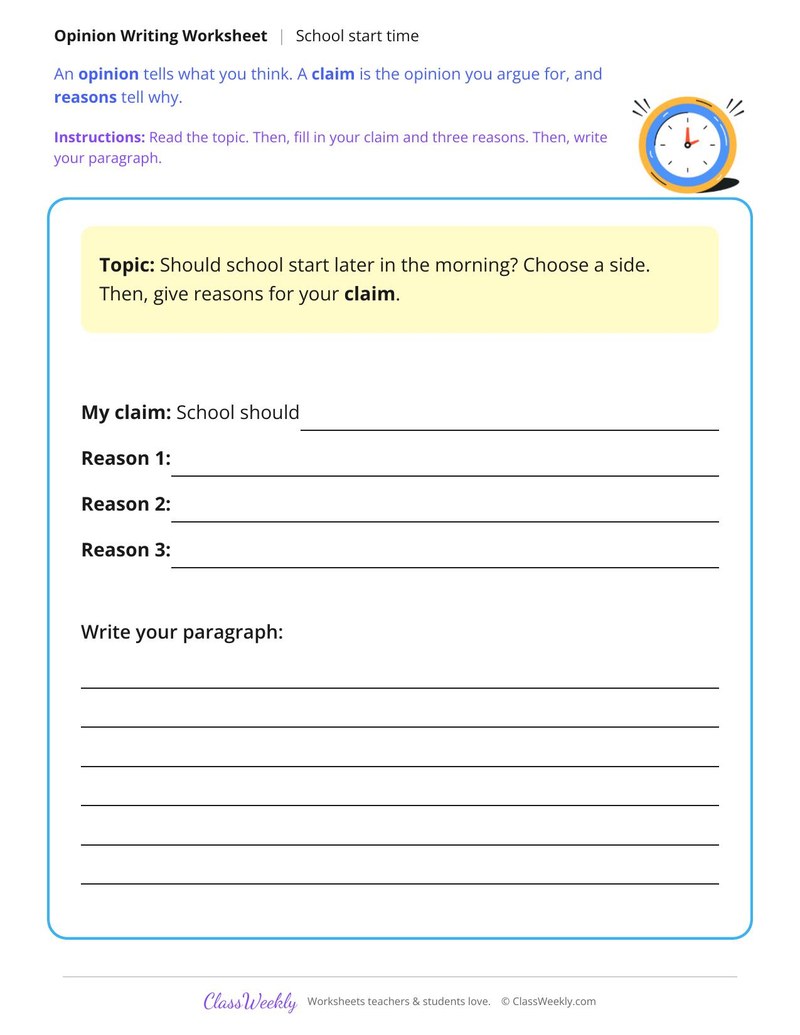
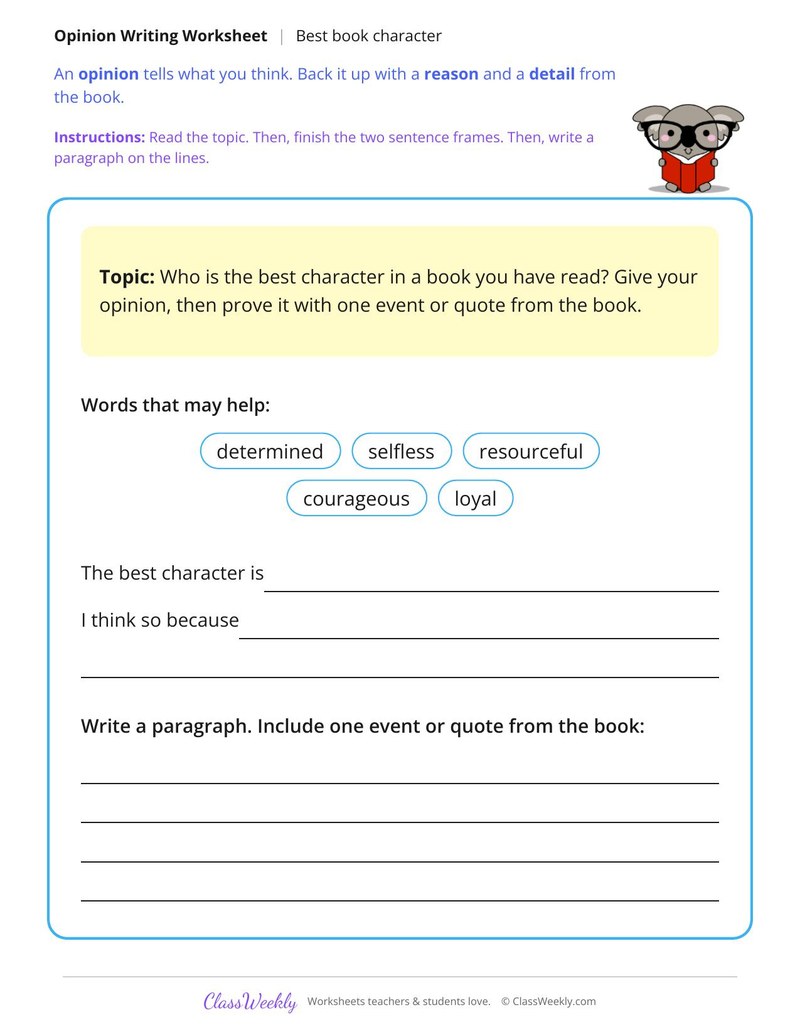
Fourth graders plan and write opinion pieces with reasons and details (CCSS W.4.1), informative pieces with facts in their own words (W.4.2) and narratives with a problem and sensory details (W.4.3), then practice introductions, conclusions, transition phrases, planning, word choice and fixing run-ons. All 15 sheets have an answer key.
Ratings & Reviews
No reviews yet. Be the first to share what you think.
Reviews are for ClassWeekly members.
Make a Request
Spotted something to fix, or want a worksheet we don't have yet? Tell us and we'll make it.
Worksheet Details
| Grade | 4th Grade |
| Subject | Grammar & Writing |
| Topic | Writing Topics |
| Standard | W.4.2.E |
| Pages | 1 page |
| Difficulty | Medium |
What is ClassWeekly?
ClassWeekly offers free worksheets and printable learning resources for kids in preschool to grade 5. All worksheets are aligned to Common Core, NGSS, and C3 Framework standards and designed by educators. Become a member to access the full library and download unlimited PDFs.