Add Within 20, Make Ten
Written by Adi Ackerman, Head Teacher
"Add Within 20, Make Ten" is written for 1st Grade (Ages 6-7), and it covers Common Core 1.OA.C.6. If your little one is a year younger but already steady on addition, the page still works. You may just need to read the instructions out loud. And if they are older and addition strategies never quite stuck, this is a short review rather than busywork.
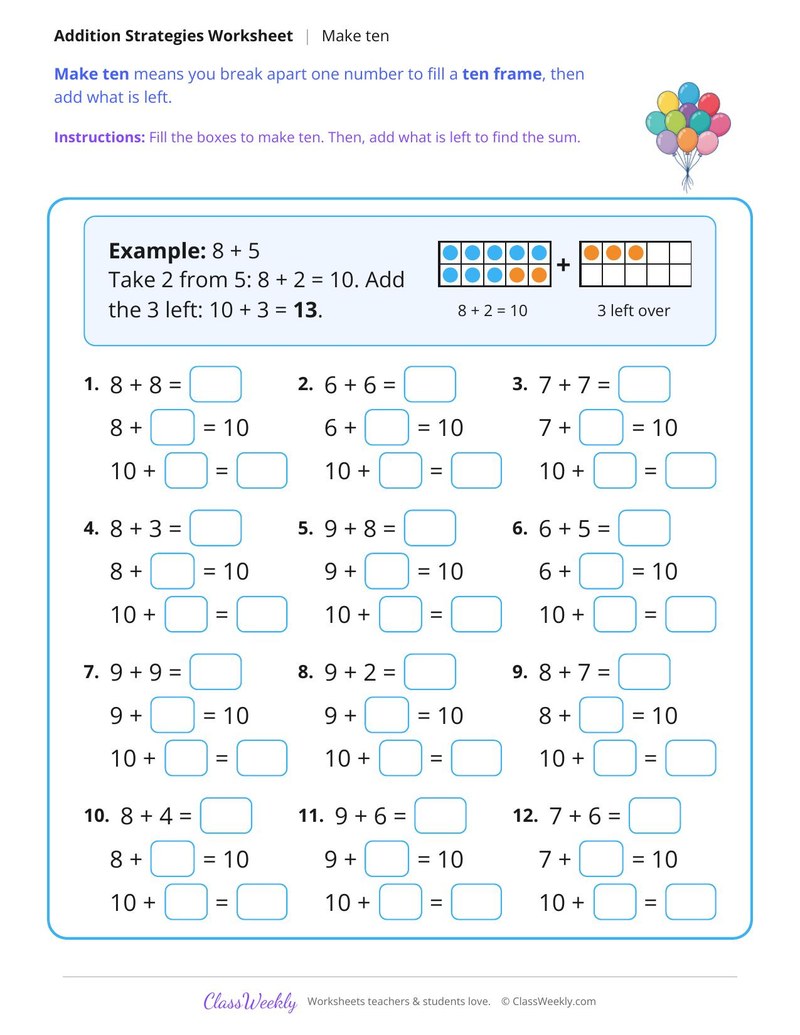
1st grade math worksheet: add within 20 by making ten first, then adding what is left. Answer key included. Part of our addition strategies collection. Aligned to Common Core standards.
How do I use this worksheet?
Work the example at the top of the page together, then let your child try the first problem alone. Ask which strategy they used and why it fits the numbers. If a strategy feels slow, go back to the ten frame or number line page for that skill.
What students will practice
- Students will use doubles and near doubles to add within 20.
- Students will make a ten, then add the rest.
- Students will choose a strategy that fits the numbers in an addition fact.
Curriculum Links
Common Core State Standards
Operations and Algebraic Thinking · 1st Grade
Standard: Add and subtract within 20, demonstrating fluency for addition and subtraction within 10. Use strategies such as counting on; making ten; decomposing a number leading to a ten; using the relationship between addition and subtraction; and creating equivalent but easier or known sums.
View all 1.OA.C.6 worksheets →Find this in the curriculum
Browse the grade, subject, and topic this belongs to.
FAQ
How do I use this addition strategies worksheet?
⌄
Work the example at the top of the page together, then let your child try the first problem alone. Ask which strategy they used and why it fits the numbers. If a strategy feels slow, go back to the ten frame or number line page for that skill.
What does this worksheet teach?
⌄
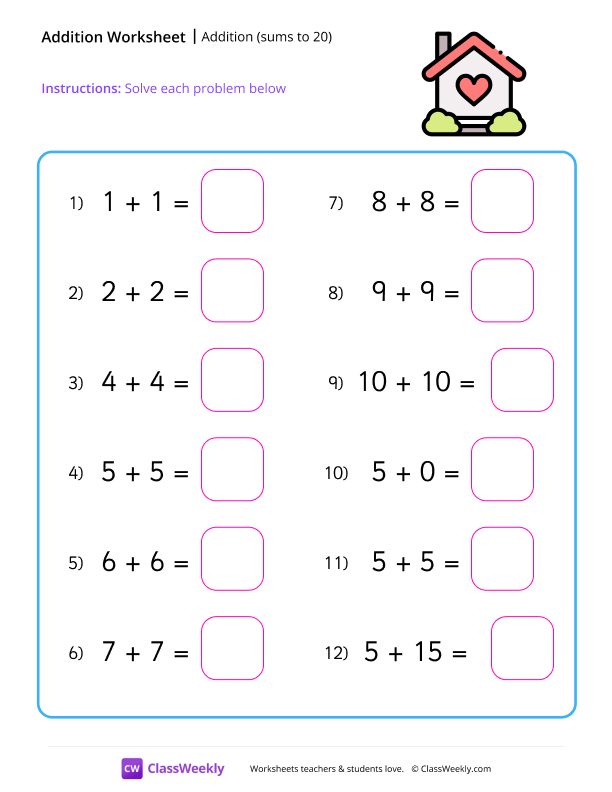
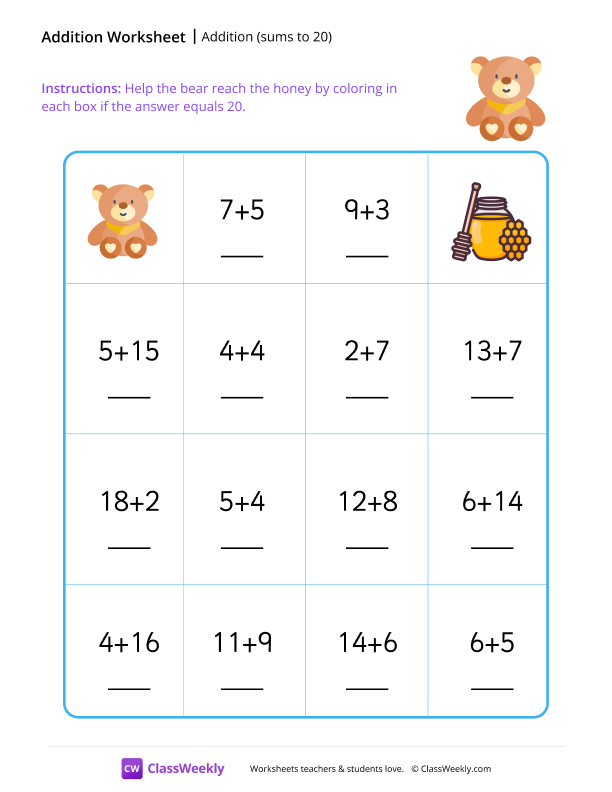
Add within 20 by making ten first, then adding what is left. Make ten means you break apart one number to fill a ten frame, then add what is left. Problems on the page include 8 + 8, 6 + 6 and 7 + 7. The directions on the page read: Fill the boxes to make ten. Then, add what is left to find the sum. The page opens with a worked example, and the answer key shows every answer.
Can I use this addition strategies worksheet for homeschool or classroom?
⌄
Yes, both. We made it for 1st Grade addition, and the page works the same whether it lands on a kitchen table or a center rotation. At home, most families go through it together and talk the answers out loud, and that talking is where most of the learning happens with addition strategies. In class it runs well as independent work while you pull a small group. Print one copy or thirty, whichever the day needs.
What does "making 10" mean and why does it matter?
⌄
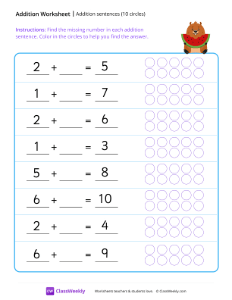
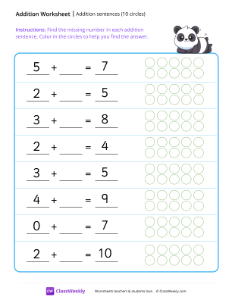
Your child works out how many more are needed to reach 10, drawing the missing ones. Ten is the anchor of our whole number system, so knowing the pairs that make 10 by heart, 6 and 4, 7 and 3, and the rest, pays off in every year of math that follows.
Should my child memorize the pairs that make 10?
⌄
Eventually, but not by drilling first. Let them build the pairs by drawing and counting until the pattern becomes familiar. Recall that grows out of understanding sticks; recall drilled first tends to fall apart under pressure.
How does this connect to later math?
⌄
Making 10 is the foundation of bridging strategies in first and second grade, where 8 plus 5 becomes 8 plus 2 plus 3. A child who knows the pairs to 10 instantly finds that easy. A child who does not falls back on counting every time.
What addition strategies do 1st graders learn?
⌄
The main ones are counting on, making ten, and using doubles and near doubles. Each gives a quick way to find a sum within 20 without counting every object from one.
How does the make ten strategy work?
⌄
For 8 + 5, take 2 from the 5 to make 8 + 2 = 10, then add the 3 that are left to get 13. The make ten sheet gives boxes for each step so students can see the ten.
What is a near double?
⌄
A near double is a fact like 6 + 7. Double the smaller number (6 + 6 = 12), then add 1 more to get 13. Knowing doubles well makes near doubles quick.
Which standard do these sheets support?
⌄
They support 1.OA.C.6, which asks students to add within 20 using strategies such as counting on, making ten, and doubles and near doubles.
What addition facts should a first grader know?
⌄
By the end of first grade, students should fluently add within 10 (CCSS 1.OA.C.6) and solve addition problems within 20 using strategies like counting on, making ten, and decomposing numbers. They should also add within 100 using place value understanding (1.NBT.C.4).
How do you teach first graders to add double-digit numbers?
⌄
Start with adding a two-digit number and a one-digit number, then progress to two two-digit numbers. Use place value understanding: add the tens first, then the ones. Base-ten blocks and place value worksheets make this concrete before moving to abstract equations.
What are addition strategies for first grade?
⌄
Key strategies include counting on from the larger number, making a ten (e.g., 8+5 becomes 8+2+3), using doubles (6+6=12) and near-doubles (6+7=6+6+1), and decomposing to known facts. Worksheets that practice each strategy separately help students build fluency.
Ratings & Reviews
No reviews yet. Be the first to share what you think.
Reviews are for ClassWeekly members.
Make a Request
Spotted something to fix, or want a worksheet we don't have yet? Tell us and we'll make it.
Learn More
What is ClassWeekly?
ClassWeekly offers free worksheets and printable learning resources for kids in preschool to grade 5. All worksheets are aligned to Common Core, NGSS, and C3 Framework standards and designed by educators. Become a member to access the full library and download unlimited PDFs.