Map Earth's Surface Features
Written by Adi Ackerman, Head Teacher
"Map Earth's Surface Features" is written for 4th Grade (Ages 9-10), and it covers NGSS 4-ESS2-2. If your little one is a year younger but already steady here, the page still works. You may just need to read the instructions out loud. And if they are older and Earth's surface never quite stuck, this is a short review rather than busywork.
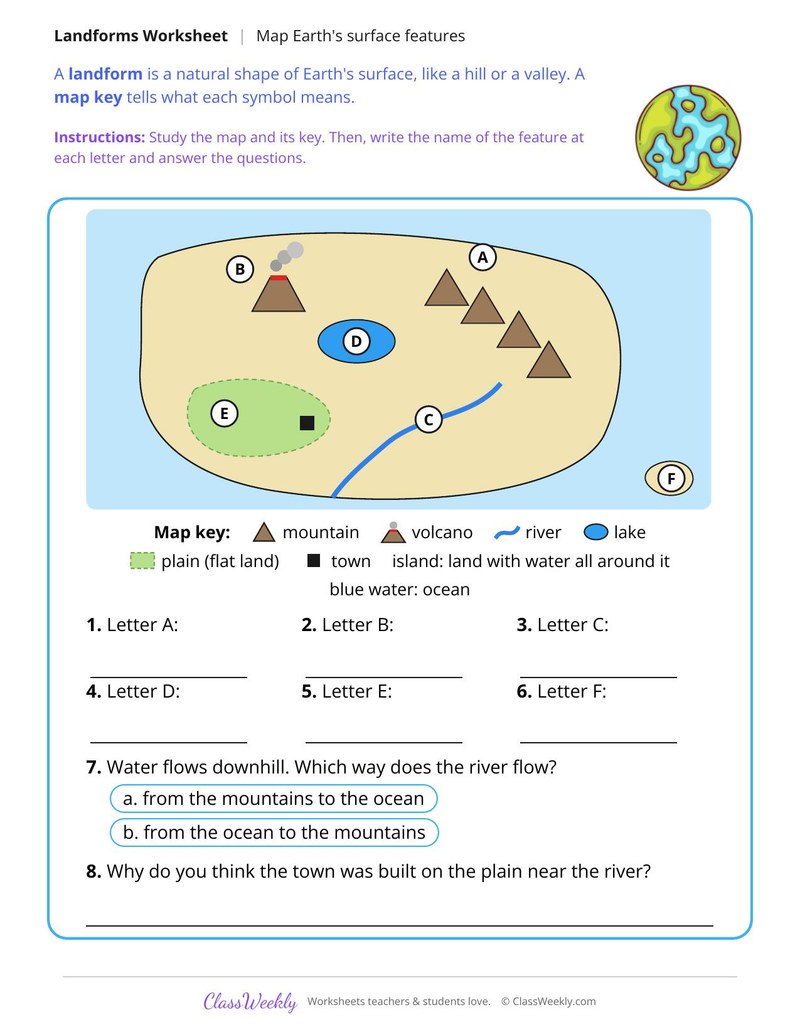
4th grade science worksheet: name mountains, rivers, lakes and other features on a map with a key. Answer key included. Part of our Earth's surface collection. Aligned to NGSS standards.
How do I use this worksheet?
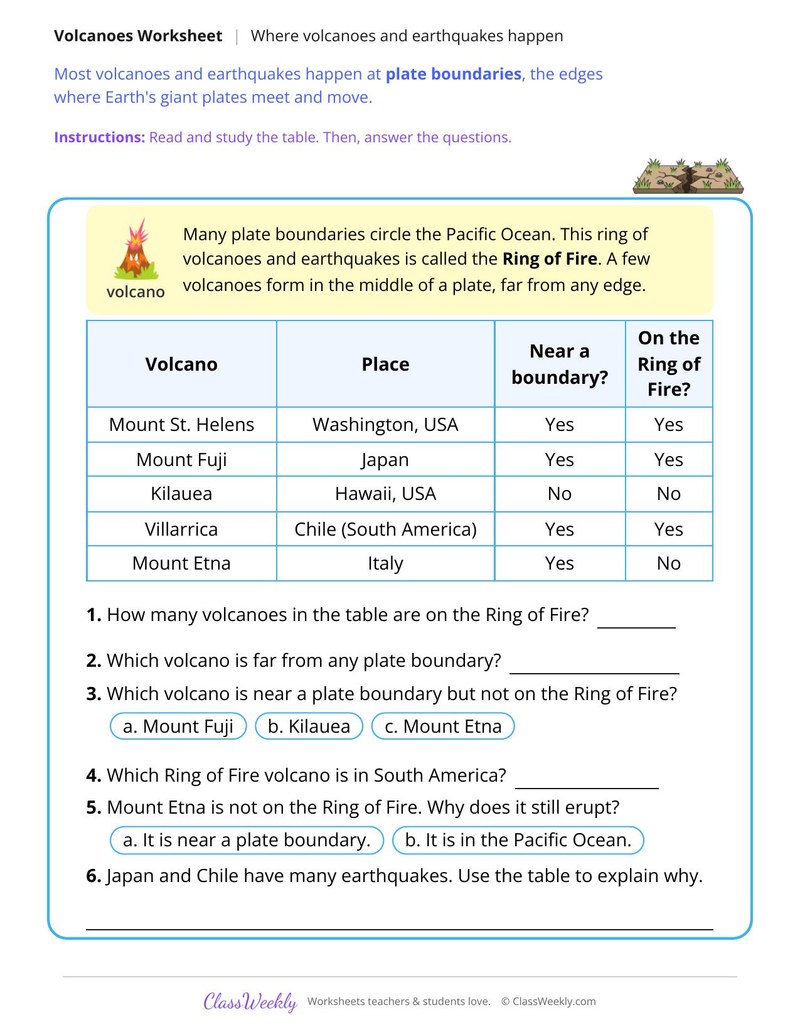
Use a peach or an egg as a model of Earth's layers before the first page. Keep a world map or globe nearby for the map and volcano pages so your child can find the real places. Check each page with the answer key.
What students will practice
- Students will label Earth's four layers and describe each one.
- Students will use a map key to name landforms and bodies of water.
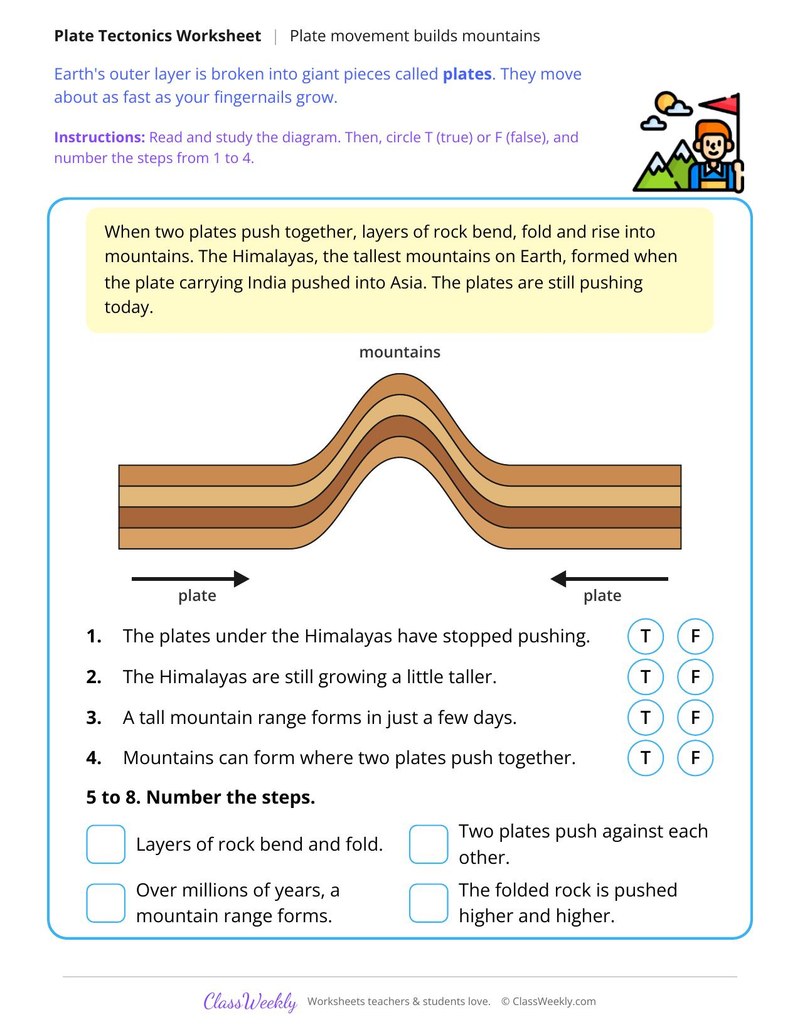
- Students will explain how moving plates build mountains and cause volcanoes and earthquakes.
Curriculum Links
Next Generation Science Standards
Science · 4th Grade
Find this in the curriculum
Browse the grade, subject, and topic this belongs to.
FAQ
How do I use this Earth's surface worksheet?
⌄
Use a peach or an egg as a model of Earth's layers before the first page. Keep a world map or globe nearby for the map and volcano pages so your child can find the real places. Check each page with the answer key.
What does this worksheet teach?
⌄
Name mountains, rivers, lakes and other features on a map with a key. A landform is a natural shape of Earth's surface, like a hill or a valley. A map key tells what each symbol means. The directions on the page read: Study the map and its key. Then, write the name of the feature at each letter and answer the questions. The answer key shows every answer.
Can I use this Earth's surface worksheet for homeschool or classroom?
⌄
Yes, both. We made it for 4th Grade Earth's surface, and the page works the same whether it lands on a kitchen table or a center rotation. At home, most families go through it together and talk the answers out loud, and that talking is where most of the learning happens. In class it runs well as independent work while you pull a small group. Print one copy or thirty, whichever the day needs.
What are Earth's four layers?
⌄
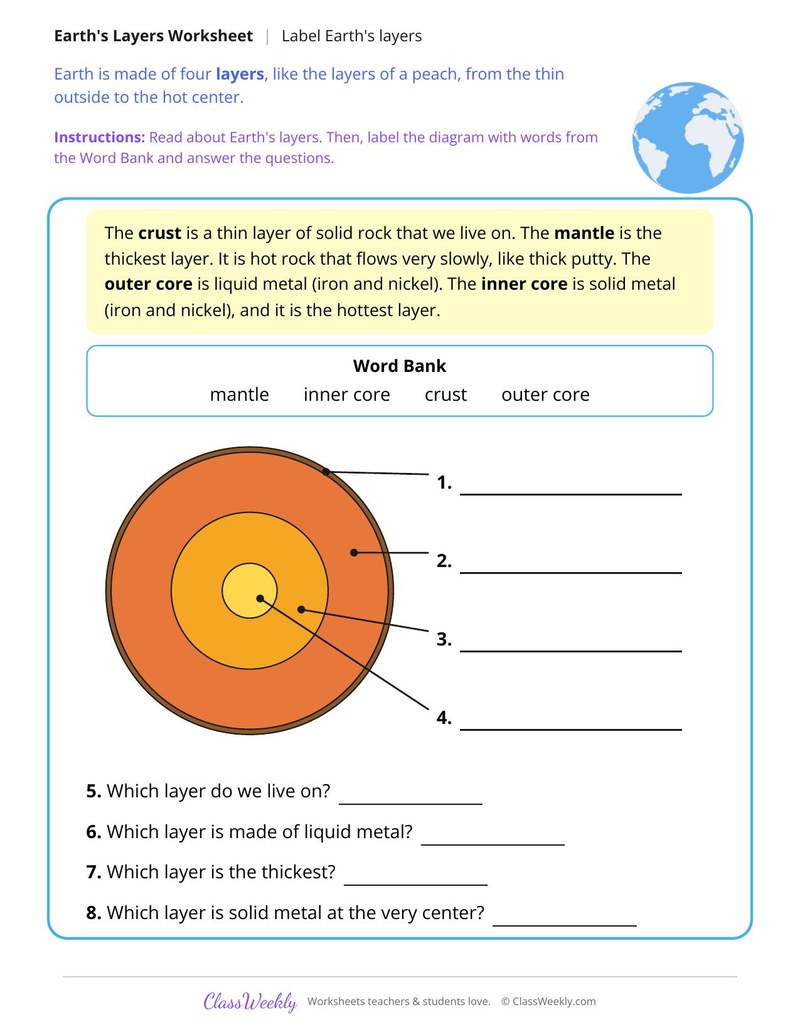
Earth's four layers are the crust, the mantle, the outer core and the inner core. The crust is the thin rock we live on. Under it is the mantle, the thickest layer, made of hot rock that flows very slowly. The outer core is liquid metal and the inner core is solid metal and the hottest layer.
Why do volcanoes and earthquakes happen in the same places?
⌄
Most of both happen at plate boundaries, where Earth's giant plates meet and move. Many boundaries circle the Pacific Ocean, which is why that ring is called the Ring of Fire.
What is a fast change and a slow change to the land?
⌄
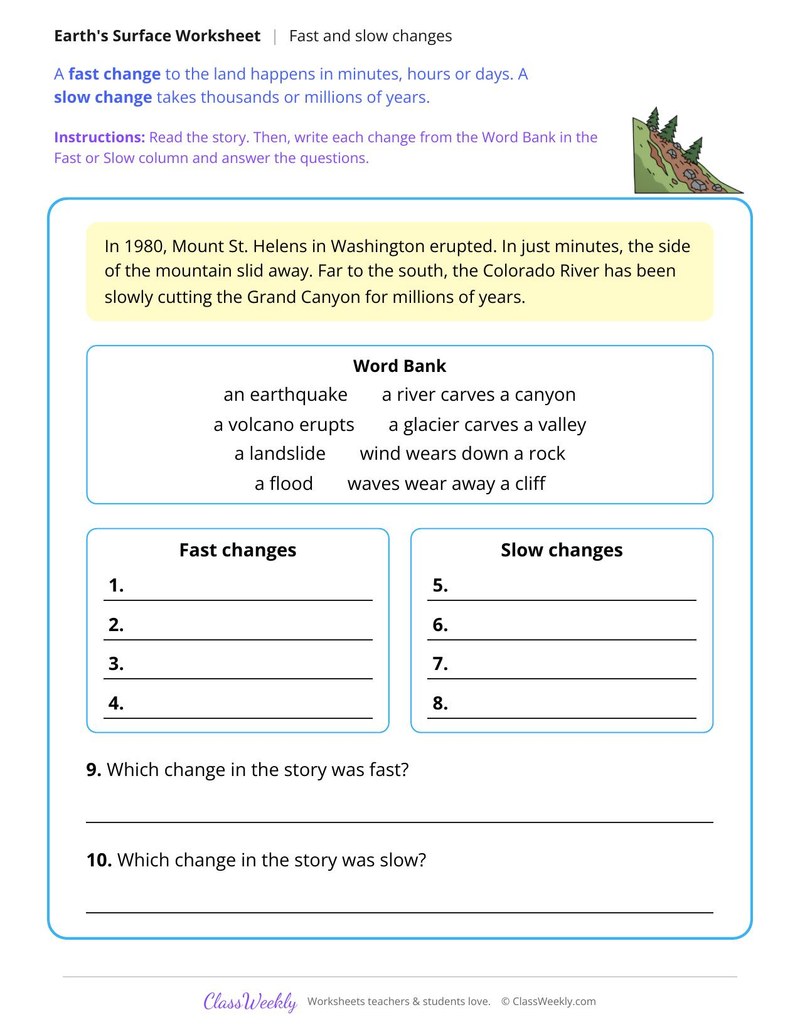
A fast change happens in minutes, hours or days, like a landslide, an earthquake or a volcano erupting. A slow change takes thousands or millions of years, like a river carving a canyon or waves wearing away a cliff.
Is there an answer key for each worksheet?
⌄
Yes. All five Earth's surface sheets have an answer key that shows every answer, including sample answers for the questions children explain in their own words.
Ratings & Reviews
No reviews yet. Be the first to share what you think.
Reviews are for ClassWeekly members.
Make a Request
Spotted something to fix, or want a worksheet we don't have yet? Tell us and we'll make it.
Worksheet Details
| Grade | 4th Grade |
| Subject | Science |
| Topic | Earth's Surface |
| Standard | 4-ESS2-2 |
| Pages | 1 page |
| Difficulty | Medium |
What is ClassWeekly?
ClassWeekly offers free worksheets and printable learning resources for kids in preschool to grade 5. All worksheets are aligned to Common Core, NGSS, and C3 Framework standards and designed by educators. Become a member to access the full library and download unlimited PDFs.