Adverbs of Time and Frequency
Written by Adi Ackerman, Head Teacher
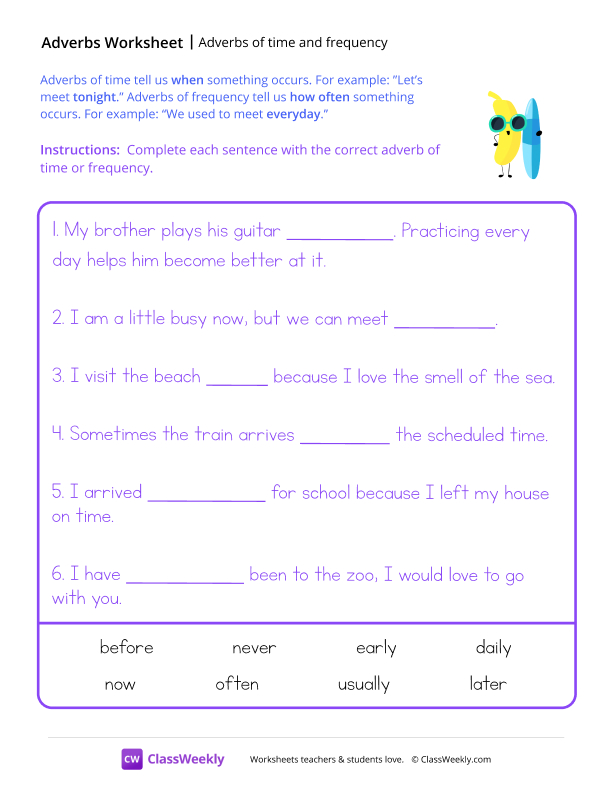
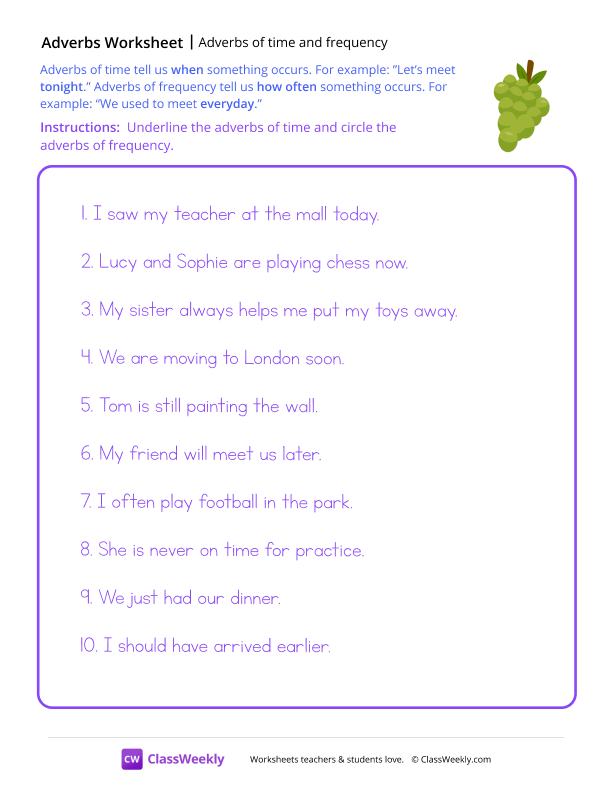
"Adverbs of Time and Frequency - Banana Dude" is written for 2nd Grade (Ages 7-8), and it covers Common Core L.2.1.E. If your little one is a year younger but already steady on adverbs, the page still works. You may just need to read the instructions out loud. And if they are older and adverbs of time never quite stuck, this is a short review rather than busywork.
2 pages in this set
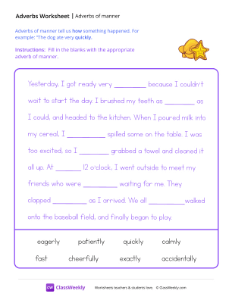
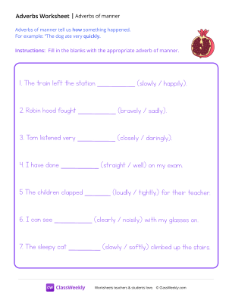
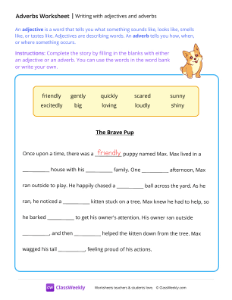
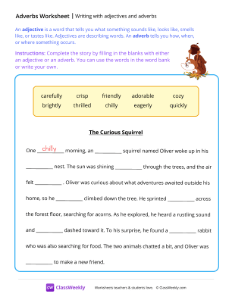
Free printable adverbs of time and frequency (banana dude) worksheet for 2nd grade students. Part of our adverbs of time collection. Aligned to Common Core standards.
How do I use this worksheet?
Introduce the skill with a brief whole-class activity, such as calling out examples and asking students to give a thumbs up when they hear adverbs of time in a sentence. Then let students work through it independently after a quick group example, checking in with a partner if they get stuck, referring to a class anchor chart if one is available. When reviewing answers, ask students to explain why an answer is correct rather than just confirming it. These adverbs of time worksheets work well as a focused practice activity, a homework assignment, or a warm-up at the start of a language arts lesson.
What students will practice
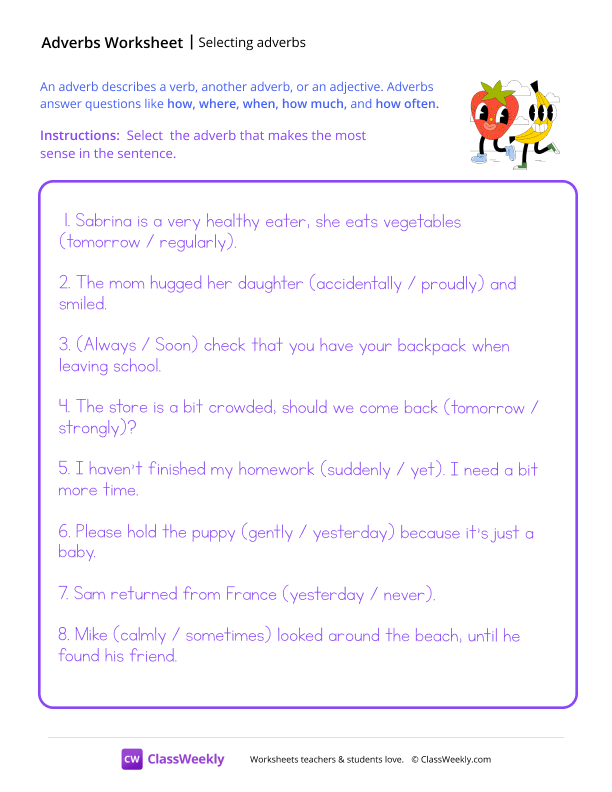
- Students will identify and correctly use adverbs of time in sentences and short passages.
- Students will distinguish adverbs of time from related language concepts and apply rules consistently.
- Students will demonstrate understanding of adverbs of time through guided and independent decoding, in both reading and their own writing.
Curriculum Links
Common Core State Standards
Language · 2nd Grade
Standard: Use adjectives and adverbs, and choose between them depending on what is to be modified.
View all L.2.1.E worksheets →Find this in the curriculum
Browse the grade, subject, and topic this belongs to.
FAQ
How do I use this adverbs of time worksheet?
⌄
Introduce the skill with a brief whole-class activity, such as calling out examples and asking students to give a thumbs up when they hear adverbs of time in a sentence. Then let students work through it independently after a quick group example, checking in with a partner if they get stuck, referring to a class anchor chart if one is available. When reviewing answers, ask students to explain why an answer is correct rather than just confirming it. These adverbs of time worksheets work well as a focused practice activity, a homework assignment, or a warm-up at the start of a language arts lesson.
What does this worksheet teach?
⌄
These adverbs of time worksheets for 2nd grade give students the targeted language arts practice they need to master this important grammar skill. Students identify, sort, complete, and write using adverbs of time through a variety of exercises designed to reinforce both recognition and application. Our adverbs worksheets connect grammar practice to reading and writing so students see how adverbs of time works in real language. Building a solid understanding of adverbs of time in 2nd grade sets students up for stronger writing and clearer communication in every subject.
Can I use this adverbs of time worksheet for homeschool or classroom?
⌄
Yes, both. We made it for 2nd Grade adverbs, and the page works the same whether it lands on a kitchen table or a center rotation. At home, most families go through it together and talk the answers out loud, and that talking is where most of the learning happens with adverbs of time. In class it runs well as independent work while you pull a small group. Print one copy or thirty, whichever the day needs.
What are adverbs of time and what question do they answer?
⌄
Adverbs of time answer the question 'When?' about a verb, with common examples including 'today,' 'never,' 'later,' and 'already,' which are all introduced in 2nd grade grammar.
How do adverbs of time help students with story sequencing?
⌄
Using time adverbs like 'first,' 'next,' and 'finally' helps students structure their narratives clearly and signal the order of events to their readers.
Are these worksheets aligned with 2nd grade informational writing standards?
⌄
Yes, adverbs of time appear frequently in informational writing to sequence steps or events, making these worksheets directly relevant to 2nd grade writing standards.
What are adverbs for second graders?
⌄
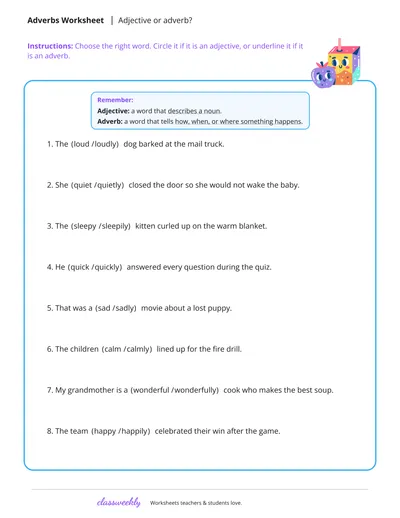
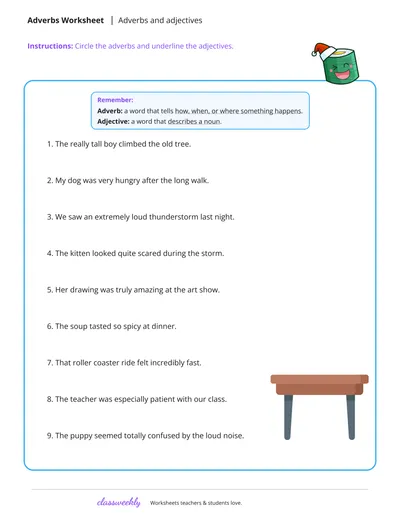
Adverbs are words that describe a verb, telling how, when, or where an action happens (CCSS L.2.1e). Examples include quickly, softly, yesterday, and outside. Second graders learn to spot adverbs in sentences and use them to make their writing more specific and interesting.
How do you teach adverbs to a 2nd grader?
⌄
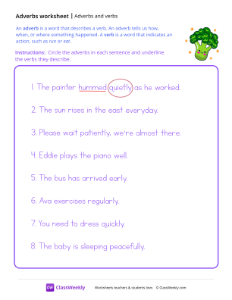
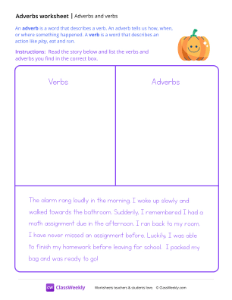
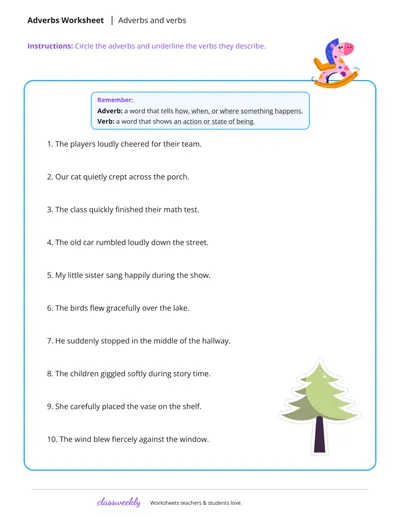
Start with the three questions an adverb answers: how (quietly), when (later), and where (upstairs). Read a simple sentence, underline the verb, then ask your child how, when, or where it happened to find the adverb. Worksheets that have students circle the adverb and match it to the verb it describes reinforce the skill through repetition.
What is the difference between an adjective and an adverb?
⌄
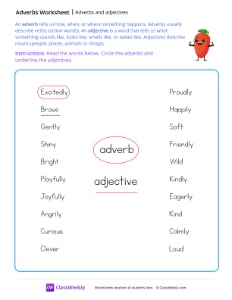
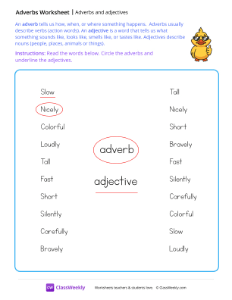
An adjective describes a noun (a fast car), while an adverb describes a verb, telling how, when, or where an action happens (the car drove fast). Many adverbs end in -ly, which is a helpful clue for second graders. Sorting words into adjective and adverb columns is a common grade-2 activity that builds this distinction.
What are some examples of adverbs for grade 2?
⌄
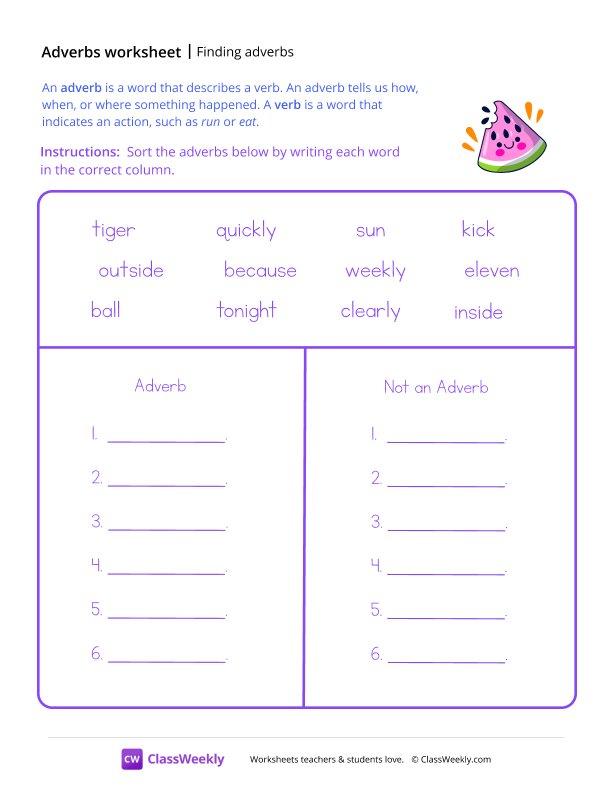
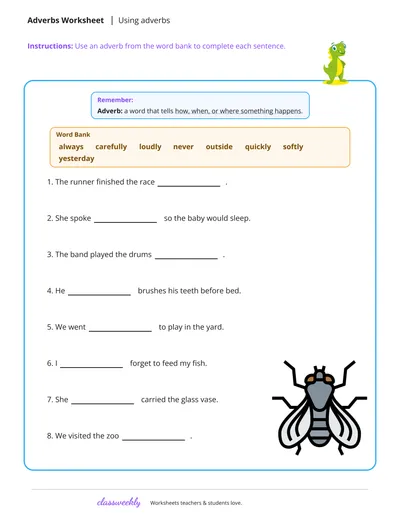
Common grade-2 adverbs include how words like slowly, loudly, gently, and carefully; when words like now, soon, always, and never; and where words like here, there, inside, and outside. Practicing these in short sentences helps children recognize that adverbs add detail to actions.
When do students learn adverbs in school?
⌄
Adverbs are formally introduced in second grade under Common Core standard L.2.1e, which asks students to use adjectives and adverbs and choose between them depending on what is being described. This builds on the descriptive-language foundation from first grade and prepares students for expanding sentences in third grade.
How can I help my child practice adverbs at home?
⌄
Play a quick game where you act out an action and your child describes it with an adverb (walking slowly, clapping loudly). During reading, pause and ask how a character did something. Then have your child rewrite a plain sentence by adding one adverb, which turns The dog barked into The dog barked loudly.
Ratings & Reviews
No reviews yet. Be the first to share what you think.
Reviews are for ClassWeekly members.
Make a Request
Spotted something to fix, or want a worksheet we don't have yet? Tell us and we'll make it.
Worksheet Details
| Grade | 2nd Grade |
| Subject | Grammar & Writing |
| Topic | Adverbs |
| Standard | L.2.1.E |
| Pages | 1 page |
| Difficulty | Medium |
Learn More
What is ClassWeekly?
ClassWeekly offers free worksheets and printable learning resources for kids in preschool to grade 5. All worksheets are aligned to Common Core, NGSS, and C3 Framework standards and designed by educators. Become a member to access the full library and download unlimited PDFs.