Short stories (34 words)
Written by Adi Ackerman, Head Teacher
"Short stories (34 words) - A Trip To The Zoo" is written for Kindergarten (Ages 5-6), and it covers Common Core RL.K.1. If your little one is a year younger but already steady here, the page still works. You may just need to read the instructions out loud. And if they are older and short stories never quite stuck, this is a short review rather than busywork.


2 pages in this set
Free printable short stories (34 words) (a trip to the zoo) worksheet for kindergarten students. Part of our short stories collection. Aligned to Common Core standards.
How do I use this worksheet?
Begin with a shared reading or oral warm-up that highlights short stories so students hear and see the skill in context before practicing it independently. Have students work through it with your modeling first (do the first item together on the board), then try the rest with a partner, especially for phonics-based tasks where saying an answer aloud first helps. After completing the worksheet, use one or two examples from the page to start a discussion: "Where else have you seen this in your reading?" These short stories worksheets are ideal for use during small group reading time, as independent center work, or as a homework activity.
What students will practice
- Students will identify and apply short stories knowledge to decode and comprehend grade-level text.
- Students will recognize patterns and rules related to short stories in spoken and written language.
- Students will build fluency and confidence with short stories through listening, speaking, and early decoding.


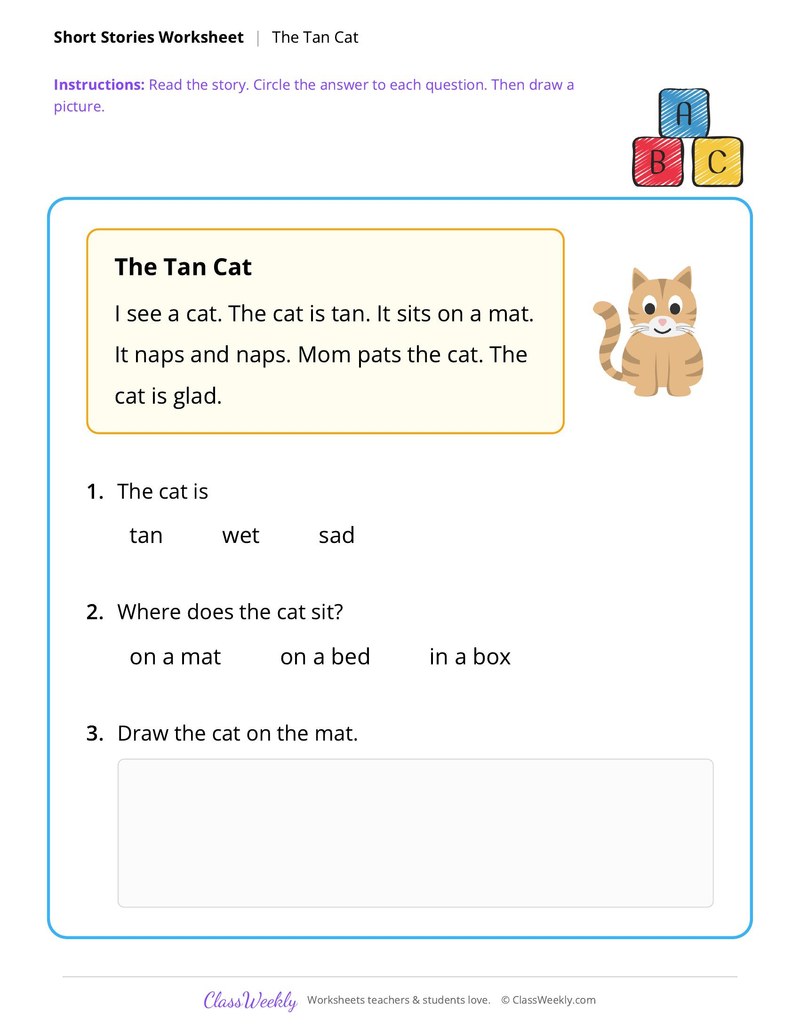
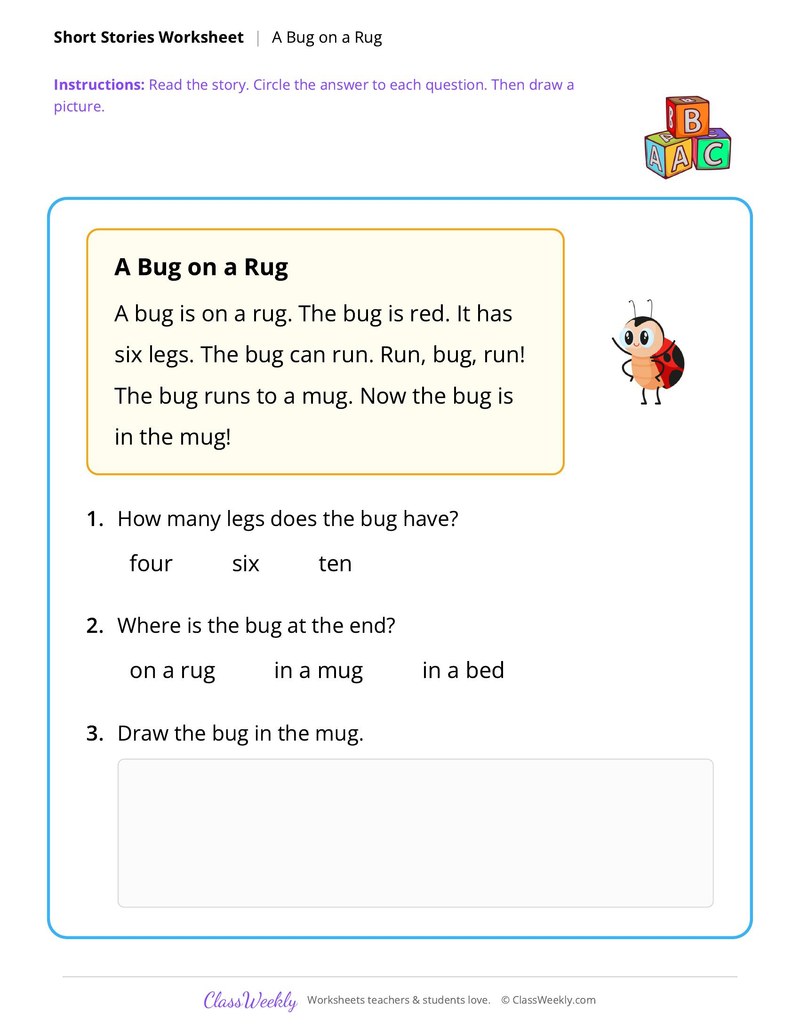
Curriculum Links
Common Core State Standards
Reading: Literature · Kindergarten
Standard: With prompting and support, ask and answer questions about key details in a text.
View all RL.K.1 worksheets →Find this in the curriculum
Browse the grade, subject, and topic this belongs to.
FAQ
How do I use this short stories worksheet?
⌄
Begin with a shared reading or oral warm-up that highlights short stories so students hear and see the skill in context before practicing it independently. Have students work through it with your modeling first (do the first item together on the board), then try the rest with a partner, especially for phonics-based tasks where saying an answer aloud first helps. After completing the worksheet, use one or two examples from the page to start a discussion: "Where else have you seen this in your reading?" These short stories worksheets are ideal for use during small group reading time, as independent center work, or as a homework activity.
What does this worksheet teach?
⌄
These short stories worksheets for Kindergarten give students focused practice with one of the key skills in early literacy. Students read, identify, and respond to short stories through a variety of activities designed for their grade level. Our short stories worksheets build both decoding skills and reading comprehension, helping students connect what they practice on paper to the books they read every day. Regular practice with short stories strengthens the reading skills that Kindergarten students need to become confident, independent readers.
Can I use this short stories worksheet for homeschool or classroom?
⌄
Yes, both. We made it for Kindergarten short stories, and the page works the same whether it lands on a kitchen table or a center rotation. At home, most families go through it together and talk the answers out loud, and that talking is where most of the learning happens. In class it runs well as independent work while you pull a small group. Print one copy or thirty, whichever the day needs.
How long is "A Trip To The Zoo"?
⌄
A Trip To The Zoo is a 34 word story, which is about right for a kindergartener reading independently. Short is deliberate: a child who finishes a whole story feels like a reader, and that feeling does more for progress than a longer text they had to be carried through.
What should I ask after reading "A Trip To The Zoo"?
⌄
Start with what happened, then ask why. "What happened first?" checks that the sequence landed. "Why do you think that happened?" is the harder question and the more valuable one. One good question beats a list of them.
My child reads the words but cannot say what happened. Is that a problem?
⌄
It is common and it is worth working on. When all the effort goes into decoding, nothing is left over for meaning. Reread the story once more now that the words are familiar and ask again. Comprehension usually appears on the second read, which is why rereading matters so much at this stage.
How many Kindergarten short stories worksheets are there?
⌄
15 printable worksheets, all free to preview. Downloads are included with a ClassWeekly free trial, and every page prints on standard 8.5 x 11 paper.
What age are short stories worksheets for?
⌄
These are written for Kindergarten students, roughly ages 5-6. Many teachers also use them a grade up for review or a grade down as an extension, so use the preview to judge the fit for a particular child.
Are these short stories worksheets aligned to Common Core?
⌄
Yes. Each one shows the Common Core code it covers on its own page, so you can check the alignment yourself rather than taking our word for it.
Ratings & Reviews
No reviews yet. Be the first to share what you think.
Reviews are for ClassWeekly members.
Make a Request
Spotted something to fix, or want a worksheet we don't have yet? Tell us and we'll make it.
Worksheet Details
| Grade | Kindergarten |
| Subject | Reading |
| Topic | Short stories |
| Standard | RL.K.1 |
| Pages | 1 page |
| Difficulty | Medium |
What is ClassWeekly?
ClassWeekly offers free worksheets and printable learning resources for kids in preschool to grade 5. All worksheets are aligned to Common Core, NGSS, and C3 Framework standards and designed by educators. Become a member to access the full library and download unlimited PDFs.