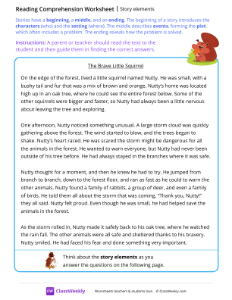
Story Elements: Character, setting & plot
Written by Adi Ackerman, Head Teacher
"Story Elements: Character, setting & plot" is written for 2nd Grade (Ages 7-8), and it covers Common Core RL.2.1. If your little one is a year younger but already steady on reading comprehension, the page still works. You may just need to read the instructions out loud. And if they are older and reading never quite stuck, this is a short review rather than busywork.
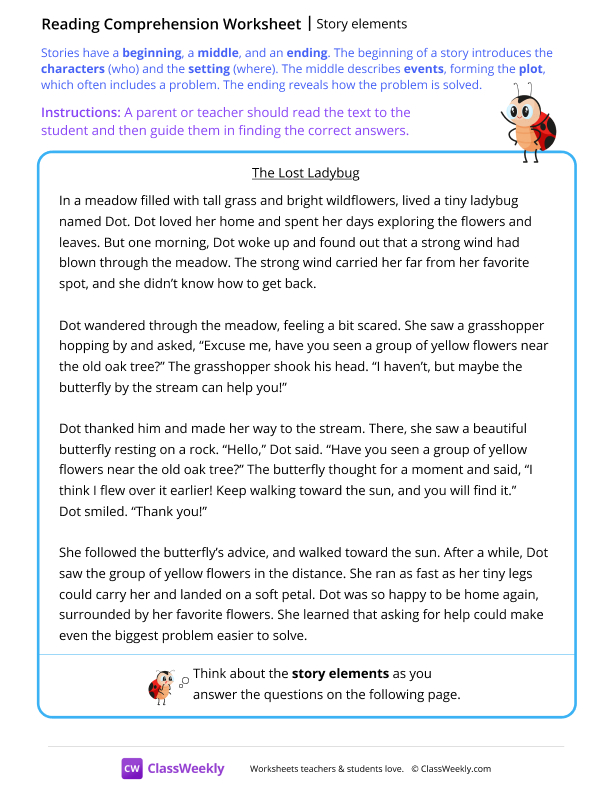
Free printable story elements: character, setting & plot worksheet for 2nd grade students. Part of our reading collection. Aligned to Common Core standards.
How do I use this worksheet?
Begin with a shared reading or oral warm-up that highlights reading so students hear and see the skill in context before practicing it independently. Have students work through it independently after a quick group example, checking in with a partner if they get stuck, especially for phonics-based tasks where saying an answer aloud first helps. After completing the worksheet, use one or two examples from the page to start a discussion: "Where else have you seen this in your reading?" These reading worksheets are ideal for use during small group reading time, as independent center work, or as a homework activity.
What students will practice
- Students will identify and apply reading knowledge to decode and comprehend grade-level text.
- Students will recognize patterns and rules related to reading in spoken and written language.
- Students will build fluency and confidence with reading through guided and independent decoding.

Curriculum Links
Common Core State Standards
Reading: Literature · 2nd Grade
Standard: Ask and answer such questions as who, what, where, when, why, and how to demonstrate understanding of key details in a text.
View all RL.2.1 worksheets →Find this in the curriculum
Browse the grade, subject, and topic this belongs to.
FAQ
How do I use this reading worksheet?
⌄
Begin with a shared reading or oral warm-up that highlights reading so students hear and see the skill in context before practicing it independently. Have students work through it independently after a quick group example, checking in with a partner if they get stuck, especially for phonics-based tasks where saying an answer aloud first helps. After completing the worksheet, use one or two examples from the page to start a discussion: "Where else have you seen this in your reading?" These reading worksheets are ideal for use during small group reading time, as independent center work, or as a homework activity.
What does this worksheet teach?
⌄
These reading worksheets for 2nd grade give students focused practice with one of the key skills in early literacy. Students read, identify, and respond to reading through a variety of activities designed for their grade level. Our reading comprehension worksheets build both decoding skills and reading comprehension, helping students connect what they practice on paper to the books they read every day. Regular practice with reading strengthens the reading skills that 2nd grade students need to become confident, independent readers.
Can I use this reading worksheet for homeschool or classroom?
⌄
Yes, both. We made it for 2nd Grade reading comprehension, and the page works the same whether it lands on a kitchen table or a center rotation. At home, most families go through it together and talk the answers out loud, and that talking is where most of the learning happens with reading. In class it runs well as independent work while you pull a small group. Print one copy or thirty, whichever the day needs.
What types of reading activities are included in 2nd grade reading worksheets?
⌄
Activities include passage reading with comprehension questions, fluency practice, vocabulary building, retelling prompts, and text-type identification.
How often should 2nd graders engage in structured reading practice?
⌄
Daily reading practice - at least 20-30 minutes of combined guided and independent reading - is recommended to build fluency and comprehension at the 2nd grade level.
How do these worksheets help prepare students for 3rd grade reading demands?
⌄
They introduce the multi-paragraph texts, informational content, and higher-order comprehension questions that become central to reading instruction in 3rd grade.
What reading level should second graders achieve?
⌄
By the end of second grade, most students should read at Guided Reading level L or M (Fountas and Pinnell), which corresponds to early chapter books with more complex plots, varied sentence structures, and content-specific vocabulary. CCSS RF.2.4 expects students to read grade-level text with sufficient accuracy and fluency to support comprehension. A fluency benchmark of 80 to 100 words correct per minute is typical by spring. Worksheets with passages of 150 to 300 words followed by comprehension questions provide appropriate practice at this level. Second grade is a critical year for reading development because children transition from "learning to read" to "reading to learn." Students who are not reading at grade level by the end of second grade face compounding difficulties as text demands increase dramatically in third grade.
How do you improve reading comprehension for a struggling second grader?
⌄
First, determine the root cause. If the child reads slowly or inaccurately, the issue is fluency or decoding, not comprehension itself. Use repeated reading and phonics practice to build fluency. If the child reads fluently but cannot answer questions, teach comprehension strategies explicitly: stop and think after each paragraph, visualize what is happening, ask "Does this make sense?" Building vocabulary is also essential, as word knowledge accounts for a large portion of comprehension ability. Worksheets at the child's independent reading level (not grade level) allow them to practice comprehension strategies without being overwhelmed by difficult text. Gradually increase text complexity as skills improve. Research shows that 20 minutes of daily reading practice at the appropriate level, combined with explicit strategy instruction, produces significant comprehension gains within 8 to 12 weeks.
What types of texts should second graders read for comprehension practice?
⌄
Second graders should read a balanced mix of literary and informational texts (CCSS expects a roughly 50/50 split). Literary texts include realistic fiction, folktales, fables, and simple poetry. Informational texts include science topics (animals, weather, plants), social studies topics (communities, maps, historical figures), and how-to texts. Exposure to varied genres builds flexible comprehension skills. Worksheets that alternate between fiction and nonfiction passages ensure children practice the different strategies each genre requires: fiction emphasizes character, plot, and theme, while nonfiction emphasizes main idea, text features, and vocabulary. High-interest topics (dinosaurs, space, animals, sports) motivate reluctant readers. Including both narrative nonfiction (tells a story) and expository nonfiction (explains a topic) helps children recognize different text structures.
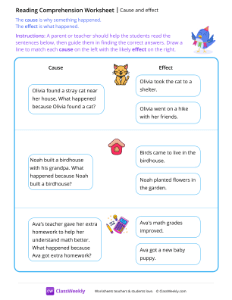
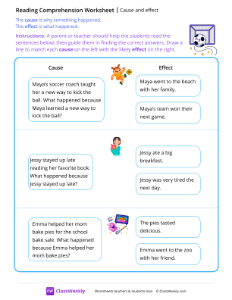
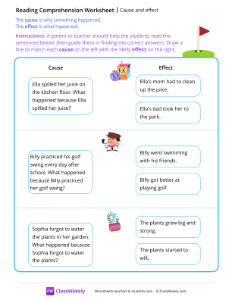
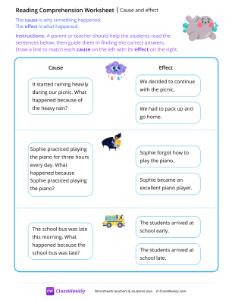
What is cause and effect in reading?
⌄
Cause and effect is the link between why something happens and what happens as a result. The cause is the reason, and the effect is the outcome. For example: it started to rain (cause), so the game was canceled (effect). Spotting this link helps second graders understand how a story fits together.
How do I teach cause and effect to a 2nd grader?
⌄
Read a short story together and pause to ask "why did that happen?" at each event. Signal words make it easier: because, so, since, and as a result usually point to a cause or an effect. Practicing with sentences to match and underline builds the skill quickly.
What are cause and effect signal words?
⌄
Signal words are clues that tell your child a cause or effect is coming. The most common ones are because, so, since, therefore, as a result, and this led to. When your child spots because, they know a reason comes next. Teaching these words gives them a reliable way to find the connection.
Why is cause and effect important for reading comprehension?
⌄
Cause and effect helps children follow how and why events unfold, which is the heart of understanding a story. A child who sees that a character was tired because they stayed up late is reading for meaning, not just words. This skill also builds the logic they will use in writing and science.
Ratings & Reviews
No reviews yet. Be the first to share what you think.
Reviews are for ClassWeekly members.
Make a Request
Spotted something to fix, or want a worksheet we don't have yet? Tell us and we'll make it.
Worksheet Details
| Grade | 2nd Grade |
| Subject | Reading |
| Topic | Reading Comprehension |
| Standard | RL.2.1 |
| Pages | 1 page |
| Difficulty | Medium |
Learn More
What is ClassWeekly?
ClassWeekly offers free worksheets and printable learning resources for kids in preschool to grade 5. All worksheets are aligned to Common Core, NGSS, and C3 Framework standards and designed by educators. Become a member to access the full library and download unlimited PDFs.