Measuring objects against a scale (length)
Written by Adi Ackerman, Head Teacher
"Measuring objects against a scale (length)" is written for Kindergarten (Ages 5-6), and it covers Common Core K.MD.A.2. If your little one is a year younger but already steady on measurement, the page still works. You may just need to read the instructions out loud. And if they are older and ruler measurements never quite stuck, this is a short review rather than busywork.


2 pages in this set
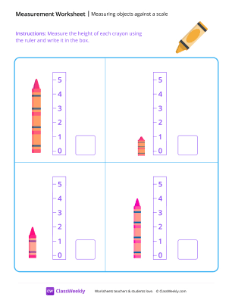
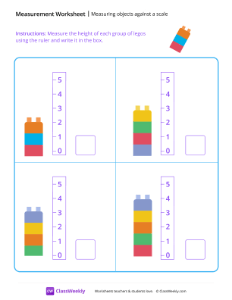
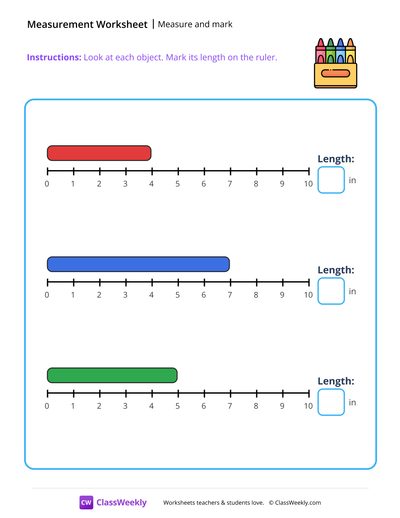
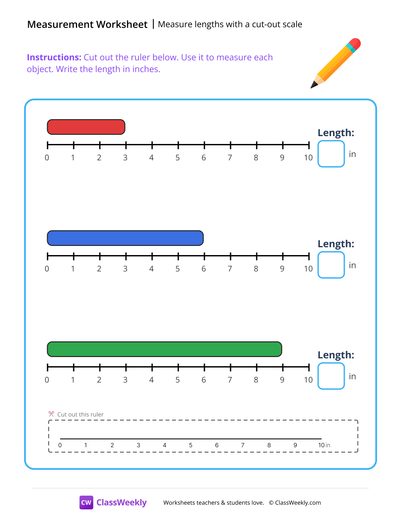
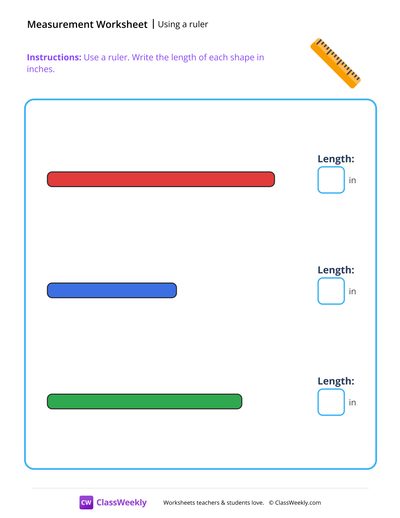
Free printable measuring objects against a scale (length) (crayon) worksheet for kindergarten students. Part of our ruler measurements measurement collection. Aligned to Common Core standards.
How do I use this worksheet?
Before handing out the worksheet, briefly introduce the concept with a short oral warm-up or a visual model on the board. Let students work through it with your modeling first (do the first item together on the board), then try the rest with a partner, encouraging them to talk through their thinking: "What strategy are you using? How do you know that is right?" After completing the worksheet, review any missed problems together and discuss the reasoning rather than just the answer. For extra support, let students use manipulatives or draw pictures alongside the written problems. These ruler measurements worksheets work well as daily practice, homework, or a focused review activity.
What students will practice
- Students will recognize and apply ruler measurements concepts using counting objects, ten-frames, and pictures.
- Students will solve problems involving ruler measurements with increasing accuracy and confidence.
- Students will connect ruler measurements skills to real-world situations and explain their reasoning clearly.

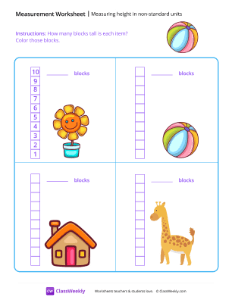
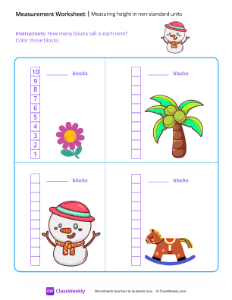
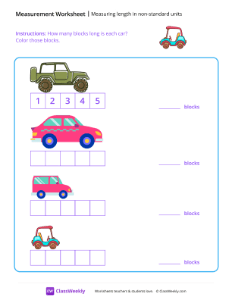
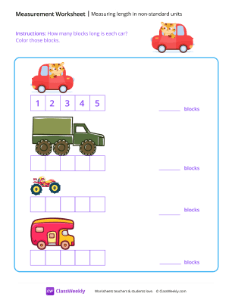




Curriculum Links
Common Core State Standards
Measurement and Data · Kindergarten
Standard: Directly compare two objects with a measurable attribute in common, to see which object has 'more of'/'less of' the attribute, and describe the difference.
View all K.MD.A.2 worksheets →Find this in the curriculum
Browse the grade, subject, and topic this belongs to.
FAQ
How do I use this ruler measurements worksheet?
⌄
Before handing out the worksheet, briefly introduce the concept with a short oral warm-up or a visual model on the board. Let students work through it with your modeling first (do the first item together on the board), then try the rest with a partner, encouraging them to talk through their thinking: "What strategy are you using? How do you know that is right?" After completing the worksheet, review any missed problems together and discuss the reasoning rather than just the answer. For extra support, let students use manipulatives or draw pictures alongside the written problems. These ruler measurements worksheets work well as daily practice, homework, or a focused review activity.
What does this worksheet teach?
⌄
These ruler measurements worksheets for Kindergarten give students the structured, hands-on practice they need to build confidence and fluency. Students work through a range of problem formats, from visual models and diagrams to written equations and word problems, so they encounter ruler measurements from every angle. Each worksheet is designed to build on prior knowledge while introducing the level of challenge appropriate for Kindergarten. Practicing ruler measurements at this stage strengthens the mathematical foundations that support more advanced concepts in later grades.
Can I use this ruler measurements worksheet for homeschool or classroom?
⌄
Yes, both. We made it for Kindergarten measurement, and the page works the same whether it lands on a kitchen table or a center rotation. At home, most families go through it together and talk the answers out loud, and that talking is where most of the learning happens with ruler measurements. In class it runs well as independent work while you pull a small group. Print one copy or thirty, whichever the day needs.
What measurement concepts should preschoolers learn?
⌄
Preschoolers should explore measurement through direct comparison and non-standard units. They can compare the length of two objects by placing them side by side, determine which container holds more water, and describe objects as heavy or light. At this age, measurement is about building vocabulary (long, short, tall, heavy, light, full, empty) and developing an awareness that attributes like length and weight can be quantified. Children do not need standard units like inches or centimeters yet. Instead, they measure using blocks, hand spans, or footsteps. Worksheets that show two objects and ask which is longer, taller, or heavier build the visual comparison skills that prepare students for formal measurement in kindergarten and first grade.
How do you teach measurement to a 4-year-old?
⌄
Make measurement part of daily life. Ask your child to find something longer than their shoe, stack blocks and count how tall the tower is, or compare how heavy two stuffed animals feel. Use non-standard units first: "This table is 8 hand-spans long." This teaches the process of measuring (choosing a unit, placing it end to end, counting) without the complexity of reading a ruler. Filling and pouring with containers teaches volume. Worksheets that show objects next to a row of counting units help children practice measuring on paper. The key principle is that every measurement is a comparison to a chosen unit. Keep activities playful and exploratory, letting the child discover rather than drilling procedures.
Why is non-standard measurement taught before standard measurement?
⌄
Non-standard measurement (using blocks, paper clips, or hand spans) teaches children the concept of measurement without the added complexity of reading scales and rulers. Children first need to understand that measurement means comparing an attribute to a unit and counting how many units fit. Once this concept is solid, transitioning to standard units like inches and centimeters makes sense. Research shows that children who skip non-standard measurement and jump directly to rulers often struggle with understanding what the numbers on a ruler mean. kindergarten worksheets that use non-standard units build the foundational understanding that a measurement is a count of equal-sized units placed end to end.
Ratings & Reviews
No reviews yet. Be the first to share what you think.
Reviews are for ClassWeekly members.
Make a Request
Spotted something to fix, or want a worksheet we don't have yet? Tell us and we'll make it.
Worksheet Details
| Grade | Kindergarten |
| Subject | Math |
| Topic | Measurement |
| Standard | K.MD.A.2 |
| Pages | 1 page |
| Difficulty | Medium |
Learn More
What is ClassWeekly?
ClassWeekly offers free worksheets and printable learning resources for kids in preschool to grade 5. All worksheets are aligned to Common Core, NGSS, and C3 Framework standards and designed by educators. Become a member to access the full library and download unlimited PDFs.