Capitals A to F, trace and write
Written by Adi Ackerman, Head Teacher
"Capitals A to F, trace and write" is written for 1st Grade (Ages 6-7), and it covers Common Core L.1.1.A. If your little one is a year younger but already steady on handwriting, the page still works. You may just need to read the instructions out loud. And if they are older and capital letters a-z never quite stuck, this is a short review rather than busywork.
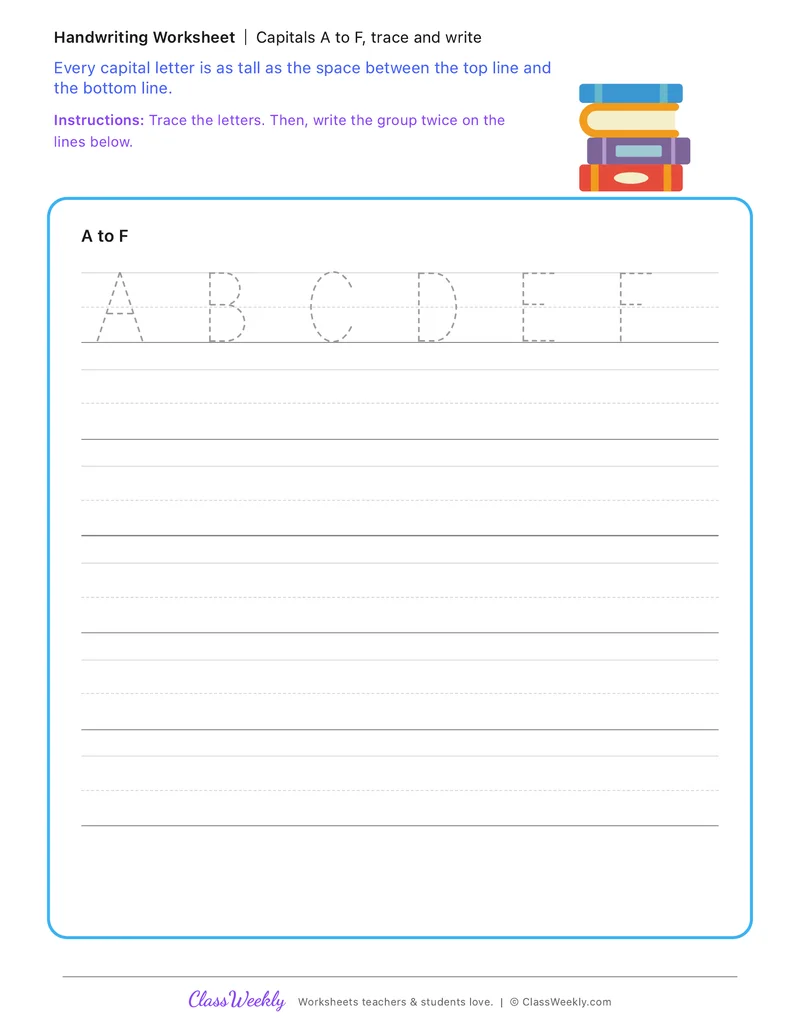
Free printable 1st grade handwriting worksheet: capitals A to F, trace and write. Every capital letter fills the space top line to bottom line. Part of our capital letters a-z handwriting collection. Aligned to Common Core standards.
How do I use this worksheet?
Introduce the skill with a brief whole-class activity, such as calling out examples and asking students to give a thumbs up when they hear capital letters a-z in a sentence. Then let students work through the first item together as a class, then finish the rest independently or with a partner, referring to a class anchor chart if one is available. When reviewing answers, ask students to explain why an answer is correct rather than just confirming it. These capital letters a-z worksheets work well as a focused practice activity, a homework assignment, or a warm-up at the start of a language arts lesson.
What students will practice
- Students will identify and correctly use capital letters a-z in sentences and short passages.
- Students will distinguish capital letters a-z from related language concepts and apply rules consistently.
- Students will demonstrate understanding of capital letters a-z through guided and independent decoding, in both reading and their own writing.
Curriculum Links
Common Core State Standards
Grammar & Writing · 1st Grade
Find this in the curriculum
Browse the grade, subject, and topic this belongs to.
FAQ
How do I use this capital letters a-z worksheet?
⌄
Introduce the skill with a brief whole-class activity, such as calling out examples and asking students to give a thumbs up when they hear capital letters a-z in a sentence. Then let students work through the first item together as a class, then finish the rest independently or with a partner, referring to a class anchor chart if one is available. When reviewing answers, ask students to explain why an answer is correct rather than just confirming it. These capital letters a-z worksheets work well as a focused practice activity, a homework assignment, or a warm-up at the start of a language arts lesson.
What does this worksheet teach?
⌄
These capital letters a-z worksheets for 1st grade give students the targeted language arts practice they need to master this important grammar skill. Students identify, sort, complete, and write using capital letters a-z through a variety of exercises designed to reinforce both recognition and application. Our handwriting worksheets connect grammar practice to reading and writing so students see how capital letters a-z works in real language. Building a solid understanding of capital letters a-z in 1st grade sets students up for stronger writing and clearer communication in every subject.
Can I use this capital letters a-z worksheet for homeschool or classroom?
⌄
Yes, both. We made it for 1st Grade handwriting, and the page works the same whether it lands on a kitchen table or a center rotation. At home, most families go through it together and talk the answers out loud, and that talking is where most of the learning happens with capital letters a-z. In class it runs well as independent work while you pull a small group. Print one copy or thirty, whichever the day needs.
What handwriting skills should 1st graders master?
⌄
By the end of 1st grade, students should write all 26 uppercase and lowercase letters from memory, without needing a model to trace or copy, and keep letter size reasonably consistent on a standard three-line guide. CCSS L.1.1.A extends kindergarten's printing standard into independent writing. Students should also form numbers 0 through 10 correctly and copy a short sentence, including the capital letter and end punctuation, without tracing. The shift from kindergarten to 1st grade handwriting is really the shift from tracing to independent writing: a 1st grader looks at a model, then writes the letter on their own line rather than tracing over dots. Worksheets that show a model letter above several blank lines, rather than a dotted letter to trace, match where a typical 1st grader should be. If a child is still tracing everything by spring of 1st grade, that's worth a closer look, not because it's alarming but because independent writing is the actual goal of the grade.
How can I help my 1st grader with handwriting at home?
⌄
Give your child a model to copy rather than a dotted letter to trace, since independent copying is the skill 1st grade is building. Keep sessions to 10 minutes and focus on one letter group at a time (letters with tall parts, letters with tails below the line, and so on) rather than the whole alphabet in one sitting. Check pencil grip early in the year since bad habits set in fast and are harder to unlearn later. A short daily sentence, even something as simple as copying their own name and one more word, builds the habit of writing a complete thought with a capital letter and a period. If letters are still noticeably uneven in size by the middle of the year, a worksheet with wider lines and a slightly bigger model letter usually helps more than more repetition on the same small lines.
My 1st grader's letters are inconsistent sizes. How do I fix that?
⌄
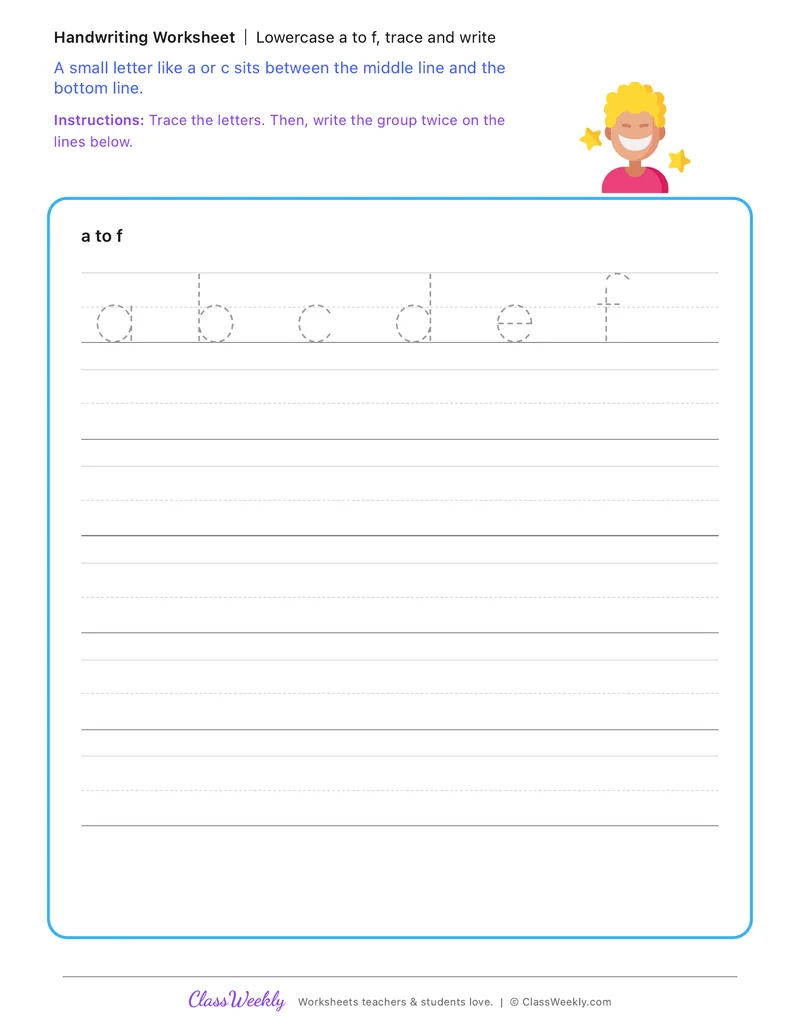
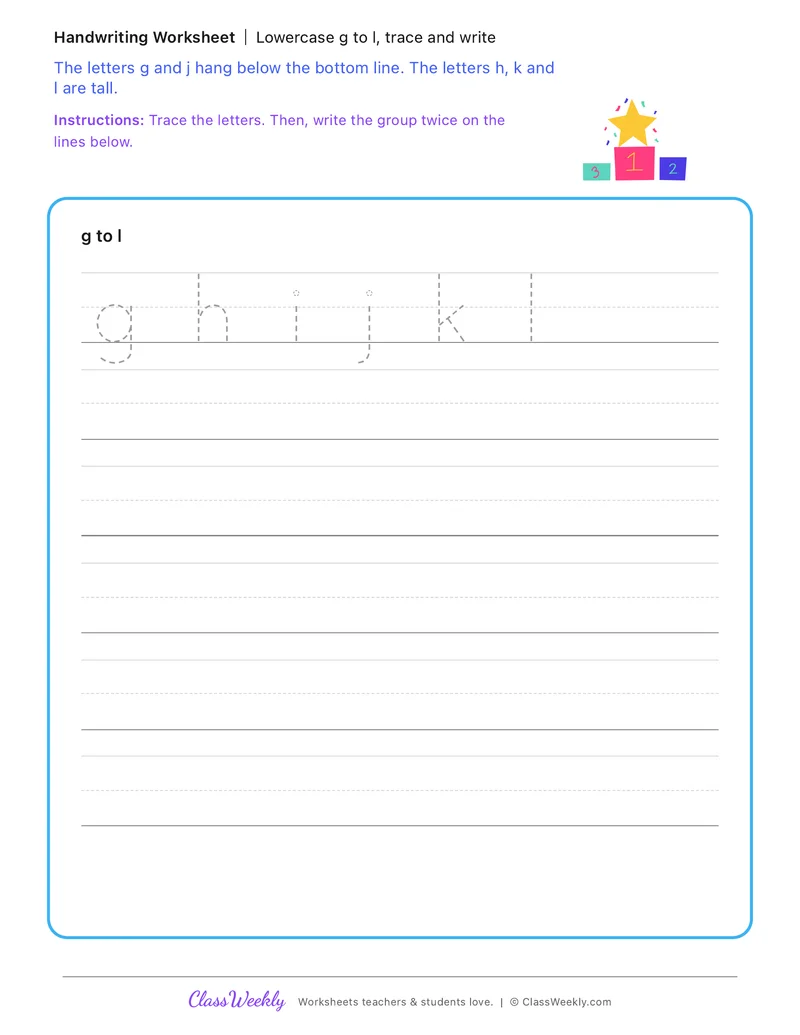
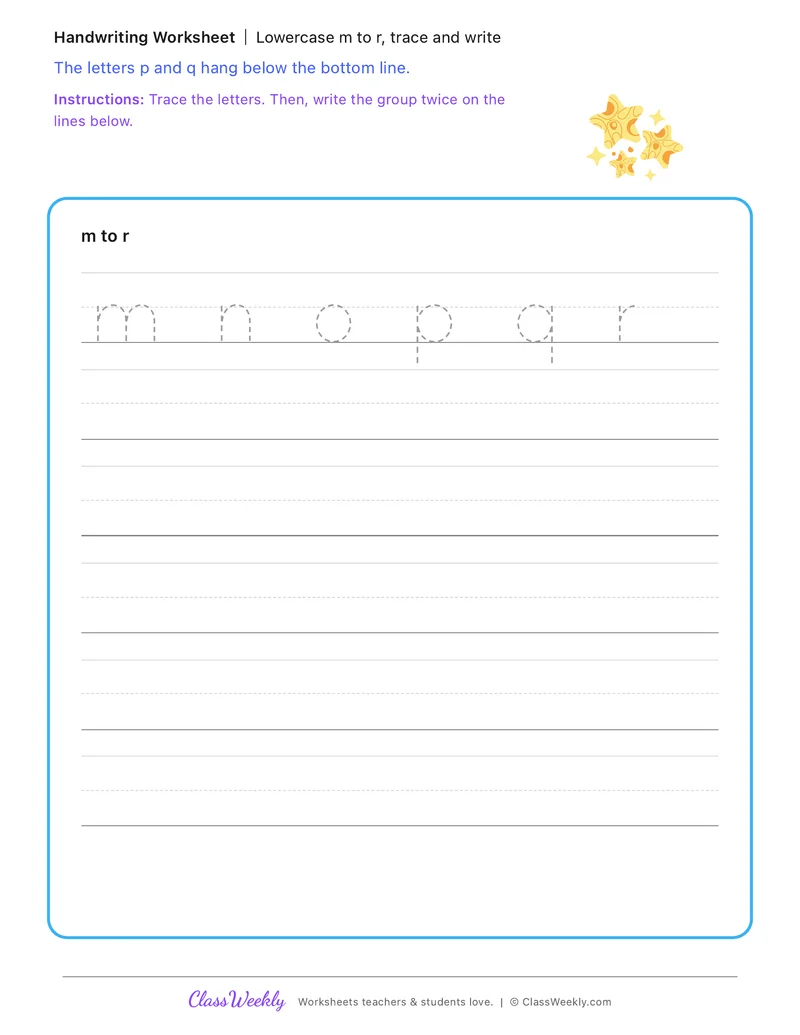
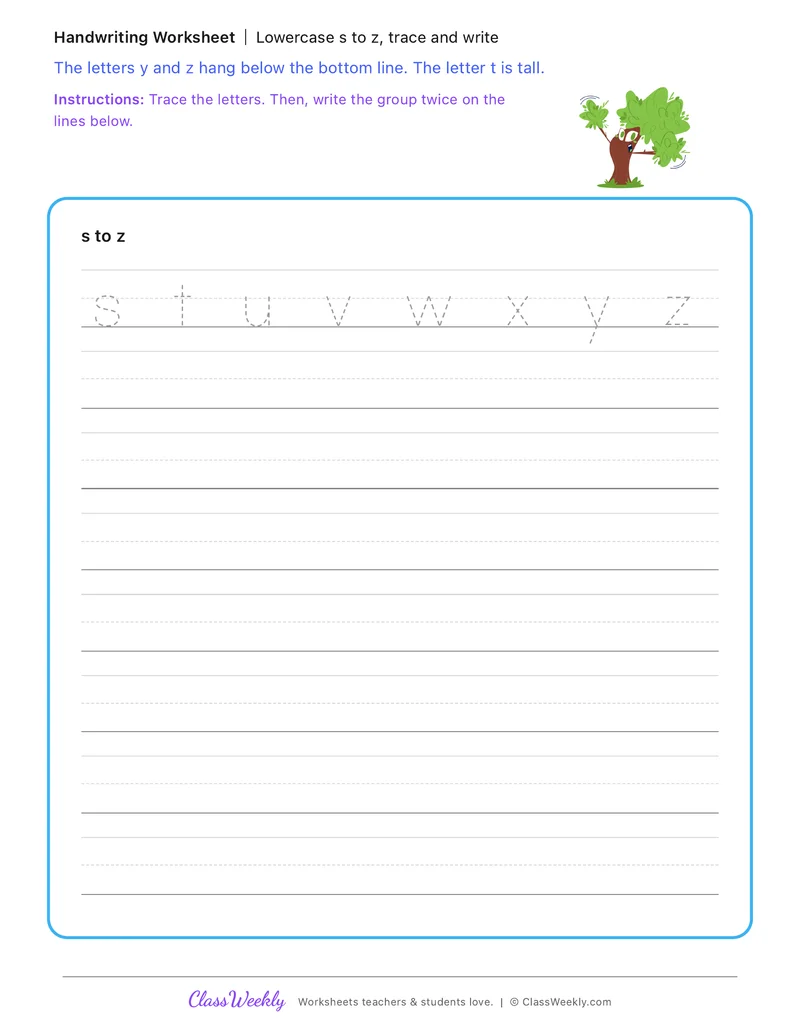
Inconsistent letter size is one of the most common 1st grade handwriting issues, and it's almost always a guideline problem, not a motor skill problem. Make sure your child is actually using the three lines (top, middle dashed, bottom) rather than writing anywhere on the page. Point out which letters should touch which lines: lowercase letters like a, c, and e sit between the middle and bottom line, tall letters like b, d, and l reach the top line, and letters like g, j, p, q, and y drop below the bottom line. Practicing one letter group at a time, rather than mixed letters, makes the size rule easier to apply consistently. This usually resolves within a few weeks of guided practice, faster than most parents expect.
Ratings & Reviews
No reviews yet. Be the first to share what you think.
Reviews are for ClassWeekly members.
Make a Request
Spotted something to fix, or want a worksheet we don't have yet? Tell us and we'll make it.
Worksheet Details
| Grade | 1st Grade |
| Subject | Grammar & Writing |
| Topic | Handwriting |
| Standard | L.1.1.A |
| Pages | 1 page |
| Difficulty | Medium |
What is ClassWeekly?
ClassWeekly offers free worksheets and printable learning resources for kids in preschool to grade 5. All worksheets are aligned to Common Core, NGSS, and C3 Framework standards and designed by educators. Become a member to access the full library and download unlimited PDFs.