Being a good citizen
Written by Adi Ackerman, Head Teacher
"Being a good citizen" is written for 2nd Grade (Ages 7-8), and it covers C3 Framework D2.Civ.7.K-2. If your little one is a year younger but already steady on Citizenship, the page still works. You may just need to read the instructions out loud. And if they are older and being a good citizen never quite stuck, this is a short review rather than busywork.
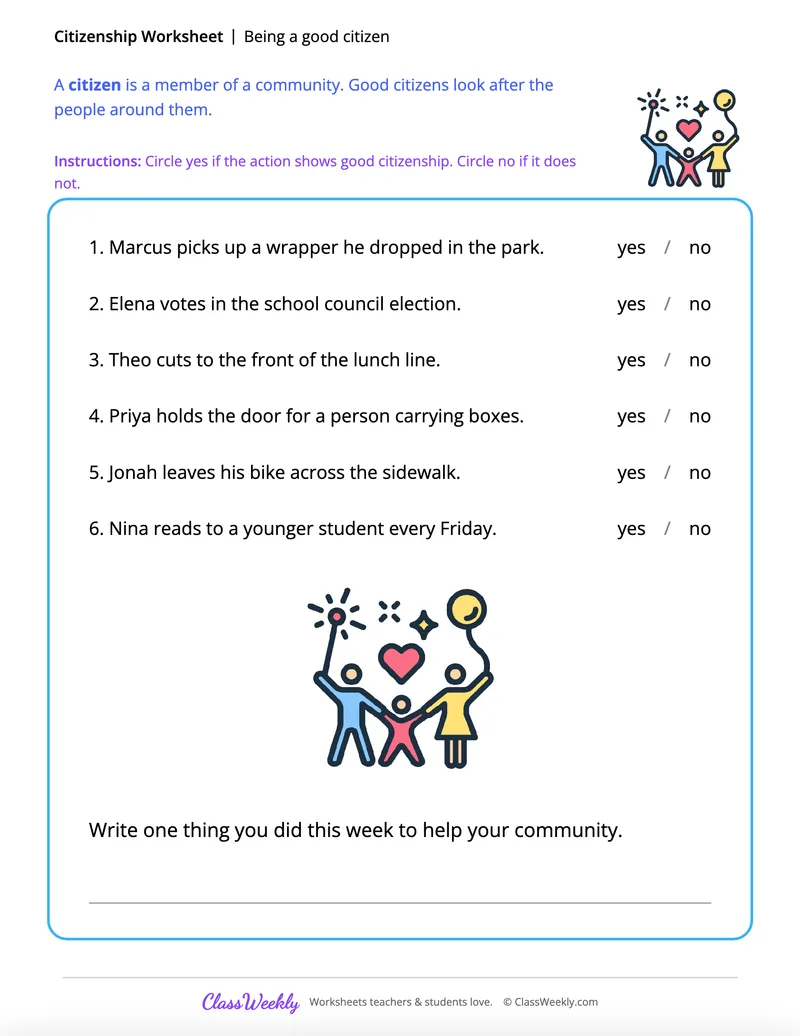
Write about Being a good citizen. A free second grade social studies worksheet from ClassWeekly. Part of our being a good citizen citizenship collection. Aligned to C3 Framework standards.
How do I use this worksheet?
Start with a question students can talk about right away: "What do you already know about being a good citizen?" or a picture on the board to look at together. Then let students work through it independently after a quick group example, checking in with a partner if they get stuck, keeping a map, calendar, or word bank in view if the activity uses one. When you review, ask students what surprised them or what they'd like to find out next. These being a good citizen worksheets work well as a class discussion starter, an independent center activity, or a take-home page to talk about with family.
What students will practice
- Students will describe being a good citizen using vocabulary and examples appropriate for their grade level.
- Students will connect what they observe or read in a short passage about being a good citizen to what they already know.
- Students will use what they learn about being a good citizen to answer questions and explain their thinking.
Curriculum Links
C3 Framework for Social Studies State Standards
Social Studies · 2nd Grade
Find this in the curriculum
Browse the grade, subject, and topic this belongs to.
FAQ
How do I use this being a good citizen worksheet?
⌄
Start with a question students can talk about right away: "What do you already know about being a good citizen?" or a picture on the board to look at together. Then let students work through it independently after a quick group example, checking in with a partner if they get stuck, keeping a map, calendar, or word bank in view if the activity uses one. When you review, ask students what surprised them or what they'd like to find out next. These being a good citizen worksheets work well as a class discussion starter, an independent center activity, or a take-home page to talk about with family.
What does this worksheet teach?
⌄
These being a good citizen worksheets for 2nd grade give students a first hands-on look at one of the big ideas in citizenship. Students label, sort, match, and answer questions that connect being a good citizen to the wider world beyond their own classroom. Each page keeps the vocabulary concrete and the reading light, so the social studies content stays the focus rather than the reading level. Working through being a good citizen on paper gives 2nd grade students a shared reference point for class discussion and a keepsake for what they noticed.
Can I use this being a good citizen worksheet for homeschool or classroom?
⌄
Yes, both. We made it for 2nd Grade Citizenship, and the page works the same whether it lands on a kitchen table or a center rotation. At home, most families go through it together and talk the answers out loud, and that talking is where most of the learning happens with being a good citizen. In class it runs well as independent work while you pull a small group. Print one copy or thirty, whichever the day needs.
What do the two citizenship worksheets in second grade cover?
⌄
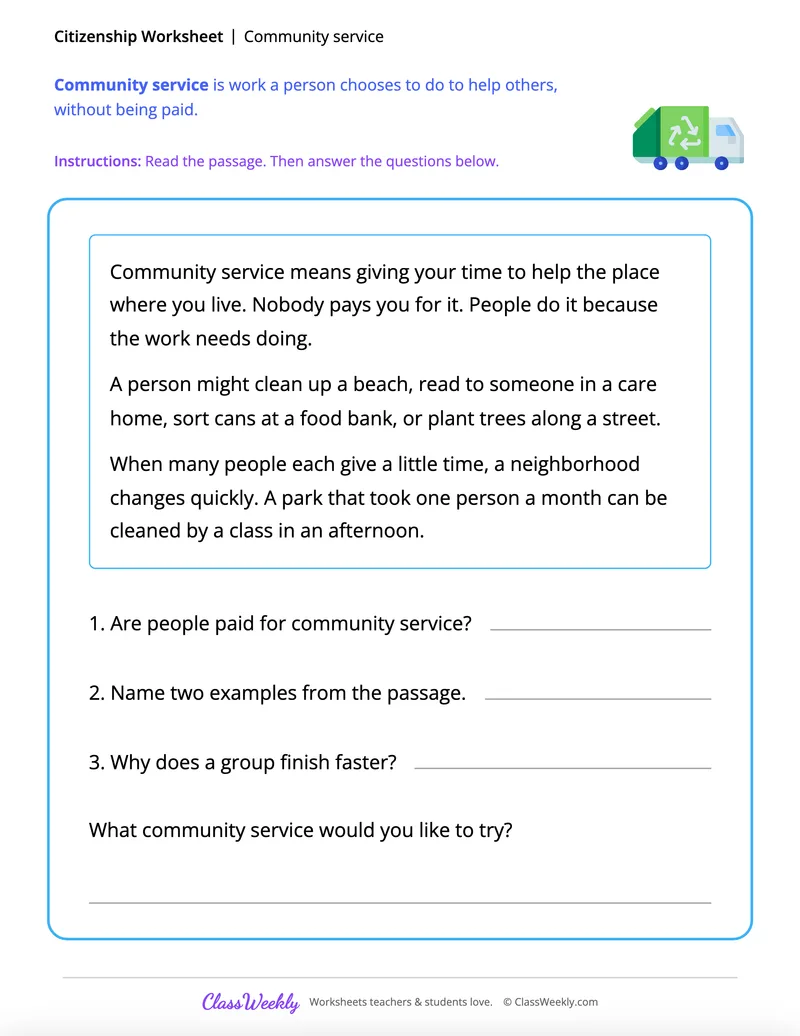
How to Be a Good Citizen asks students to circle yes or no for whether an action shows good citizenship, and What Is Community Service pairs a reading passage, defining community service as work a person chooses to do to help others without being paid, with short-answer questions. Together they build the C3 Framework's civics dimension (D2.Civ.7.K-2), applying civic virtues when participating in school settings.
Why does the good citizenship worksheet use a yes/no format rather than open questions?
⌄
A yes/no judgment call for each action, rather than an open-ended question, forces a student to actually evaluate a specific behavior against the idea of good citizenship, rather than restate a general definition they've memorized, which is a more concrete and checkable form of the same civic-reasoning skill the C3 Framework targets at this level.
How is community service different from the community helper jobs covered elsewhere?
⌄
A community helper, a firefighter or police officer, is paid to do their job; the worksheet's own concept line specifically defines community service as work a person chooses to do without being paid, which is the key distinction second graders need to hold both ideas separately: some help is a paid profession, and some is a voluntary choice, and both matter to how a community runs.
Ratings & Reviews
No reviews yet. Be the first to share what you think.
Reviews are for ClassWeekly members.
Make a Request
Spotted something to fix, or want a worksheet we don't have yet? Tell us and we'll make it.
Worksheet Details
| Grade | 2nd Grade |
| Subject | Social Studies |
| Topic | Citizenship |
| Standard | D2.Civ.7.K-2 |
| Pages | 1 page |
| Difficulty | Medium |
What is ClassWeekly?
ClassWeekly offers free worksheets and printable learning resources for kids in preschool to grade 5. All worksheets are aligned to Common Core, NGSS, and C3 Framework standards and designed by educators. Become a member to access the full library and download unlimited PDFs.