Remembrance Words
Written by Adi Ackerman, Head Teacher
"Remembrance Words - Patriot Day" is written for 3rd Grade (Ages 8-9), and it covers Common Core L.3.4. If your little one is a year younger but already steady on the meanings of words, the page still works. You may just need to read the instructions out loud. And if they are older and words and their meanings never quite stuck, this is a short review rather than busywork.
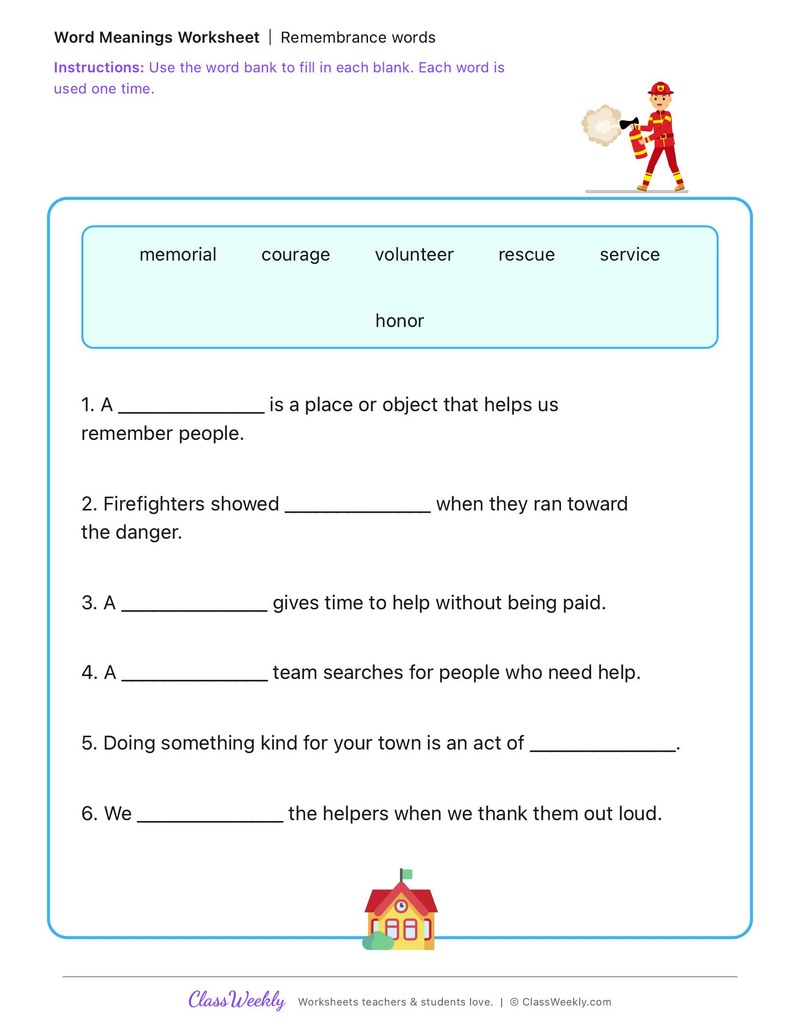
Fill in six sentences using a word bank of memorial, courage, volunteer, rescue, service, and honor. Free printable 3rd grade vocabulary worksheet with answer key. Part of our words and their meanings the meanings of words collection. Aligned to Common Core standards.
How do I use this worksheet?
Use this one last, after the other Meanings-of-Words pages, as a check on what actually stuck rather than a first introduction to any of these words. If a word trips your child up here, that's the one worth a quick one-on-one review rather than moving straight on, since it's already had its first pass and didn't land yet.
What students will practice
- Students will identify and correctly use words and their meanings in sentences and short passages.
- Students will distinguish words and their meanings from related language concepts and apply rules consistently.
- Students will demonstrate understanding of words and their meanings through guided and independent practice, in both reading and their own writing.


Curriculum Links
Common Core State Standards
Vocabulary · 3rd Grade
Find this in the curriculum
Browse the grade, subject, and topic this belongs to.
FAQ
How do I use this words and their meanings worksheet?
⌄
Use this one last, after the other Meanings-of-Words pages, as a check on what actually stuck rather than a first introduction to any of these words. If a word trips your child up here, that's the one worth a quick one-on-one review rather than moving straight on, since it's already had its first pass and didn't land yet.
What does this worksheet teach?
⌄
A broader mixed-practice page covering vocabulary words from across this unit, asking students to connect each one to its meaning using whichever strategy fits: definition, picture, or example sentence. It functions as a review, pulling together the words this catalog's other Meanings-of-Words pages introduced one at a time.
Can I use this words and their meanings worksheet for homeschool or classroom?
⌄
Yes, both. We made it for 3rd Grade the meanings of words, and the page works the same whether it lands on a kitchen table or a center rotation. At home, most families go through it together and talk the answers out loud, and that talking is where most of the learning happens with words and their meanings. In class it runs well as independent work while you pull a small group. Print one copy or thirty, whichever the day needs.
When should this worksheet be used?
⌄
Best used last, after the other Meanings-of-Words worksheets, as a check on what actually stuck rather than a first introduction to any of the words.
What should I do if a word trips my child up here?
⌄
Give it a quick one-on-one review rather than moving on. It's already had its first pass in an earlier worksheet and didn't land yet.
How is this different from the other worksheets in this topic?
⌄
The others each focus on one strategy (definitions, context, shades of meaning). This one mixes strategies together as a broader review.
How is third grade word-meanings work different from earlier grades?
⌄
Third grade adds shades of meaning to the toolkit alongside definitions and context clues (CCSS L.3.5c): students now compare related words like happy, glad, thrilled, and ecstatic and rank them by intensity, rather than just matching a word to one fixed definition. This is the beginning of nuance: recognizing that words which mean roughly the same thing still aren't interchangeable in every sentence.
Why does context clues work show up again in third grade if my child already covered it in first grade?
⌄
Context clues are practiced at every grade because the texts get harder, not because the skill itself is new. A first grader uses context to figure out a simple, concrete word; a third grader uses the same strategy on more abstract vocabulary inside longer paragraphs, often stacked with other reading demands like following a story's plot at the same time. The strategy is the same, but the reading it's applied to has grown up.
What should I do if my child can define a word but still uses it incorrectly in a sentence?
⌄
That gap is common and worth taking seriously rather than dismissing, since it means the word hasn't fully transferred from recognition to use. Ask your child to write their own sentence with the word, then read it back out loud and ask if it sounds right. Producing a sentence (not just matching a definition) is the actual test of whether a word has been learned.
Ratings & Reviews
No reviews yet. Be the first to share what you think.
Reviews are for ClassWeekly members.
Make a Request
Spotted something to fix, or want a worksheet we don't have yet? Tell us and we'll make it.
Worksheet Details
| Grade | 3rd Grade |
| Subject | Vocabulary |
| Topic | The Meanings of Words |
| Standard | L.3.4 |
| Pages | 1 page |
| Difficulty | Medium |
What is ClassWeekly?
ClassWeekly offers free worksheets and printable learning resources for kids in preschool to grade 5. All worksheets are aligned to Common Core, NGSS, and C3 Framework standards and designed by educators. Become a member to access the full library and download unlimited PDFs.