Day of Service, Multi-Step
Written by Adi Ackerman, Head Teacher
"Day of Service, Multi-Step - Patriot Day" is written for 5th Grade (Ages 10-11), and it covers Common Core 5.NBT.B.6. If your little one is a year younger but already steady on word problems, the page still works. You may just need to read the instructions out loud. And if they are older and mixed 4 operations never quite stuck, this is a short review rather than busywork.
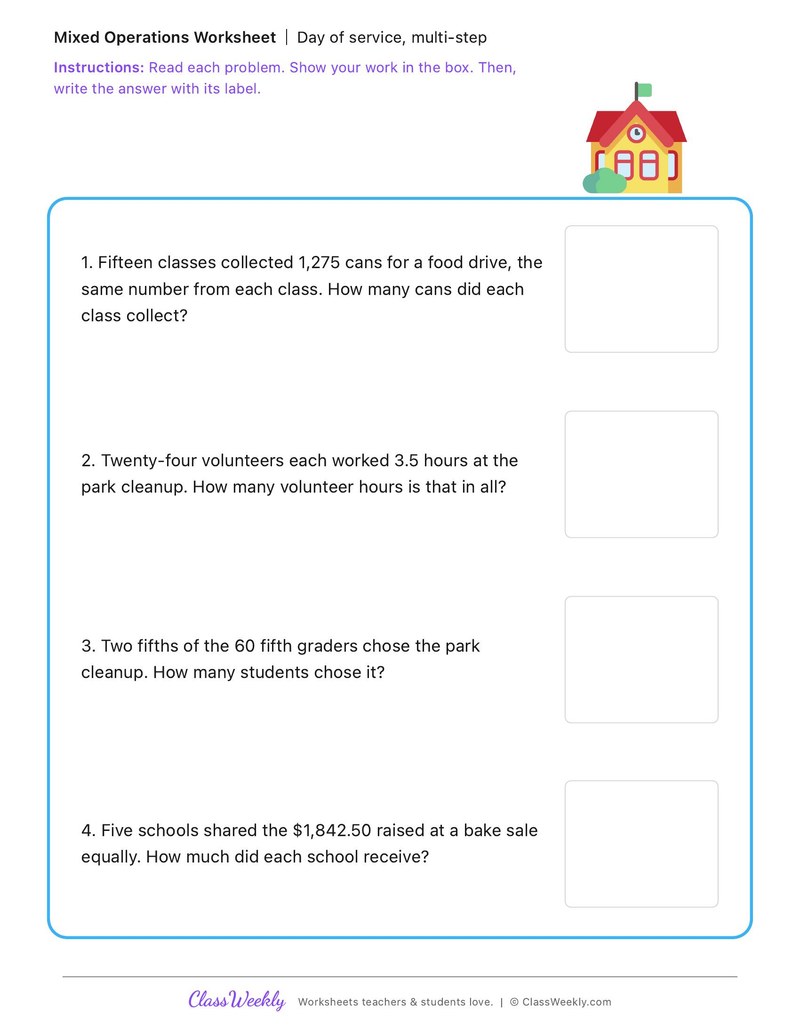
Solve four multi-step word problems mixing division, decimal multiplication, fractions of a set, and equal sharing. Free printable 5th grade math worksheet with answer key. Part of our mixed 4 operations word problems collection. Aligned to Common Core standards.
How do I use this worksheet?
Before handing out the worksheet, briefly introduce the concept with a short oral warm-up or a visual model on the board. Let students work through it independently and self-check their own work against an answer key before you review it as a class, encouraging them to talk through their thinking: "What strategy are you using? How do you know that is right?" After completing the worksheet, review any missed problems together and discuss the reasoning rather than just the answer. For extra support, let students use manipulatives or draw pictures alongside the written problems. These mixed 4 operations worksheets work well as daily practice, homework, or a focused review activity.
What students will practice
- Students will recognize and apply mixed 4 operations concepts using written strategies and mental math.
- Students will solve problems involving mixed 4 operations with increasing accuracy and confidence.
- Students will connect mixed 4 operations skills to real-world situations and explain their reasoning clearly.


Curriculum Links
Common Core State Standards
Number and Operations in Base Ten · 5th Grade
Standard: Find whole-number quotients and remainders with up to four-digit dividends and two-digit divisors.
View all 5.NBT.B.6 worksheets →Find this in the curriculum
Browse the grade, subject, and topic this belongs to.
FAQ
How do I use this mixed 4 operations worksheet?
⌄
Before handing out the worksheet, briefly introduce the concept with a short oral warm-up or a visual model on the board. Let students work through it independently and self-check their own work against an answer key before you review it as a class, encouraging them to talk through their thinking: "What strategy are you using? How do you know that is right?" After completing the worksheet, review any missed problems together and discuss the reasoning rather than just the answer. For extra support, let students use manipulatives or draw pictures alongside the written problems. These mixed 4 operations worksheets work well as daily practice, homework, or a focused review activity.
What does this worksheet teach?
⌄
These mixed 4 operations worksheets for 5th grade give students the structured, hands-on practice they need to build confidence and fluency. Students work through a range of problem formats, from visual models and diagrams to written equations and word problems, so they encounter mixed 4 operations from every angle. Each worksheet is designed to build on prior knowledge while introducing the level of challenge appropriate for 5th grade. Practicing mixed 4 operations at this stage strengthens the mathematical foundations that support more advanced concepts in later grades.
Can I use this mixed 4 operations worksheet for homeschool or classroom?
⌄
Yes, both. We made it for 5th Grade word problems, and the page works the same whether it lands on a kitchen table or a center rotation. At home, most families go through it together and talk the answers out loud, and that talking is where most of the learning happens with mixed 4 operations. In class it runs well as independent work while you pull a small group. Print one copy or thirty, whichever the day needs.
What makes mixed 4-operations word problems particularly challenging?
⌄
Students must read carefully to determine which operations to apply and in which order, without the contextual cue of a single-topic section - identifying operation clues and distinguishing multi-step from single-step problems are the key challenges.
What strategies help students tackle multi-step mixed operation word problems?
⌄
Reading the problem fully before writing any math, underlining key quantities and operation keywords, drawing a diagram or organizing given information in a table, and labeling each step clearly all improve accuracy on multi-step problems.
How do mixed operation word problems connect to real-world mathematical reasoning?
⌄
Real-world problems (planning a budget, comparing purchase options, splitting group expenses) rarely signal which operation to use - mixed operation practice is the closest simulation of authentic quantitative reasoning students will encounter outside school.
How do fifth graders approach multi-step word problems?
⌄
Multi-step word problems require selecting the correct operations, ordering them, and keeping intermediate results organized (CCSS 5.OA, 5.NBT, 5.NF, 5.MD). A reliable problem-solving framework is: (1) read the problem and identify what is being asked, (2) identify the given information and what is missing, (3) determine what operations are needed and in what order, (4) compute each step, and (5) check whether the final answer is reasonable in the context of the problem. The Read-Draw-Write strategy (read the problem, draw a visual representation, write the equation) is widely used in elementary classrooms. Common errors include performing the right operations in the wrong order, using all numbers in the problem without assessing which are relevant (some word problems include extraneous information), and forgetting the unit in the final answer. Worksheets that present multi-step problems with workspace organized into labeled steps (what I know, what I need to find, my work, my answer) scaffold the organization without reducing the mathematical demand.
What strategies help fifth graders solve fraction word problems?
⌄
Fraction word problems are among the most challenging at the fifth-grade level because they combine reading comprehension, fraction computation, and contextual interpretation. Two visual strategies are particularly effective: tape diagrams (also called bar models) and fraction circles. A tape diagram for a problem like Sarah had 3/4 of a pizza and ate 1/3 of what she had shows the 3/4 divided into thirds, making 1/3 of 3/4 equal to 1/4 visible and concrete. Key vocabulary that determines the operation: of means multiply (1/3 of 3/4), split between or shared equally means divide, and how much more means subtract. Students frequently confuse the whole (the reference unit) in problems where the whole changes: giving away 2/5 of a 30-item collection leaves 18 items, but now those 18 items are the new whole for any subsequent fractions. Worksheets that explicitly label the whole in each step of a solution model, and that include both one-step and two-step fraction problems, build the flexibility to handle changing wholes.
How do you teach fifth graders to check their word problem answers?
⌄
Answer-checking strategies work only if students have estimated before computing, so estimation must be a required step rather than an afterthought. For computation with whole numbers, round all values to the leading digit and compute mentally: a problem involving 47 and 23 should give an answer near 50 times 20 equals 1000 for multiplication or near 50 minus 20 equals 30 for subtraction. For fractions, use benchmark fractions: 5/8 is close to 1/2, so 5/8 of 40 should be close to 20. For measurement conversions, check whether the answer is in larger or smaller units and whether it should therefore be a bigger or smaller number. A qualitative reasonableness check: re-read the question and ask whether the answer makes sense in real life. The price of one apple cannot be $147; the length of a classroom cannot be 3 miles. Worksheets that include a required reasonableness box (is this answer reasonable? explain why) build the checking habit rather than leaving it as optional. Students who skip estimation consistently miss errors that an estimate would immediately flag.
Ratings & Reviews
No reviews yet. Be the first to share what you think.
Reviews are for ClassWeekly members.
Make a Request
Spotted something to fix, or want a worksheet we don't have yet? Tell us and we'll make it.
Worksheet Details
| Grade | 5th Grade |
| Subject | Math |
| Topic | Word Problems |
| Standard | 5.NBT.B.6 |
| Pages | 1 page |
| Difficulty | Medium |
Learn More
What is ClassWeekly?
ClassWeekly offers free worksheets and printable learning resources for kids in preschool to grade 5. All worksheets are aligned to Common Core, NGSS, and C3 Framework standards and designed by educators. Become a member to access the full library and download unlimited PDFs.