The Fox Who Skipped Practice (Fable)
Written by Adi Ackerman, Head Teacher
"The Fox Who Skipped Practice (Fable)" is written for 1st Grade (Ages 6-7), and it covers Common Core RL.1.2. If your little one is a year younger but already steady on fables, the page still works. You may just need to read the instructions out loud. And if they are older and fables with lessons never quite stuck, this is a short review rather than busywork.
2 pages in this set
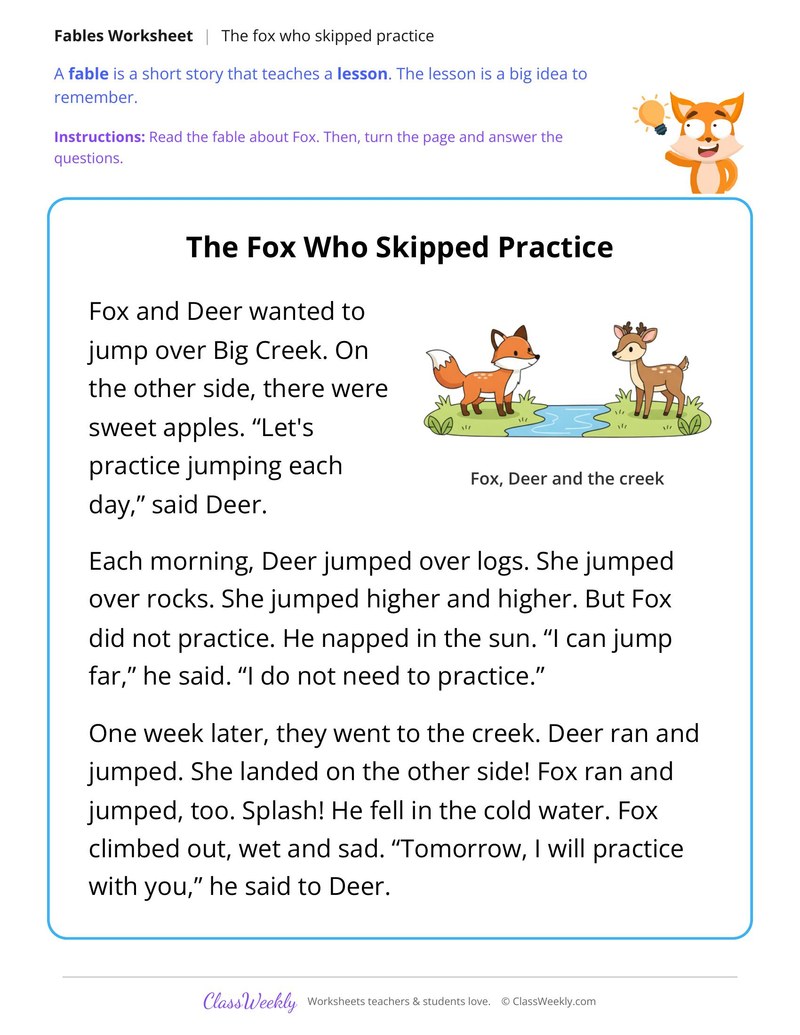
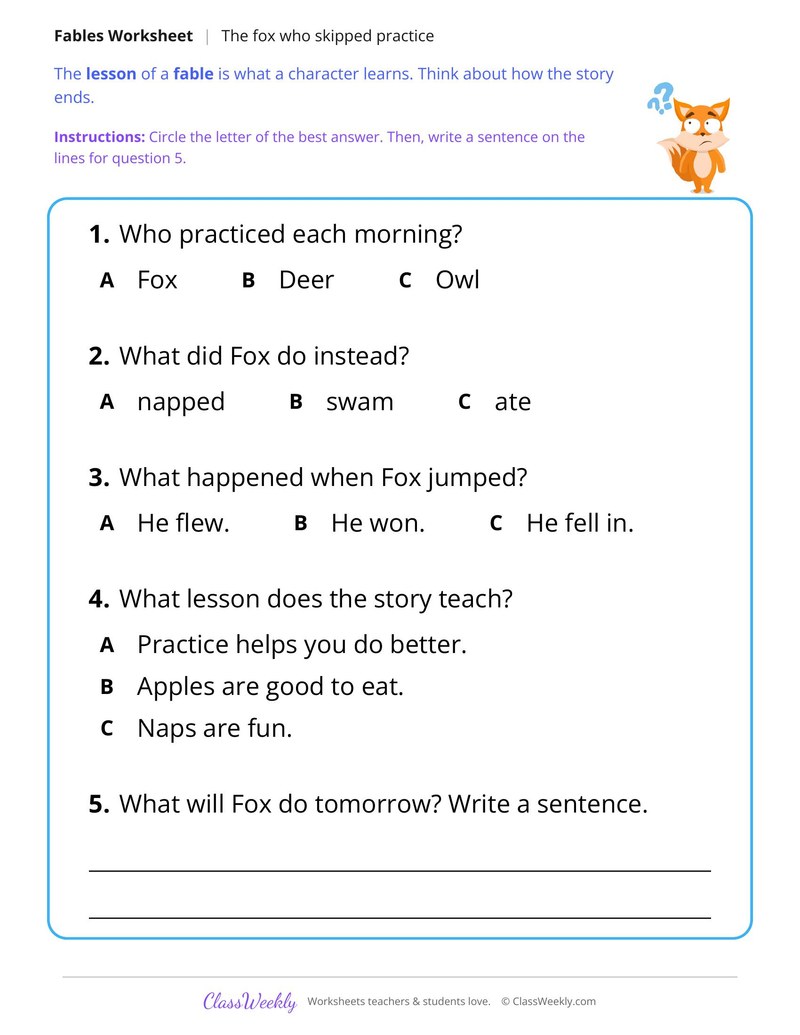
1st grade reading worksheet: read the fable of the fox who skips jump practice, pick the lesson practice pays off. Answer key included. Part of our fables with lessons collection. Aligned to Common Core standards.
How do I use this worksheet?
Read the fable together, then talk about what the main character did before turning the page. Ask your child to say the lesson in their own words. Check with the answer key.
What students will practice
- Students will read a short fable with animal characters.
- Students will answer questions about what happens in the story.
- Students will choose the lesson the fable teaches.
Curriculum Links
Common Core State Standards
Reading · 1st Grade
Find this in the curriculum
Browse the grade, subject, and topic this belongs to.
FAQ
How do I use this fables with lessons worksheet?
⌄
Read the fable together, then talk about what the main character did before turning the page. Ask your child to say the lesson in their own words. Check with the answer key.
What does this worksheet teach?
⌄
Read the fable of the fox who skips jump practice, pick the lesson practice pays off. A fable is a short story that teaches a lesson. The lesson is a big idea to remember. The directions on the page read: Read the fable about Fox. Then, turn the page and answer the questions. On page 2: Circle the letter of the best answer. Then, write a sentence on the lines for question 5. The answer key covers the questions on page 2.
Can I use this fables with lessons worksheet for homeschool or classroom?
⌄
Yes, both. We made it for 1st Grade fables, and the page works the same whether it lands on a kitchen table or a center rotation. At home, most families go through it together and talk the answers out loud, and that talking is where most of the learning happens with fables with lessons. In class it runs well as independent work while you pull a small group. Print one copy or thirty, whichever the day needs.
What is a fable?
⌄
A fable is a short story, often with talking animals, that teaches a lesson. The lesson is sometimes called the moral.
How do 1st graders find the lesson in a fable?
⌄
Ask what the main character did and what happened because of it. Owl talks so much that she never listens, so the lesson is to listen first. Telling the lesson of a story is part of RL.1.2.
How should I read these fables with my child?
⌄
Read the fable together, or let your child read it aloud. Talk about what happened before turning the page to the questions, then ask how the lesson fits your child's own day.
Is there an answer key for each worksheet?
⌄
Yes. All nine fables have an answer key for the question page.
Why are fables good reading material for first graders?
⌄
Fables are short, follow a predictable structure, and end with a clear lesson, which makes them ideal for teaching central message. CCSS RL.1.2 asks first graders to retell stories and demonstrate understanding of their central message or lesson, and fables make that lesson explicit and discussable. Because fables feature animal characters with strong traits, they also give children easy practice describing characters and their actions (RL.1.3).
How do I help my first grader find the moral of a fable?
⌄
After reading, ask three questions in order: What did the character want? What went wrong or right? What should the character have done? The answer to the third question usually points to the moral. Then connect it to real life: ask when your child has seen the same lesson at school or home. Avoid just telling them the moral; working it out from the events is the comprehension skill being practiced.
What do rhyming poems teach first grade readers?
⌄
Rhyming poems strengthen two skills at once. The rhymes reinforce phonemic awareness and word families (cat, hat, sat), which supports decoding. The rhythm and repeated lines build fluency, because children naturally read poems with phrasing and expression instead of word by word. CCSS RL.1.10 includes poetry in the range of texts first graders should read. Reading a short poem aloud several times is one of the simplest fluency exercises available.
Ratings & Reviews
No reviews yet. Be the first to share what you think.
Reviews are for ClassWeekly members.
Make a Request
Spotted something to fix, or want a worksheet we don't have yet? Tell us and we'll make it.
What is ClassWeekly?
ClassWeekly offers free worksheets and printable learning resources for kids in preschool to grade 5. All worksheets are aligned to Common Core, NGSS, and C3 Framework standards and designed by educators. Become a member to access the full library and download unlimited PDFs.