Melt, Freeze, Evaporate or Condense?
Written by Adi Ackerman, Head Teacher
"Melt, Freeze, Evaporate or Condense?" is written for 2nd Grade (Ages 7-8), and it covers NGSS 2-PS1-4. If your little one is a year younger but already steady on material properties, the page still works. You may just need to read the instructions out loud. And if they are older and physical changes never quite stuck, this is a short review rather than busywork.
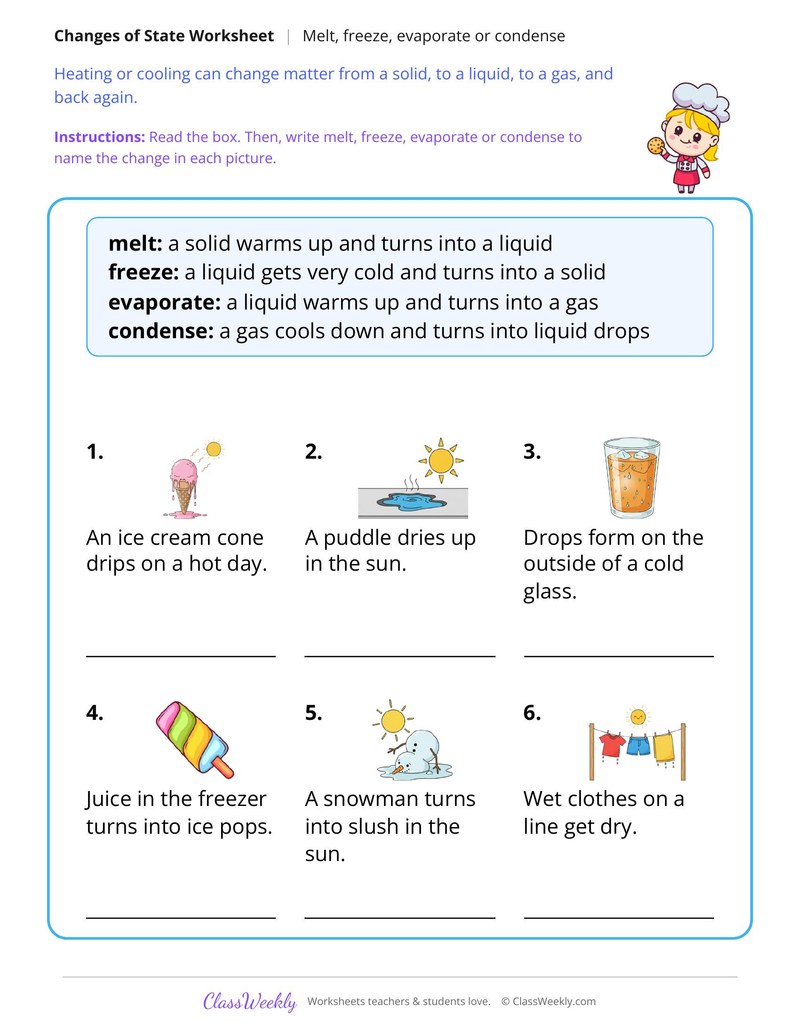
2nd grade science worksheet: name melt, freeze, evaporate or condense for six changes such as a dripping ice cream cone. Answer key included. Part of our physical changes material properties collection. Aligned to NGSS standards.
How do I use this worksheet?
Start with something students can look at or think about: a photo, a short video, a jar on the windowsill, or a question like "what do you already know about physical changes?" Then let them work through it independently after a quick group example, checking in with a partner if they get stuck, keeping a word bank or anchor chart in view so the vocabulary stays available. When you review, ask students how they knew, and let them point to the part of the diagram or reading that told them. These physical changes worksheets work well as a lead in before an investigation, as a way to capture what students noticed afterward, or as review before an assessment.
What students will practice
- Identify physical changes in matter such as cutting, melting, and bending
- Explain that physical changes do not create a new substance
- Give two examples of physical changes from everyday life and describe what changed


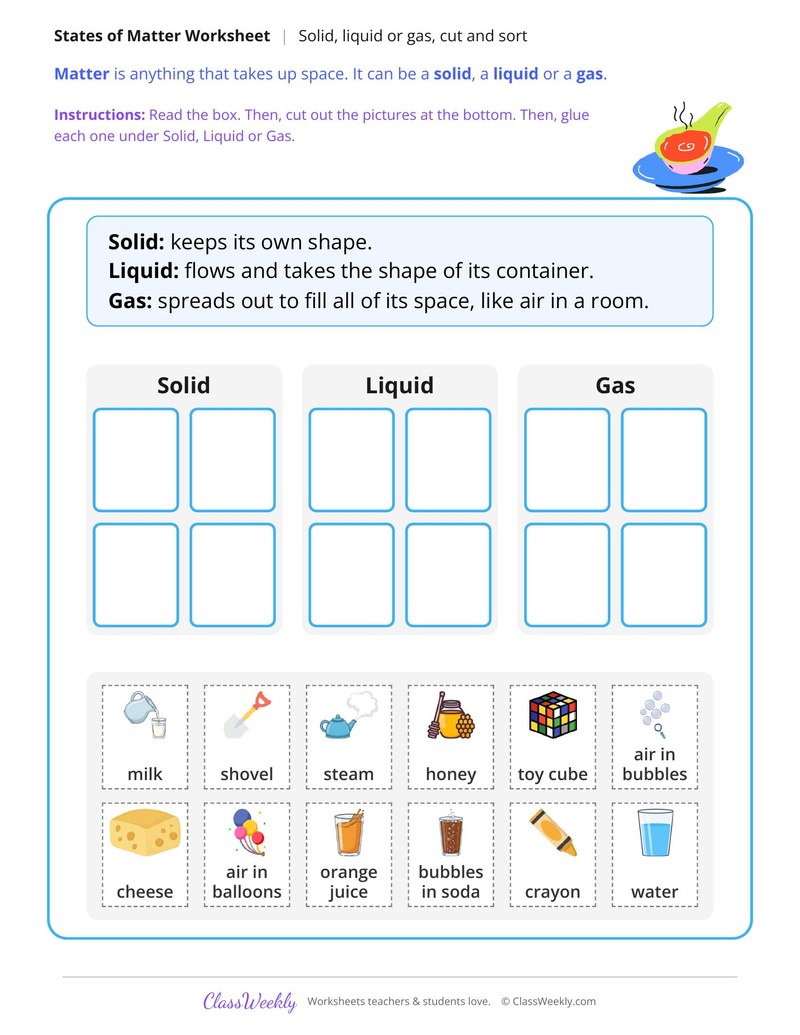
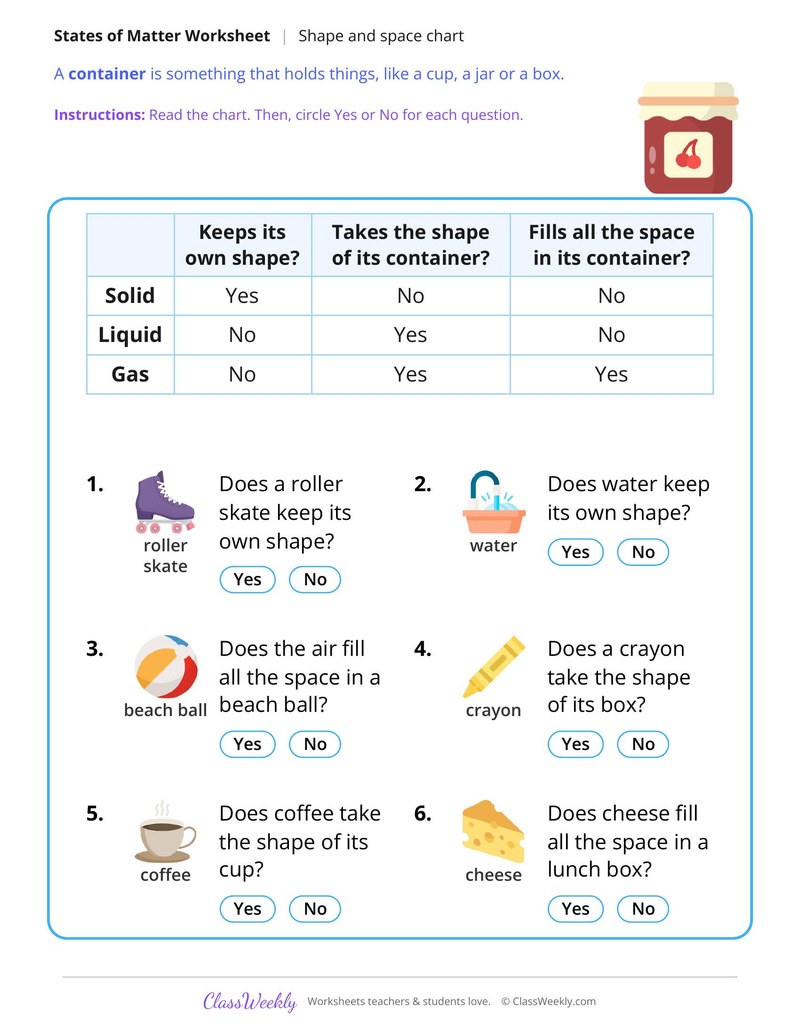
Curriculum Links
Next Generation Science Standards
Science · 2nd Grade
Find this in the curriculum
Browse the grade, subject, and topic this belongs to.
FAQ
How do I use this physical changes worksheet?
⌄
Start with something students can look at or think about: a photo, a short video, a jar on the windowsill, or a question like "what do you already know about physical changes?" Then let them work through it independently after a quick group example, checking in with a partner if they get stuck, keeping a word bank or anchor chart in view so the vocabulary stays available. When you review, ask students how they knew, and let them point to the part of the diagram or reading that told them. These physical changes worksheets work well as a lead in before an investigation, as a way to capture what students noticed afterward, or as review before an assessment.
What does this worksheet teach?
⌄
Name melt, freeze, evaporate or condense for six changes such as a dripping ice cream cone. Heating or cooling can change matter from a solid, to a liquid, to a gas, and back again. The directions on the page read: Read the box. Then, write melt, freeze, evaporate or condense to name the change in each picture. The answer key shows every answer.
Can I use this physical changes worksheet for homeschool or classroom?
⌄
Yes, both. We made it for 2nd Grade material properties, and the page works the same whether it lands on a kitchen table or a center rotation. At home, most families go through it together and talk the answers out loud, and that talking is where most of the learning happens with physical changes. In class it runs well as independent work while you pull a small group. Print one copy or thirty, whichever the day needs.
What do physical changes worksheets teach second graders?
⌄
Students learn that physical changes alter the form or appearance of a material but not its chemical identity, cut paper is still paper, melted wax is still wax. For 7-8 year olds, sorting familiar examples into 'physical change' and 'new substance formed' categories builds the foundational distinction between physics and chemistry.
When do second graders learn about physical changes?
⌄
Physical changes are introduced in Grade 2 physical science as part of matter properties units. Most state standards include this topic as a precursor to chemical changes, which are explored more fully in Grade 5 and middle school.
How can I use these worksheets at home?
⌄
Conduct a series of simple physical change experiments, tear paper, fold foil, dissolve sugar in water, melt chocolate, and use the worksheets to classify and describe each change. Encourage your child to ask: is this still the same stuff, just different looking? That question is the heart of physical versus chemical change.
How many 2nd Grade physical changes worksheets are there?
⌄
1 printable worksheet, free to preview. Downloads are included with a ClassWeekly free trial, and every page prints on standard 8.5 x 11 paper.
What age are physical changes worksheets for?
⌄
These are written for 2nd Grade students, roughly ages 7-8. Many teachers also use them a grade up for review or a grade down as an extension, so use the preview to judge the fit for a particular child.
Are these physical changes worksheets aligned to NGSS?
⌄
Yes. Each one shows the NGSS code it covers on its own page, so you can check the alignment yourself rather than taking our word for it.
Ratings & Reviews
No reviews yet. Be the first to share what you think.
Reviews are for ClassWeekly members.
Make a Request
Spotted something to fix, or want a worksheet we don't have yet? Tell us and we'll make it.
Worksheet Details
| Grade | 2nd Grade |
| Subject | Science |
| Topic | Material Properties |
| Standard | 2-PS1-4 |
| Pages | 1 page |
| Difficulty | Medium |
Learn More
What is ClassWeekly?
ClassWeekly offers free worksheets and printable learning resources for kids in preschool to grade 5. All worksheets are aligned to Common Core, NGSS, and C3 Framework standards and designed by educators. Become a member to access the full library and download unlimited PDFs.