Matter True or False
Written by Adi Ackerman, Head Teacher
"Matter True or False" is written for 1st Grade (Ages 6-7). If your little one is a year younger but already steady on material properties, the page still works. You may just need to read the instructions out loud. And if they are older and solids, liquids and gases never quite stuck, this is a short review rather than busywork.
2 pages in this set
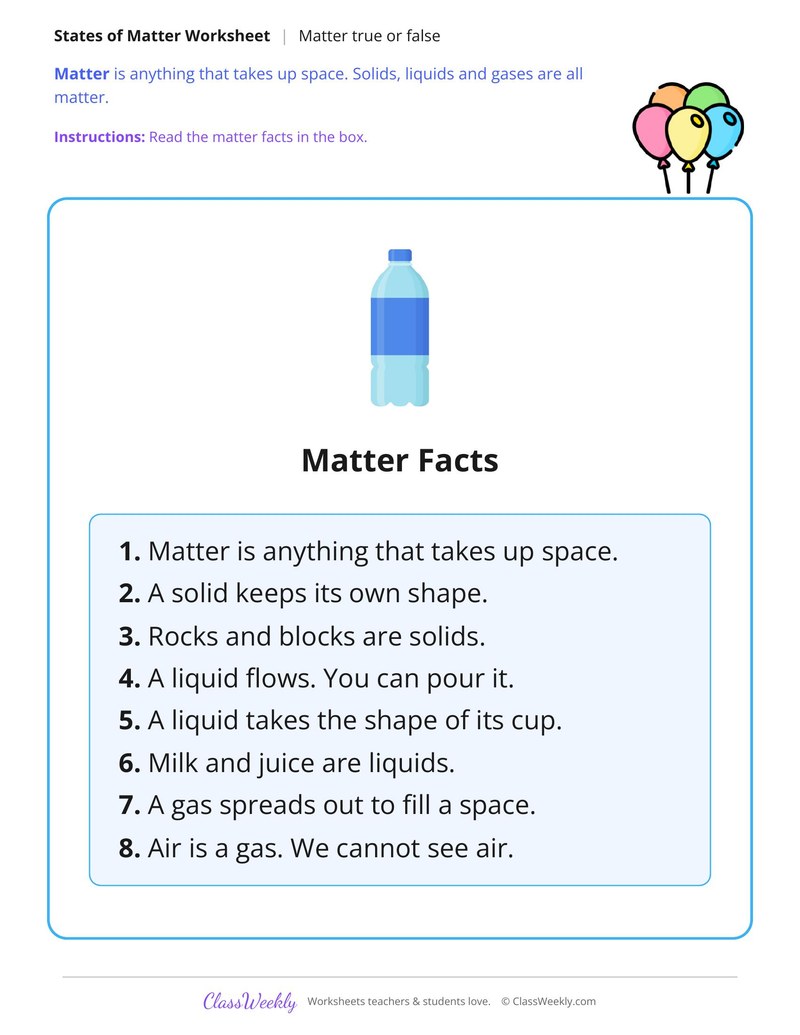
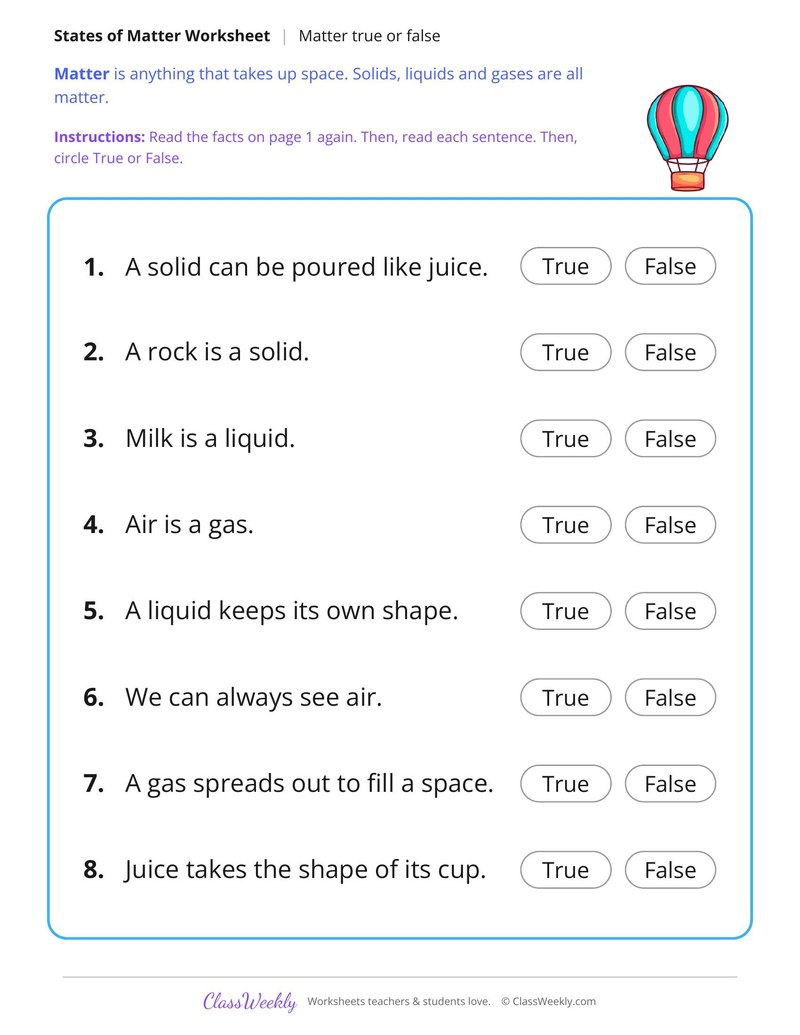
1st grade science worksheet: use a box of matter facts to circle true or false for eight statements. Answer key included. Part of our solids, liquids and gases material properties collection. Aligned to NGSS standards.
How do I use this worksheet?
Start with something students can look at or think about: a photo, a short video, a jar on the windowsill, or a question like "what do you already know about solids, liquids and gases?" Then let them work through the first item together as a class, then finish the rest independently or with a partner, keeping a word bank or anchor chart in view so the vocabulary stays available. When you review, ask students how they knew, and let them point to the part of the diagram or reading that told them. These solids, liquids and gases worksheets work well as a lead in before an investigation, as a way to capture what students noticed afterward, or as review before an assessment.
What students will practice
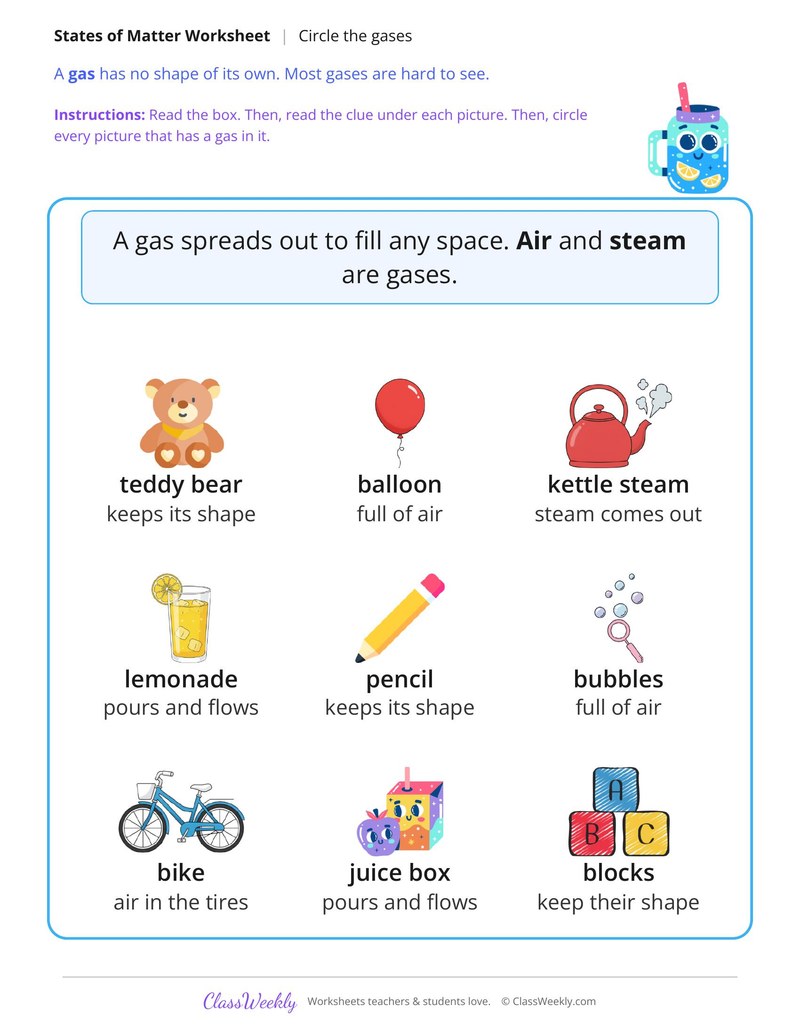
- Identify examples of solids, liquids, and gases from everyday life
- Describe one property that makes each state of matter different from the others
- Explain what happens when a solid melts or a liquid freezes


Curriculum Links
Find this in the curriculum
Browse the grade, subject, and topic this belongs to.
FAQ
How do I use this solids, liquids and gases worksheet?
⌄
Start with something students can look at or think about: a photo, a short video, a jar on the windowsill, or a question like "what do you already know about solids, liquids and gases?" Then let them work through the first item together as a class, then finish the rest independently or with a partner, keeping a word bank or anchor chart in view so the vocabulary stays available. When you review, ask students how they knew, and let them point to the part of the diagram or reading that told them. These solids, liquids and gases worksheets work well as a lead in before an investigation, as a way to capture what students noticed afterward, or as review before an assessment.
What does this worksheet teach?
⌄
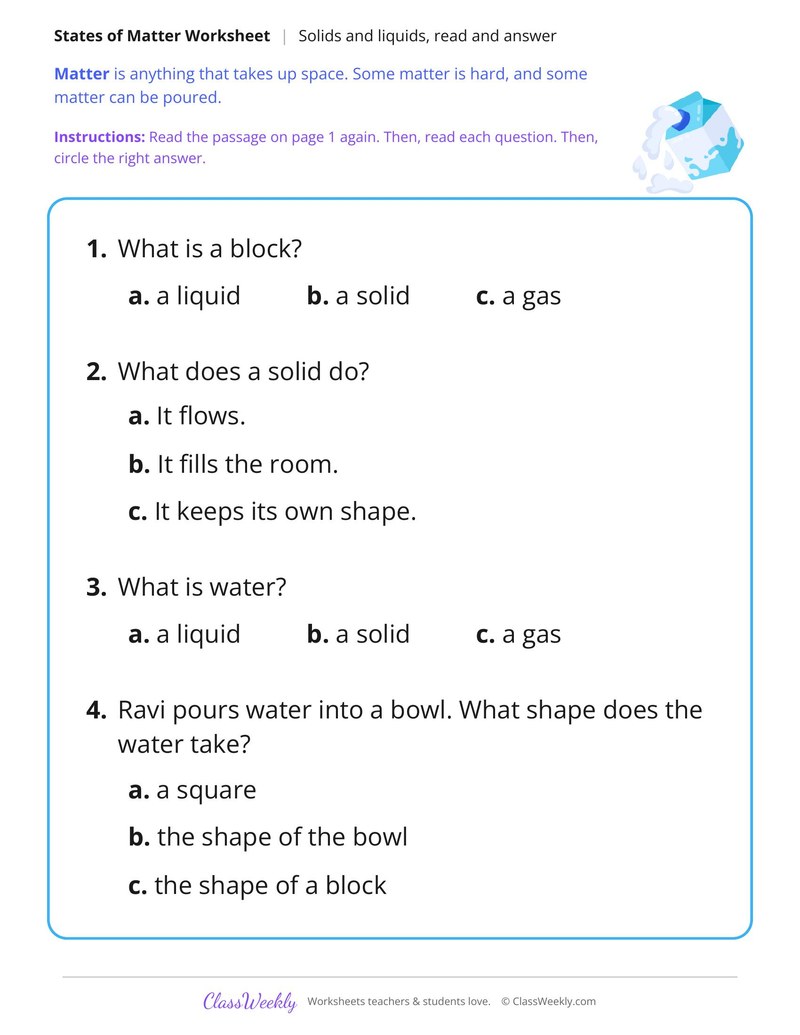
Use a box of matter facts to circle true or false for eight statements. Matter is anything that takes up space. Solids, liquids and gases are all matter. The directions on the page read: Read the matter facts in the box. On page 2: Read the facts on page 1 again. Then, read each sentence. Then, circle True or False. The answer key covers the questions on page 2.
Can I use this solids, liquids and gases worksheet for homeschool or classroom?
⌄
Yes, both. We made it for 1st Grade material properties, and the page works the same whether it lands on a kitchen table or a center rotation. At home, most families go through it together and talk the answers out loud, and that talking is where most of the learning happens with solids, liquids and gases. In class it runs well as independent work while you pull a small group. Print one copy or thirty, whichever the day needs.
What does solids, liquids, and gases teach first graders?
⌄
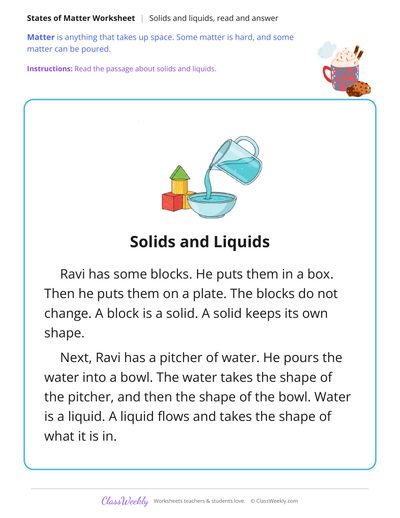
First graders learn that matter exists in three states and that each state behaves differently: solids have a fixed shape, liquids flow and take the shape of their container, and gases spread out to fill their container. They identify familiar examples of each state and explore simple examples of state changes, like ice melting to water.
When do first graders learn about solids, liquids, and gases?
⌄
The three states of matter are typically introduced in Grade 1 during a physical science or matter unit. Teachers often use water in its three forms, ice, liquid water, and steam (carefully), as a central example.
How can I use these worksheets at home?
⌄
Cook or bake together and point out examples of all three states: the solid butter, the liquid oil, the steam rising from a pot. Ask your child to classify what they see and explain their reasoning. Watching ice melt in a glass at the table is also a simple, engaging demonstration of a state change.
How many 1st Grade solids, liquids and gases worksheets are there?
⌄
6 printable worksheets, all free to preview. Downloads are included with a ClassWeekly free trial, and every page prints on standard 8.5 x 11 paper.
What age are solids, liquids and gases worksheets for?
⌄
These are written for 1st Grade students, roughly ages 6-7. Many teachers also use them a grade up for review or a grade down as an extension, so use the preview to judge the fit for a particular child.
Are these solids, liquids and gases worksheets aligned to NGSS?
⌄
Yes. Each one shows the NGSS code it covers on its own page, so you can check the alignment yourself rather than taking our word for it.
Ratings & Reviews
No reviews yet. Be the first to share what you think.
Reviews are for ClassWeekly members.
Make a Request
Spotted something to fix, or want a worksheet we don't have yet? Tell us and we'll make it.
Worksheet Details
| Grade | 1st Grade |
| Subject | Science |
| Topic | Material Properties |
| Pages | 2 pages |
| Difficulty | Medium |
Learn More
What is ClassWeekly?
ClassWeekly offers free worksheets and printable learning resources for kids in preschool to grade 5. All worksheets are aligned to Common Core, NGSS, and C3 Framework standards and designed by educators. Become a member to access the full library and download unlimited PDFs.