Pancake Day (Shrove Tuesday) 2027
Taught in US schools

Key Takeaways
- Pancake Day (Shrove Tuesday) falls on February 9, 2027, a culturally rich anchor for history, storytelling, and community discussion
- Students in Kindergarten–Grade 2 can explore the origins, traditions, and significance of this day through age-appropriate learning
- Hands-on activities, games, and grade-level discussions make Pancake Day (Shrove Tuesday) memorable and educationally meaningful
- In the classroom, Pancake Day (Shrove Tuesday) connects to: Pancake races, Lent preparation
What’s Taught
Pancake races, Lent preparation
The History of Pancake Day (Shrove Tuesday)
Pancake Day (Shrove Tuesday) has a rich history that stretches back decades, and in some cases, centuries. Flip into Pancake Day with fun sequencing worksheets, pancake-race math problems, and a peek at the Shrove Tuesday tradition before Lent. Understanding where this day comes from gives students the context to truly appreciate its meaning in the present.
Over time, Pancake Day (Shrove Tuesday) has evolved from its origins into a widely recognized occasion observed in schools, communities, and households across the United States. On February 9, 2027, millions of students, families, and educators will pause to honor what this day represents.
For young learners, exploring the "why" behind Pancake Day (Shrove Tuesday) builds historical thinking and cultural literacy, skills that transfer across every subject and every grade level.
Why Pancake Day (Shrove Tuesday) Matters in the Classroom
Holidays and observances anchor the school year with moments of shared meaning. When teachers take time to explore Pancake Day (Shrove Tuesday) with students, they signal that learning is connected to real life, not confined to textbooks.
Research consistently shows that culturally responsive teaching improves engagement, retention, and belonging. When students see their communities reflected in classroom content, and when all students learn about each other's traditions, everyone benefits. Pancake Day (Shrove Tuesday) is an entry point into that kind of teaching.
For students in Kindergarten–Grade 2, this event also builds the social-emotional foundations that underpin all academic success: empathy, perspective-taking, and a sense of connection to something larger than themselves.
How to Teach Pancake Day (Shrove Tuesday) by Grade Level
Kindergarten
For kindergarteners, make Pancake Day (Shrove Tuesday) concrete and sensory. Use picture books, puppets, songs, and simple art activities to introduce the key concept. Focus on one big idea, "we are all connected" or "the world is changing", and return to it throughout the day through different experiences.
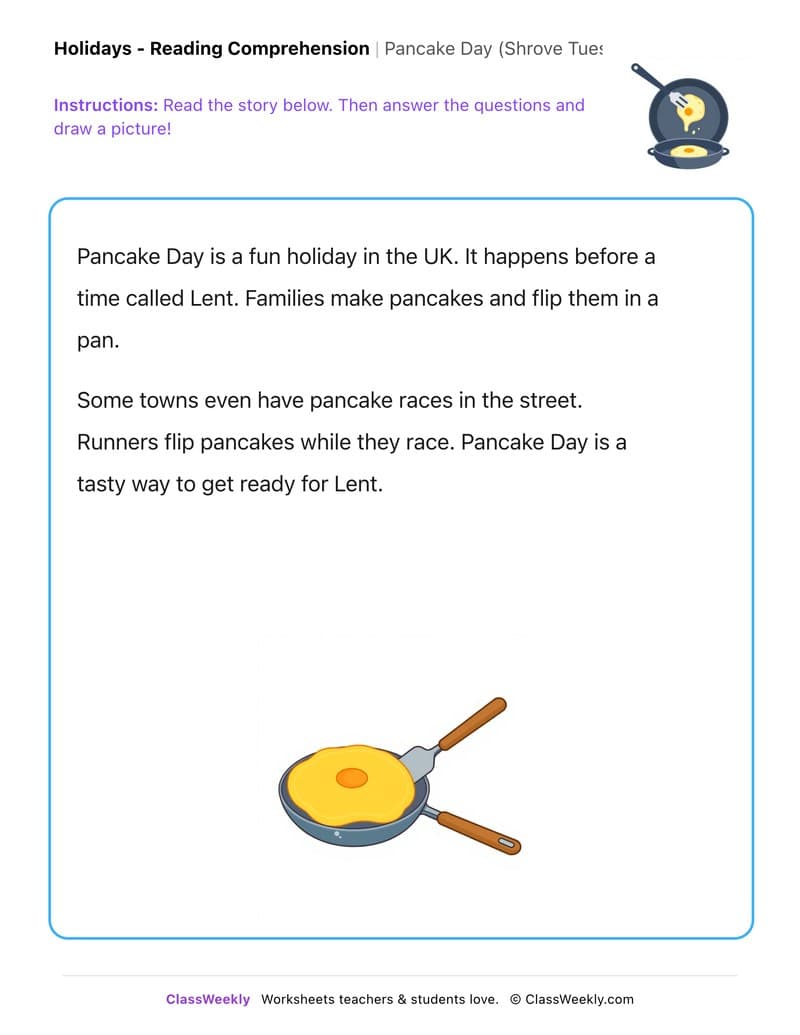
Pancake Day (Shrove Tuesday) Worksheets for Kindergarten
1st Grade
First graders are ready for simple explanations and structured discussion. Anchor Pancake Day (Shrove Tuesday) with a shared read-aloud, then use sentence frames ("I notice… I wonder… This makes me think…") to guide responses. Drawing and labeling lets emergent writers participate fully.
2nd Grade
Second graders thrive with short informational texts paired with graphic organizers. For Pancake Day (Shrove Tuesday), have students identify the main idea and two supporting details, then share with a partner. A class anchor chart captures key vocabulary and builds shared knowledge.
Pancake Day (Shrove Tuesday) Classroom Activities
Pancake Day (Shrove Tuesday) Timeline
Students research the history of Pancake Day (Shrove Tuesday) and create a visual timeline of key events. They sequence dates, add illustrations, and present their timelines to the class. Builds historical thinking and sequencing skills.
Grades 2–5Traditions Around the World
Explore how different cultures celebrate this type of occasion. Students use maps, books, and guided research to compare traditions, then create "celebration posters" showcasing what they learned.
Grades 3–5Pancake Day (Shrove Tuesday) Memory Book
Students create a mini-book with pages for: what the event is, why it matters, one tradition or fact they found interesting, and a personal reflection. Simple enough for K–1 with drawing; challenging for Grade 5 with detailed writing.
Kindergarten–Grade 2Discussion Web
Pose a thought-provoking question about Pancake Day (Shrove Tuesday). Students write their initial opinion, gather evidence for both sides using a graphic organizer, discuss with a partner, then reach a group conclusion. Builds argumentation skills.
Grades 3–5Pancake Day (Shrove Tuesday) Read-Aloud Response
Choose a picture book or short text connected to Pancake Day (Shrove Tuesday). After reading, students respond through drawing, writing, drama, or discussion, depending on grade level. The discussion that follows the story is often the richest part.
Kindergarten–Grade 2
Pancake Day (Shrove Tuesday) Games & Interactive Ideas
Pancake Day (Shrove Tuesday) Trivia Challenge
Divide the class into teams and run a trivia game with questions about the history, traditions, and significance of Pancake Day (Shrove Tuesday). Teams earn points for correct answers and bonus points for explaining their reasoning.
Kindergarten–Grade 2Traditions Bingo
Create bingo cards featuring images or words related to traditions, symbols, foods, or customs connected to Pancake Day (Shrove Tuesday). Call out clues and let students mark their cards. A low-stakes way to build vocabulary and cultural knowledge.
Kindergarten–Grade 2Timeline Race
Give small groups shuffled cards showing key events in the history of Pancake Day (Shrove Tuesday). Teams race to arrange the cards in chronological order. First team to get it right explains their reasoning to the class.
Grades 2–5Vocabulary Pictionary
Students draw key vocabulary words connected to Pancake Day (Shrove Tuesday) for their team to guess, without using letters or numbers. Great for building conceptual understanding and encouraging students who shine in non-written formats.
Kindergarten–Grade 2Frequently Asked Questions
When is Pancake Day (Shrove Tuesday) in 2027?
Pancake Day (Shrove Tuesday) falls on February 9, 2027.
How do I teach Pancake Day (Shrove Tuesday) to elementary students?
For kindergarteners, make Pancake Day (Shrove Tuesday) concrete and sensory. Use picture books, puppets, songs, and simple art activities to introduce the key concept. Focus on one big idea, "we are all connected" or "the world is changing", and return to it throughout the day through different experiences. A good starting activity: pancake day (shrove tuesday) timeline, where students research the history of Pancake Day (Shrove Tuesday) and create a visual timeline of key events. They sequence dates, add illustrations, and present their timelines to the class. Builds historical thinking and sequencing skills.
What are the best Pancake Day (Shrove Tuesday) activities for kids?
Pancake Day (Shrove Tuesday) Timeline (Grades 2–5): Students research the history of Pancake Day (Shrove Tuesday) and create a visual timeline of key events. They sequence dates, add illustrations, and present their timelines to the class. Builds historical thinking and sequencing skills. Another option, Traditions Around the World (Grades 3–5): explore how different cultures celebrate this type of occasion. Students use maps, books, and guided research to compare traditions, then create "celebration posters" showcasing what they learned.
Why is Pancake Day (Shrove Tuesday) important for students to learn about?
Flip into Pancake Day with fun sequencing worksheets, pancake-race math problems, and a peek at the Shrove Tuesday tradition before Lent. Teaching students about Pancake Day (Shrove Tuesday) builds cultural literacy, historical thinking, and empathy, skills that support learning across every subject and prepare students to be thoughtful, informed community members.
What grade levels is Pancake Day (Shrove Tuesday) appropriate for?
With the right scaffolding, Pancake Day (Shrove Tuesday) can be explored at every grade level from PreK through Grade 5. The content is the same; the depth, text complexity, and task demand shift by grade. ClassWeekly offers differentiated resources for Kindergarten–Grade 2.
What specific topics does Pancake Day (Shrove Tuesday) cover in the classroom?
Pancake Day (Shrove Tuesday) lessons typically cover Pancake races, Lent preparation. Teachers can build a full lesson around these specific topics rather than a generic overview.
Free Teaching Resources for Every Occasion
#1 Curriculum aligned resource library (K‑5) with teacher-made materials.