Read a Diagram in a Text About How a Canal Lock Works
Written by Adi Ackerman, Head Teacher
"Read a Diagram in a Text About How a Canal Lock Works" is written for 4th Grade (Ages 9-10), and it covers Common Core RI.4.7. If your little one is a year younger but already steady on comprehension exercises, the page still works. You may just need to read the instructions out loud. And if they are older and visual information never quite stuck, this is a short review rather than busywork.
2 pages in this set
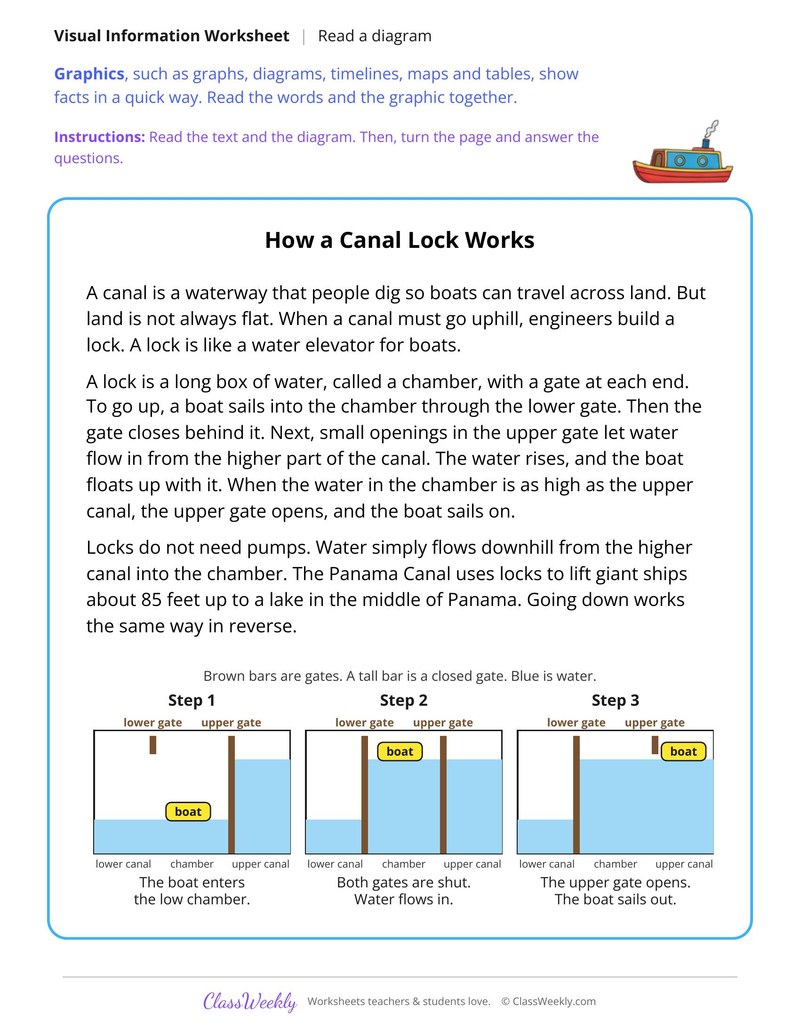
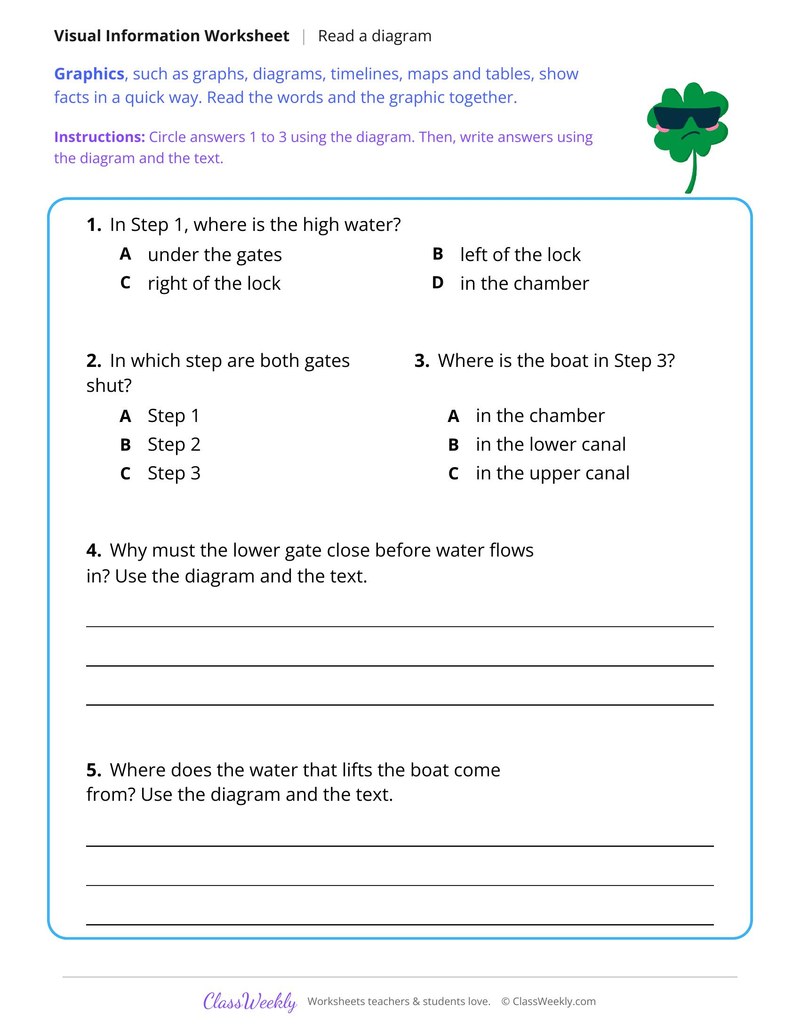
4th grade reading worksheet: read a diagram and an original text about how a canal lock lifts a boat to answer questions. Answer key included. Part of our visual information comprehension exercises collection. Aligned to Common Core standards.
How do I use this worksheet?
Before reading, ask your child what the graphic shows and what its labels mean. Point to the tag beside each question so they know where to look. Check with the answer key.
What students will practice
- Students will read a bar graph, diagram, timeline, map or table.
- Students will answer questions using information from a graphic.
- Students will combine a graphic with the text to explain an answer.


Curriculum Links
Common Core State Standards
Reading · 4th Grade
Find this in the curriculum
Browse the grade, subject, and topic this belongs to.
FAQ
How do I use this visual information worksheet?
⌄
Before reading, ask your child what the graphic shows and what its labels mean. Point to the tag beside each question so they know where to look. Check with the answer key.
What does this worksheet teach?
⌄
Read a diagram and an original text about how a canal lock lifts a boat to answer questions. Graphics, such as graphs, diagrams, timelines, maps and tables, show facts in a quick way. Read the words and the graphic together. The directions on the page read: Read the text and the diagram. Then, turn the page and answer the questions. On page 2: Circle answers 1 to 3 using the diagram. Then, write answers using the diagram and the text. The answer key covers the questions on page 2.
Can I use this visual information worksheet for homeschool or classroom?
⌄
Yes, both. We made it for 4th Grade comprehension exercises, and the page works the same whether it lands on a kitchen table or a center rotation. At home, most families go through it together and talk the answers out loud, and that talking is where most of the learning happens with visual information. In class it runs well as independent work while you pull a small group. Print one copy or thirty, whichever the day needs.
What does visual information mean?
⌄
It is information shown in a graphic, such as a graph, diagram, timeline, map or table. RI.4.7 asks 4th graders to read these graphics and explain how they add to the text.
Why do some questions need both the graphic and the text?
⌄
The graph might show that December was low, but only the text explains why. Questions that use both teach children to read the words and the graphic together.
Which graphics are on these sheets?
⌄
A bar graph, a step by step diagram, a timeline, a route map and a table, one on each sheet.
Is there an answer key for each worksheet?
⌄
Yes. All five visual information sheets have an answer key.
What specific comprehension skills does fourth grade focus on?
⌄
Fourth grade comprehension standards cover: main idea and supporting details (RI.4.2), cause and effect (RI.4.3), compare and contrast between two texts on the same topic (RI.4.9), point of view, meaning first person versus third person (RL.4.6), fact versus opinion (RI.4.8), using context clues for unfamiliar words (L.4.4), and prediction based on evidence in the text. Each of these is typically taught and tested as its own distinct skill rather than bundled together.
How is a comprehension exercise worksheet different from a story worksheet?
⌄
A story worksheet centers on one passage and asks a range of question types about it. A comprehension exercise worksheet isolates a single skill, like cause and effect or compare and contrast, and gives focused practice on just that skill, often using two shorter passages instead of one longer one. This is useful when a student has already mastered general reading but is struggling with one particular skill, since it lets you target the exact gap instead of re-practicing everything at once.
How can I help my child improve reading comprehension skills at home?
⌄
Pick one skill at a time rather than practicing comprehension in general. If cause and effect is the target, read a short passage together and explicitly ask "what happened, and why did it happen?" after every paragraph, not just at the end. Repetition on a single named skill builds a mental habit faster than mixed general-comprehension practice, and it's easier to tell when the skill has actually clicked.
Ratings & Reviews
No reviews yet. Be the first to share what you think.
Reviews are for ClassWeekly members.
Make a Request
Spotted something to fix, or want a worksheet we don't have yet? Tell us and we'll make it.
Worksheet Details
| Grade | 4th Grade |
| Subject | Reading |
| Topic | Comprehension Exercises |
| Standard | RI.4.7 |
| Pages | 2 pages |
| Difficulty | Medium |
What is ClassWeekly?
ClassWeekly offers free worksheets and printable learning resources for kids in preschool to grade 5. All worksheets are aligned to Common Core, NGSS, and C3 Framework standards and designed by educators. Become a member to access the full library and download unlimited PDFs.