Make a Source Card for a Book and a Website
Written by Adi Ackerman, Head Teacher
"Make a Source Card for a Book and a Website" is written for 4th Grade (Ages 9-10), and it covers Common Core W.4.8. If your little one is a year younger but already steady on informative writing, the page still works. You may just need to read the instructions out loud. And if they are older and research writing never quite stuck, this is a short review rather than busywork.
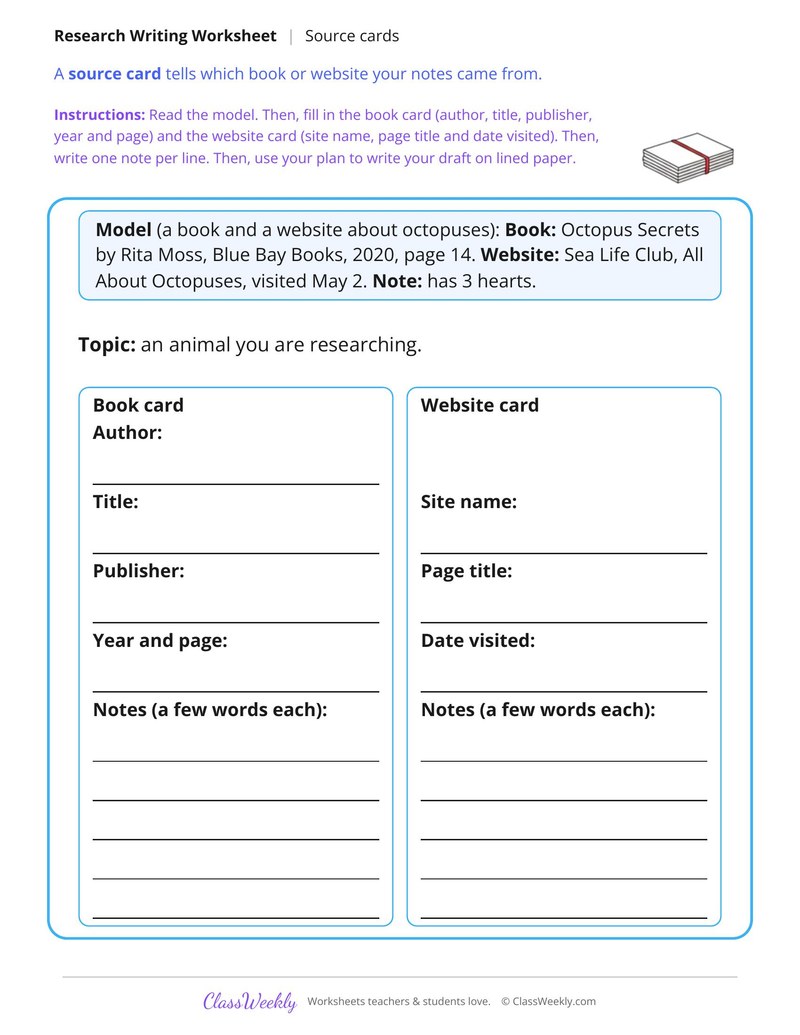
4th grade writing worksheet: fill in a book source card and a website source card for an animal you research, then write one note per line. Part of our research writing collection. Aligned to Common Core standards.
How do I use this worksheet?
Pair each planner with one library book and one website your child can read on their own. Have them write each note in a few words, never a copied sentence, and fill in the source line before moving on.
What students will practice
- Students will record a book and a website source for their notes.
- Students will tell facts from opinions in a source and sort notes under headings.
- Students will plan a short report, a poster or a set of research questions with sources.


Curriculum Links
Common Core State Standards
Writing · 4th Grade
Standard: Recall relevant information from experiences or gather relevant information from print and digital sources; take notes and categorize information, and provide a list of sources.
View all W.4.8 worksheets →Find this in the curriculum
Browse the grade, subject, and topic this belongs to.
FAQ
How do I use this research writing worksheet?
⌄
Pair each planner with one library book and one website your child can read on their own. Have them write each note in a few words, never a copied sentence, and fill in the source line before moving on.
What does this worksheet teach?
⌄
Fill in a book source card and a website source card for an animal you research, then write one note per line. A source card tells which book or website your notes came from. The directions on the page read: Read the model. Then, fill in the book card (author, title, publisher, year and page) and the website card (site name, page title and date visited). Then, write one note per line. Then, use your plan to write your draft on lined paper.
Can I use this research writing worksheet for homeschool or classroom?
⌄
Yes, both. We made it for 4th Grade informative writing, and the page works the same whether it lands on a kitchen table or a center rotation. At home, most families go through it together and talk the answers out loud, and that talking is where most of the learning happens with research writing. In class it runs well as independent work while you pull a small group. Print one copy or thirty, whichever the day needs.
What does research look like in 4th grade?
⌄
W.4.7 asks for short research projects that build knowledge about one topic. At this age that means asking a few questions, finding answers in a book or website, taking notes in your own words and writing down where each note came from.
What is a source card?
⌄
It records where a note came from. The book card has the author, title, publisher, year and page, and the website card has the site name, page title and the date visited, with a model about octopuses.
Why sort notes under headings?
⌄
Each heading can become a paragraph. The honeybee page has 12 note cards to sort under body, home and food, 4 under each, then asks for a topic sentence for one heading.
Is there an answer key?
⌄
The fact or opinion page and the note sorting page have one. The pyramids notes, the source cards and the 3 planners are open, so check that each note is short, in your own words and has a source.
What informative and explanatory writing skills do fourth graders learn?
⌄
Fourth graders learn to explain a topic clearly by grouping related information and supporting it with facts (CCSS W.4.2). They start with a strong introduction that names the topic and tells the reader what is coming (W.4.2a), then develop the topic with facts, definitions, and concrete details rather than opinions (W.4.2b). Students group related ideas into paragraphs, use linking words like for example and in addition, and finish with a closing that wraps up the information. Fourth grade widens the range of informative writing: students write informative paragraphs and multi-paragraph essays, compare and contrast two subjects, write a short biography, and do simple research by gathering facts from sources and putting them in their own words (W.4.7). The key difference from opinion writing is stance: informative writing teaches and explains rather than argues. Worksheets that provide a topic and an organizer for the introduction, supporting details, and conclusion, or a compare-and-contrast chart, or a research note-catcher, give students the structure CCSS W.4.2 expects. The aim is writing that leaves a reader knowing more than they did before, organized clearly enough to follow easily.
How do you teach a fourth grader to write an informative paragraph or essay with an introduction and supporting details?
⌄
Teach it as a clear frame: introduce the topic, give supporting details, then close. Start with the introduction, where your fourth grader names the topic and tells the reader what the piece will cover (CCSS W.4.2a). Model a topic sentence that is specific ("Sea otters have three clever ways to survive cold water") rather than vague ("Sea otters are cool"). Next, gather supporting details: facts, definitions, and examples that back up the topic (W.4.2b). A note-catcher helps students collect these details and, just as important, put them in their own words instead of copying. Then group related details into paragraphs, since dumping every fact in one block confuses readers. Teach linking words (for example, in addition, another) to move from one detail to the next. Finish with a closing that sums up the main idea in fresh words. The most effective approach separates planning from drafting: students fill an organizer first, then write from it. Worksheets that provide the topic, an introduction box, detail lines, and a conclusion box match how CCSS W.4.2 expects students to build informative writing piece by piece, and they keep young writers from stalling on the blank page.
How do worksheets help fourth graders research, compare, and explain a topic clearly?
⌄
Worksheets give research and explanation a structure young writers can actually follow. Fourth grade research (CCSS W.4.7) is not a report copied from a website, it is gathering facts from sources and explaining them in your own words. A research note-catcher worksheet teaches that habit by giving students spots to record a fact and then rephrase it, which also heads off copying. A compare-and-contrast chart, with columns for two subjects and rows for their features, helps students organize similarities and differences before they try to write about them. An introduction-and-details organizer keeps an informative paragraph on track: topic first, then facts and definitions that support it (CCSS W.4.2a and W.4.2b). Biography worksheets give a timeline or key-events frame so students explain a person's life in order rather than at random. The common thread is that these tools separate thinking from writing, so students organize their information first and draft second. Practicing on a structured worksheet, then reusing the same frame for their own topic, is how fourth graders learn to explain clearly, which is exactly the outcome CCSS W.4.2 is after.
Ratings & Reviews
No reviews yet. Be the first to share what you think.
Reviews are for ClassWeekly members.
Make a Request
Spotted something to fix, or want a worksheet we don't have yet? Tell us and we'll make it.
Worksheet Details
| Grade | 4th Grade |
| Subject | Grammar & Writing |
| Topic | Informative Writing |
| Standard | W.4.8 |
| Pages | 1 page |
| Difficulty | Medium |
What is ClassWeekly?
ClassWeekly offers free worksheets and printable learning resources for kids in preschool to grade 5. All worksheets are aligned to Common Core, NGSS, and C3 Framework standards and designed by educators. Become a member to access the full library and download unlimited PDFs.