Abbreviations for Months of the Year
Written by Adi Ackerman, Head Teacher
"Abbreviations for Months of the Year" is written for 3rd Grade (Ages 8-9), and it covers Common Core L.3.2. If your little one is a year younger but already steady on capitalization, the page still works. You may just need to read the instructions out loud. And if they are older and abbreviations never quite stuck, this is a short review rather than busywork.
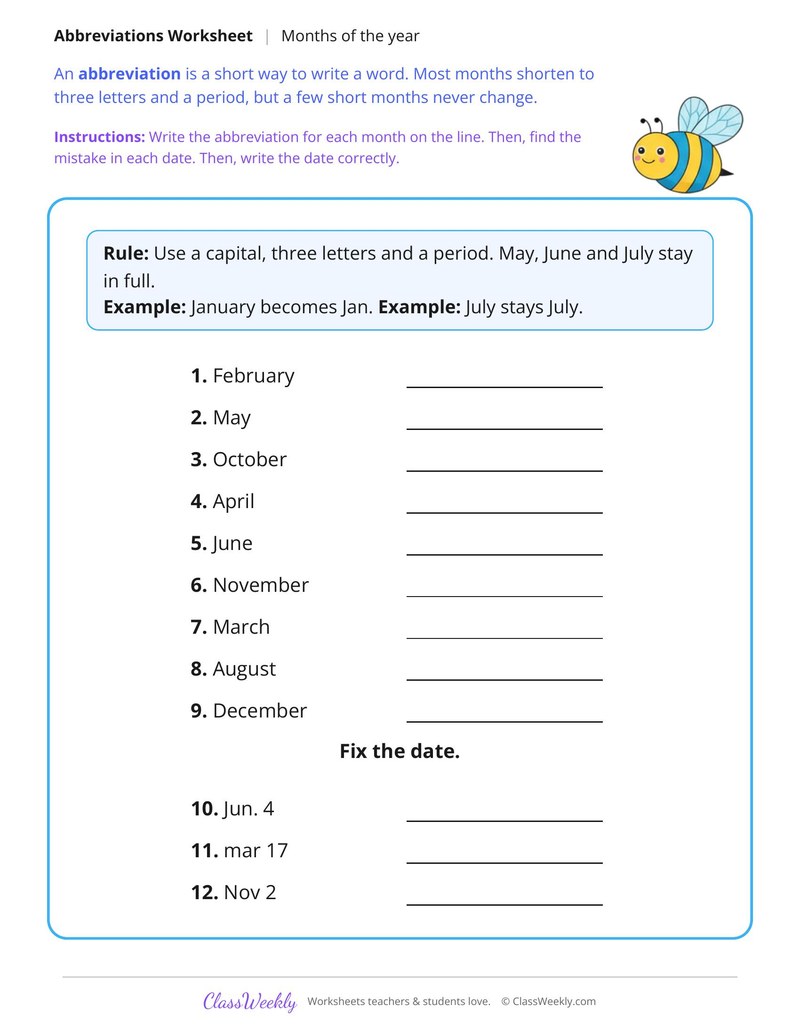
3rd grade grammar worksheet: write month abbreviations like Jan. and Oct., then fix the mistake in each date. Answer key included. Part of our abbreviations capitalization collection. Aligned to Common Core standards.
How do I use this worksheet?
Look at a real calendar, a piece of mail or a store receipt together and find abbreviations first. Remind your child that most abbreviations end with a period. Check with the answer key.
What students will practice
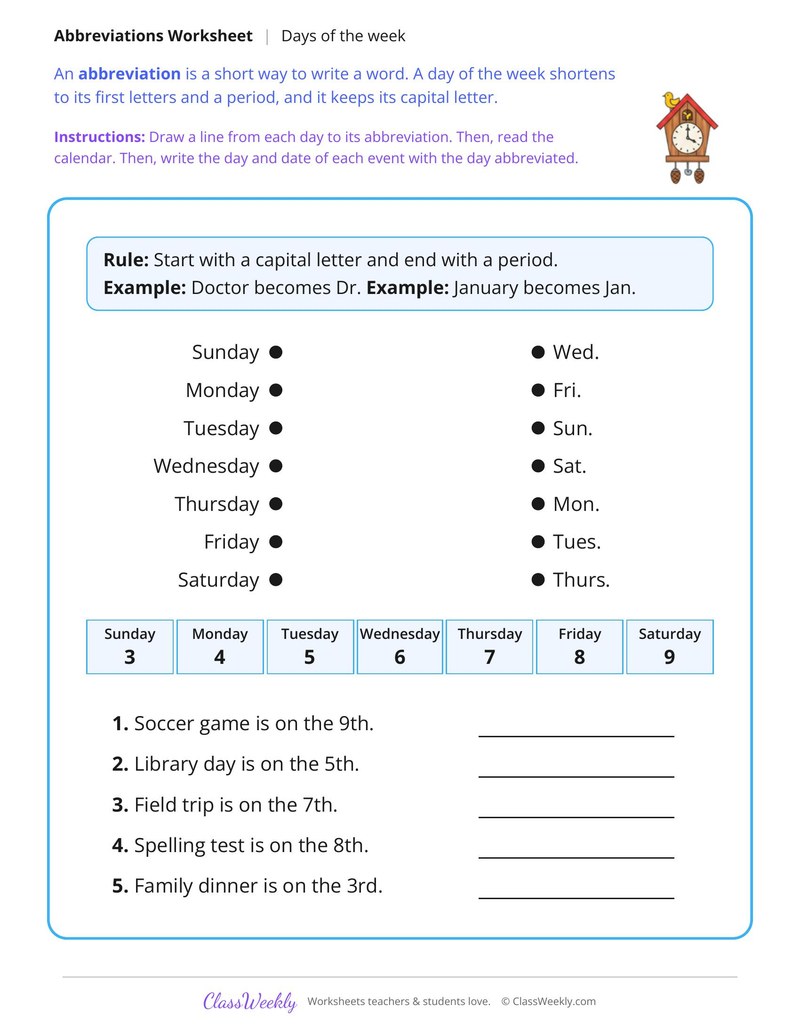
- Students will write abbreviations for the days of the week and the months.
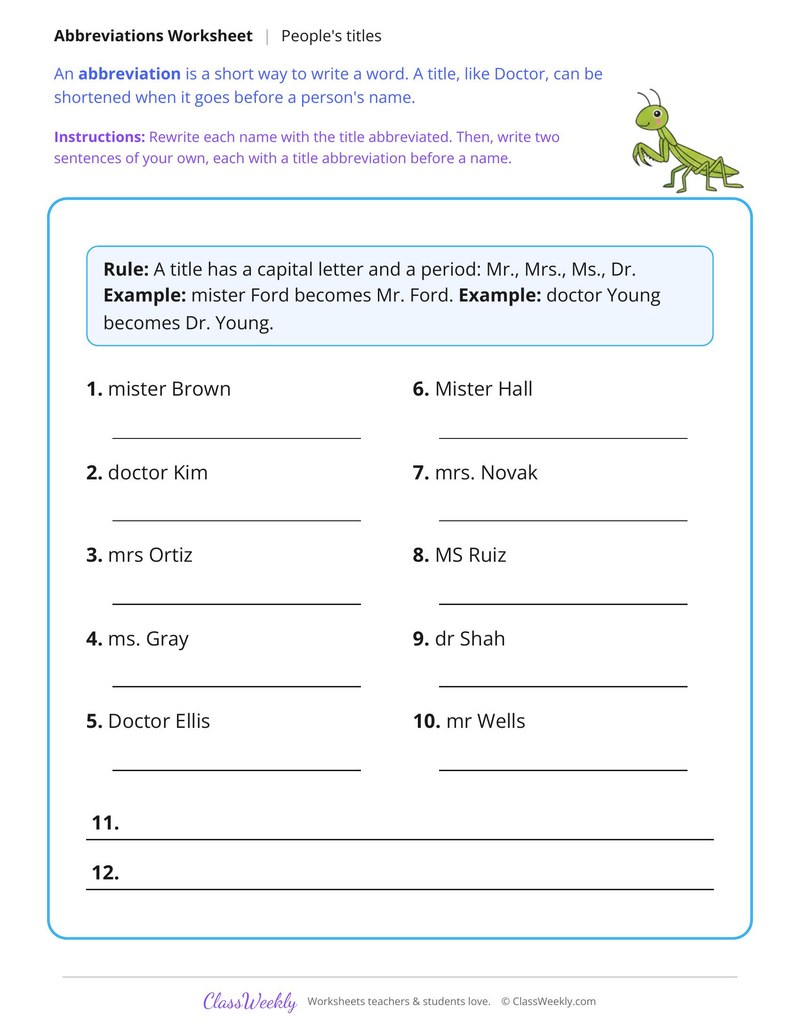
- Students will use titles like Mr., Mrs., Ms. and Dr. before names.
- Students will shorten street words in an address with a capital letter and a period.


Curriculum Links
Common Core State Standards
Language · 3rd Grade
Standard: Demonstrate command of the conventions of standard English capitalization, punctuation, and spelling when writing.
View all L.3.2 worksheets →Find this in the curriculum
Browse the grade, subject, and topic this belongs to.
FAQ
How do I use this abbreviations worksheet?
⌄
Look at a real calendar, a piece of mail or a store receipt together and find abbreviations first. Remind your child that most abbreviations end with a period. Check with the answer key.
What does this worksheet teach?
⌄
Write month abbreviations like Jan. and Oct., then fix the mistake in each date. An abbreviation is a short way to write a word. Most months shorten to three letters and a period, but a few short months never change. The directions on the page read: Write the abbreviation for each month on the line. Then, find the mistake in each date. Then, write the date correctly. An answer key is included.
Can I use this abbreviations worksheet for homeschool or classroom?
⌄
Yes, both. We made it for 3rd Grade capitalization, and the page works the same whether it lands on a kitchen table or a center rotation. At home, most families go through it together and talk the answers out loud, and that talking is where most of the learning happens with abbreviations. In class it runs well as independent work while you pull a small group. Print one copy or thirty, whichever the day needs.
What is an abbreviation?
⌄
An abbreviation is a short way to write a word, like Mon. for Monday or Dr. for Doctor. Most begin with a capital letter when the full word does and end with a period.
When should my child use abbreviations?
⌄
Abbreviations fit calendars, lists, addresses and notes, where space is short. In sentences and stories, children should usually write the full word, except for titles like Mr., Mrs., Ms. and Dr. before a name.
Why practice abbreviations in an address?
⌄
Addresses on envelopes use short forms like St., Ave. and Blvd., and 3rd graders also learn where commas go in an address (L.3.2.B). The envelope page puts both together.
Is there an answer key for each worksheet?
⌄
Yes. All four abbreviations sheets have an answer key.
What capitalization rules should third graders master?
⌄
Third graders should capitalize all previously learned rules (first word of sentences, proper nouns, days, months, the pronoun "I") and extend their knowledge to titles of books and other works, geographic regions, historical events, and words in dialogue. CCSS L.3.2a specifies capitalizing appropriate words in titles, which means capitalizing the first word, the last word, and all major words while leaving short prepositions, articles, and conjunctions lowercase. Students also learn to capitalize the first word inside quotation marks when it begins a new sentence of dialogue. Third graders encounter more complex proper nouns in their reading and social studies, such as the names of countries, continents, oceans, and historical periods. Worksheets that present mixed-case text and ask students to correct capitalization errors provide realistic editing practice. Activities that focus specifically on title capitalization rules help students master this new, rule-heavy skill.
How do I help my third grader capitalize titles correctly?
⌄
Title capitalization has specific rules that differ from regular sentence capitalization, so it requires targeted instruction. Teach the basic rule: capitalize the first word, the last word, and all important words. Words that typically stay lowercase include short articles (a, an, the), short prepositions (of, in, on, at, to, for), and short conjunctions (and, but, or). However, these words ARE capitalized when they are the first or last word of the title. Practice with familiar book titles your child knows, then move to worksheets where students correct improperly capitalized titles. A helpful strategy is to have your child underline each word and decide: "Is this word important or is it a small connecting word?" Creating their own titles for stories or reports gives authentic practice. CCSS L.3.2a covers this skill, and it appears frequently on standardized assessments, making it worth dedicated practice throughout the third grade year.
What capitalization errors are most common in third grade writing?
⌄
Third graders frequently over-capitalize words they consider important, writing "My Dog went to the Big Park" because dog and park feel significant to them, even though they are common nouns. This shows the student is thinking about capitalization but has not fully internalized the common versus proper noun distinction. Under-capitalizing proper nouns in context is also common, especially with geographic terms (the rocky mountains instead of the Rocky Mountains) and titles (president lincoln instead of President Lincoln). In title writing, the most frequent error is capitalizing every word, including articles and prepositions ("The Cat In The Hat" instead of "The Cat in the Hat"). Run-on capitalization, where a student capitalizes the first word after a comma but not after a period, reveals confusion about sentence boundaries. Targeted worksheets that address each error type separately, combined with regular proofreading of their own work using a capitalization checklist aligned to CCSS L.3.2a, help students self-correct these patterns over time.
Ratings & Reviews
No reviews yet. Be the first to share what you think.
Reviews are for ClassWeekly members.
Make a Request
Spotted something to fix, or want a worksheet we don't have yet? Tell us and we'll make it.
Worksheet Details
| Grade | 3rd Grade |
| Subject | Grammar & Writing |
| Topic | Capitalization |
| Standard | L.3.2 |
| Pages | 1 page |
| Difficulty | Medium |
Learn More
What is ClassWeekly?
ClassWeekly offers free worksheets and printable learning resources for kids in preschool to grade 5. All worksheets are aligned to Common Core, NGSS, and C3 Framework standards and designed by educators. Become a member to access the full library and download unlimited PDFs.