Greater Than Less Than Number Riddles
Written by Adi Ackerman, Head Teacher
"Greater Than Less Than Number Riddles" is written for 1st Grade (Ages 6-7), and it covers Common Core 1.NBT.A.1. If your little one is a year younger but already steady here, the page still works. You may just need to read the instructions out loud. And if they are older and comparing numbers never quite stuck, this is a short review rather than busywork.
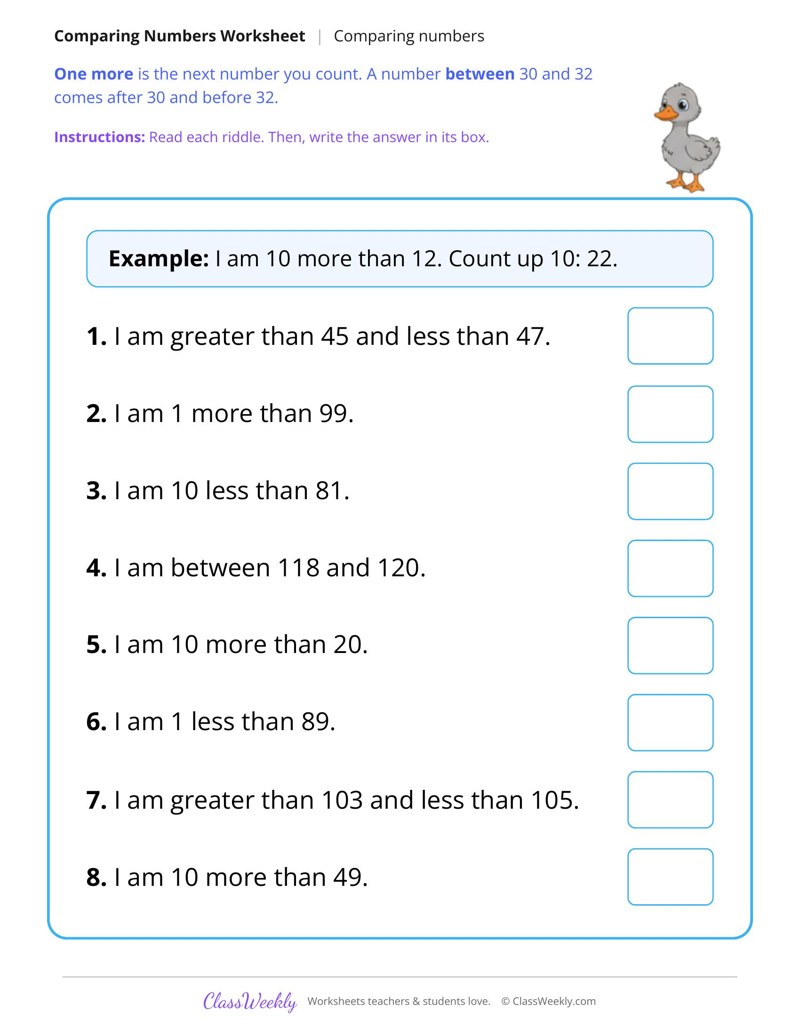
1st grade math worksheet: solve 8 number riddles to 120, like I am 1 more than 99 or I am between 118 and 120. Answer key included. Part of our comparing numbers collection. Aligned to Common Core standards.
How do I use this worksheet?
Before handing out the worksheet, briefly introduce the concept with a short oral warm-up or a visual model on the board. Let students work through the first item together as a class, then finish the rest independently or with a partner, encouraging them to talk through their thinking: "What strategy are you using? How do you know that is right?" After completing the worksheet, review any missed problems together and discuss the reasoning rather than just the answer. For extra support, let students use manipulatives or draw pictures alongside the written problems. These comparing numbers worksheets work well as daily practice, homework, or a focused review activity.
What students will practice
- Students will solve 8 riddles about 1 more, 1 less and 10 more or 10 less.
- Students will find the number between two numbers, like 118 and 120.
- Students will write each answer number up to 120 in its box.

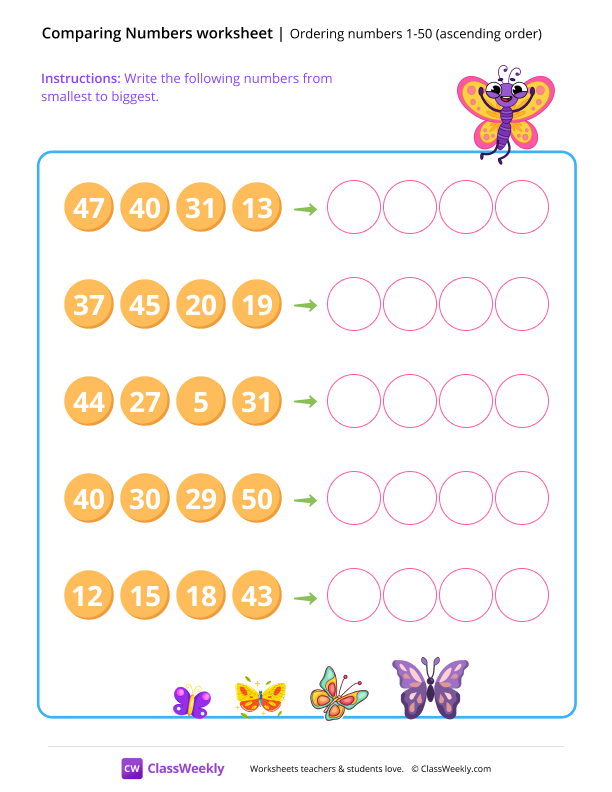
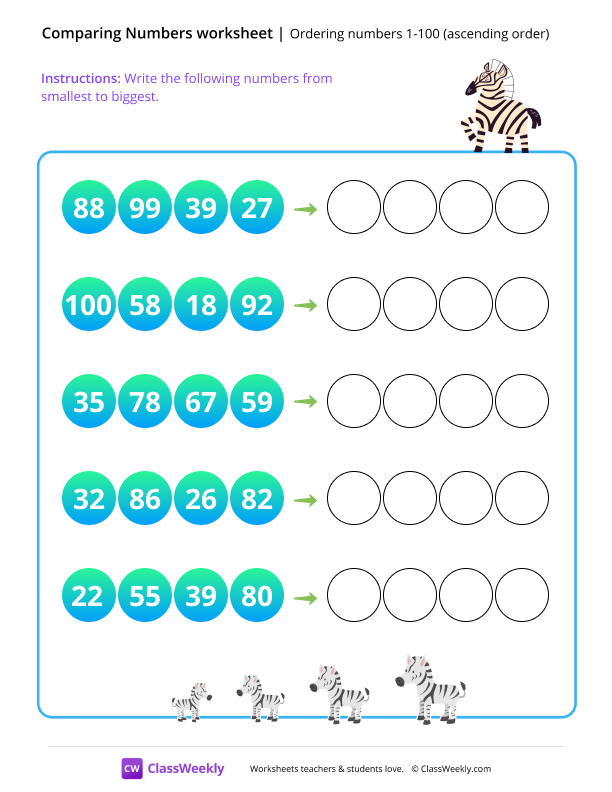
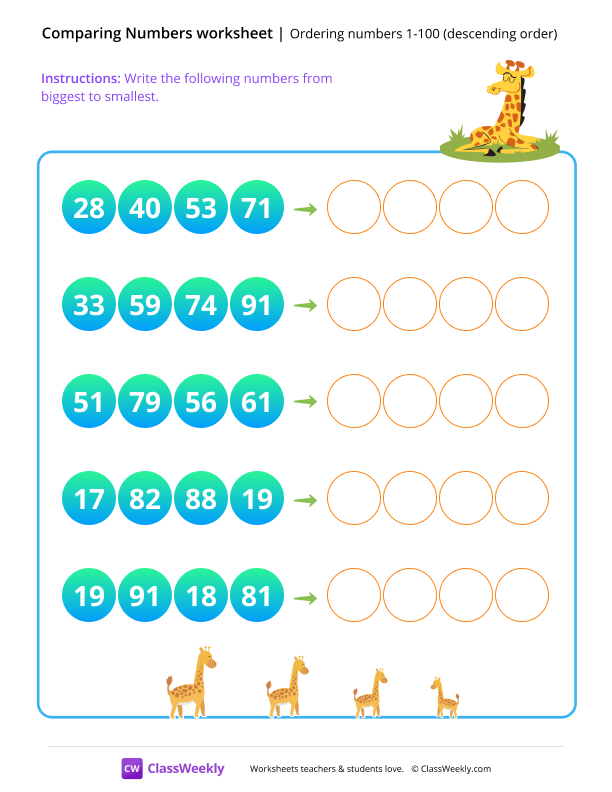

Curriculum Links
Common Core State Standards
Number and Operations in Base Ten · 1st Grade
Standard: Count to 120, starting at any number less than 120. In this range, read and write numerals and represent a number of objects with a written numeral.
View all 1.NBT.A.1 worksheets →Find this in the curriculum
Browse the grade, subject, and topic this belongs to.
FAQ
How do I use this comparing numbers worksheet?
⌄
Before handing out the worksheet, briefly introduce the concept with a short oral warm-up or a visual model on the board. Let students work through the first item together as a class, then finish the rest independently or with a partner, encouraging them to talk through their thinking: "What strategy are you using? How do you know that is right?" After completing the worksheet, review any missed problems together and discuss the reasoning rather than just the answer. For extra support, let students use manipulatives or draw pictures alongside the written problems. These comparing numbers worksheets work well as daily practice, homework, or a focused review activity.
What does this worksheet teach?
⌄
Solve 8 number riddles to 120, like I am 1 more than 99 or I am between 118 and 120. One more is the next number you count. A number between 30 and 32 comes after 30 and before 32. The directions on the page read: Read each riddle. Then, write the answer in its box. An answer key is included.
Can I use this comparing numbers worksheet for homeschool or classroom?
⌄
Yes, both. We made it for 1st Grade comparing numbers, and the page works the same whether it lands on a kitchen table or a center rotation. At home, most families go through it together and talk the answers out loud, and that talking is where most of the learning happens. In class it runs well as independent work while you pull a small group. Print one copy or thirty, whichever the day needs.
What comparison skills do 1st grade standards require students to demonstrate?
⌄
Students must compare two-digit numbers using >, <, and = and explain their reasoning using place value language.
How should teachers address the equal sign in comparison activities?
⌄
Emphasize that = means 'the same value as,' not just 'the answer is' - this prevents later confusion with equations and algebraic balance.
What common misconception do students have when comparing numbers like 15 and 51?
⌄
Students sometimes focus on the digits individually (1 < 5) rather than the number as a whole, reversing the comparison - place value instruction corrects this.
What number comparison skills should first graders have?
⌄
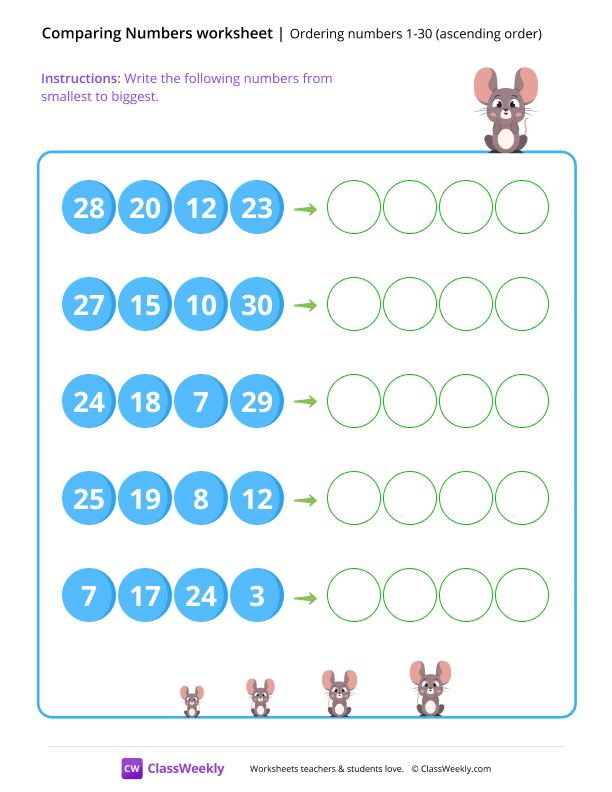
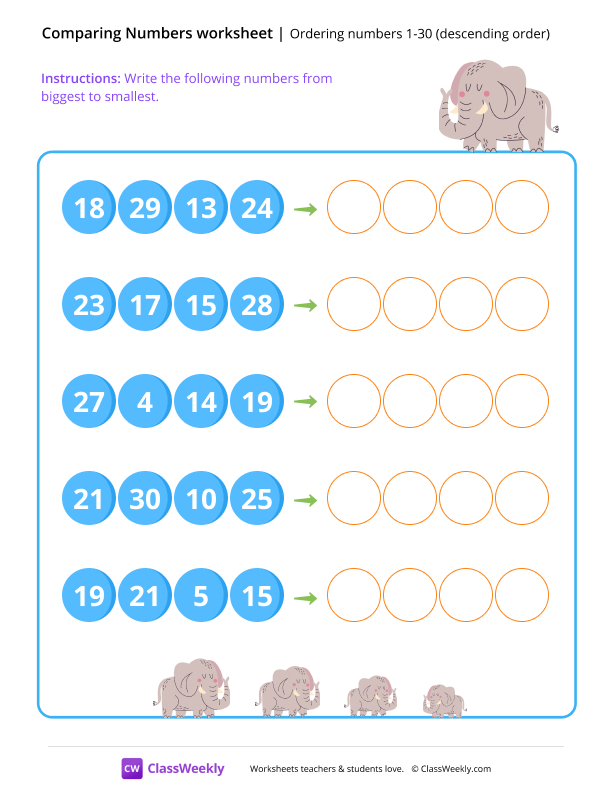
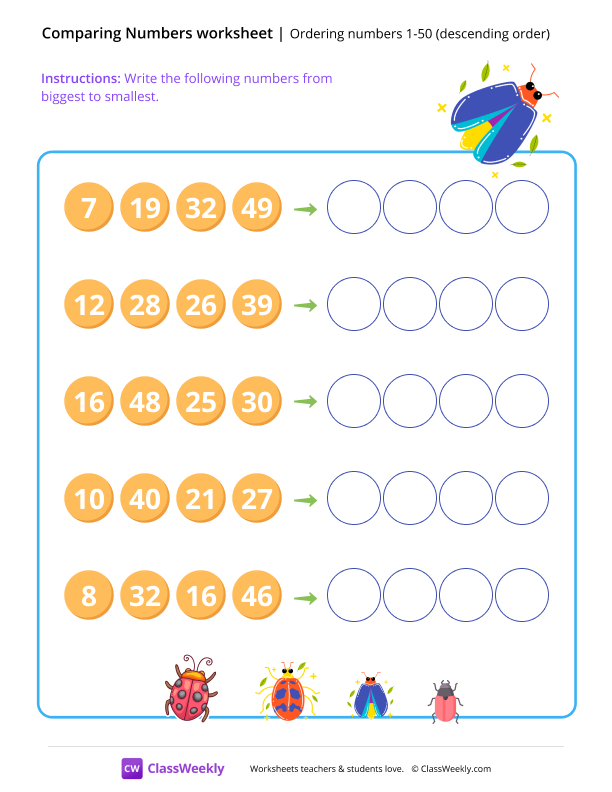
First graders should compare two two-digit numbers based on the meanings of the tens and ones digits, recording the results with the symbols for greater than, less than, and equal to (CCSS 1.NBT.B.3). They should understand that when comparing two numbers, you first look at the tens place, and only if the tens are equal do you compare the ones place. This place-value-based reasoning is more sophisticated than the kindergarten approach of counting and matching. Worksheets that present pairs of two-digit numbers and ask students to write the correct comparison symbol build fluency with this skill. Students should also be able to order three or more numbers from least to greatest or greatest to least.
How do you teach greater than and less than symbols to first graders?
⌄
Many teachers use the "alligator mouth" strategy: the open end of the symbol always faces the larger number because the alligator wants to eat the bigger meal. Draw two numbers with the symbol between them and show how the open side faces the larger number. Reinforce with place value understanding: compare tens first, then ones. Use base-ten blocks so children can see that 47 has more tens than 32. Worksheets that pair visual base-ten block representations with the comparison symbols help children connect the concrete to the abstract. Practice with both "which is greater" and "which is less" questions ensures children understand the symbol in both directions, preventing the common error of always reading left to right.
Why is comparing numbers important in first grade math?
⌄
Comparing numbers develops place value understanding and number sense, both of which are critical for addition, subtraction, and problem solving. When a child can quickly determine that 67 is greater than 54, they demonstrate an understanding of how tens and ones compose a number. This reasoning supports estimation, mental math, and checking the reasonableness of answers. The comparison symbols (greater than, less than, equal to) are also used throughout mathematics, from simple number sentences through algebraic inequalities. Worksheets that progress from comparing single-digit numbers to two-digit numbers, and from using pictures to using only numerals, build this skill systematically across the first-grade year.
Ratings & Reviews
No reviews yet. Be the first to share what you think.
Reviews are for ClassWeekly members.
Make a Request
Spotted something to fix, or want a worksheet we don't have yet? Tell us and we'll make it.
Worksheet Details
| Grade | 1st Grade |
| Subject | Math |
| Topic | Comparing Numbers |
| Standard | 1.NBT.A.1 |
| Pages | 1 page |
| Difficulty | Medium |
What is ClassWeekly?
ClassWeekly offers free worksheets and printable learning resources for kids in preschool to grade 5. All worksheets are aligned to Common Core, NGSS, and C3 Framework standards and designed by educators. Become a member to access the full library and download unlimited PDFs.