What Do Greater Than and Less Than Mean?
Taught in US schools
Key Takeaways
- The symbol > means greater than (the left number is bigger); < means less than (the left number is smaller).
- The open side of both symbols always faces the larger number - a helpful memory trick.
- These symbols are used to compare whole numbers, fractions, and decimals, and to write inequality statements.
What Do Greater Than and Less Than Mean?
Greater than and less than are ways to compare two numbers and show which one is bigger or smaller. Mathematicians use two symbols for this:
-
> means greater than (the number on the left is bigger)
-
< means less than (the number on the left is smaller)
-
= means equal to (both numbers have the same value)
Example: 8 > 5 means "8 is greater than 5." 3 < 7 means "3 is less than 7."
The Alligator Memory Trick
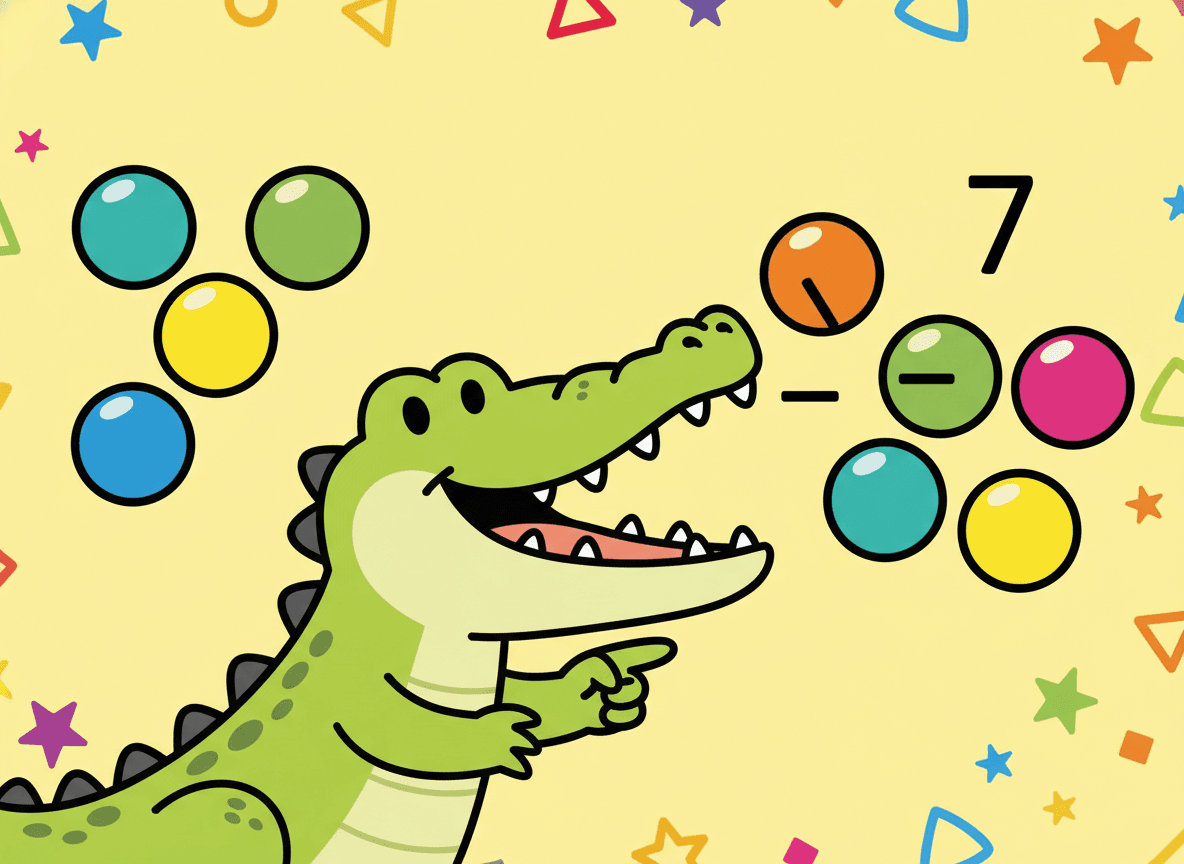
A popular way to remember the symbols is the alligator (or crocodile) trick:
Imagine the symbol is a hungry alligator's mouth. The alligator always opens its mouth toward the bigger number because it wants to eat more.
-
5 > 3 - the alligator opens toward 5, so 5 is bigger.
-
2 < 9 - the alligator opens toward 9, so 9 is bigger.
Another way to remember: the open end faces the larger number; the pointed end faces the smaller number.
Comparing Numbers Step by Step
To compare two numbers, use place value:
- First compare the largest place (hundreds, then tens, then ones).
- If the hundreds digits are equal, move to the tens. If tens are equal, compare the ones.
47 vs. 52: Tens: 4 < 5 - 47 < 52
318 vs. 281: Hundreds: 3 > 2 - 318 > 281
65 vs. 65: All digits equal - 65 = 65
Using a Number Line
A number line is a powerful tool for comparison: numbers to the right are always greater; numbers to the left are always less.
Example: On a number line, 6 is to the right of 4, so 6 > 4. This works for negative numbers too: -2 is to the right of -5, so -2 > -5.
Comparing Fractions and Decimals
The same symbols work for fractions and decimals:
-
1/2 < 3/4 - one-half is less than three-quarters
-
0.6 > 0.42 - 0.6 is greater than 0.42 (tenths place: 6 > 4)
-
2.5 = 5/2 - two and a half equals five halves
Inequality Statements
A mathematical inequality uses > or < to show that two values are not equal. These appear in word problems and algebra:
"A number n is greater than 10" is written as n > 10.
Practice Activities
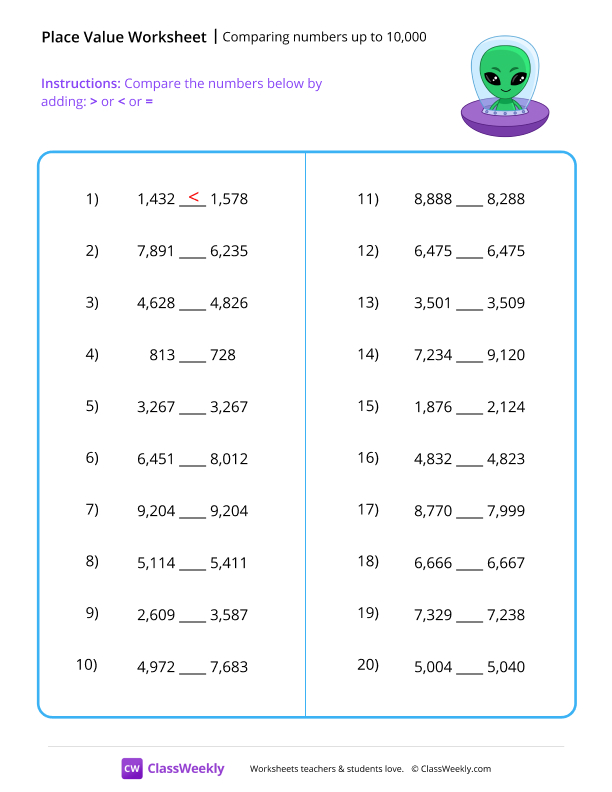
- Write a number on each side of a blank and have students fill in >, <, or = to make the statement true.
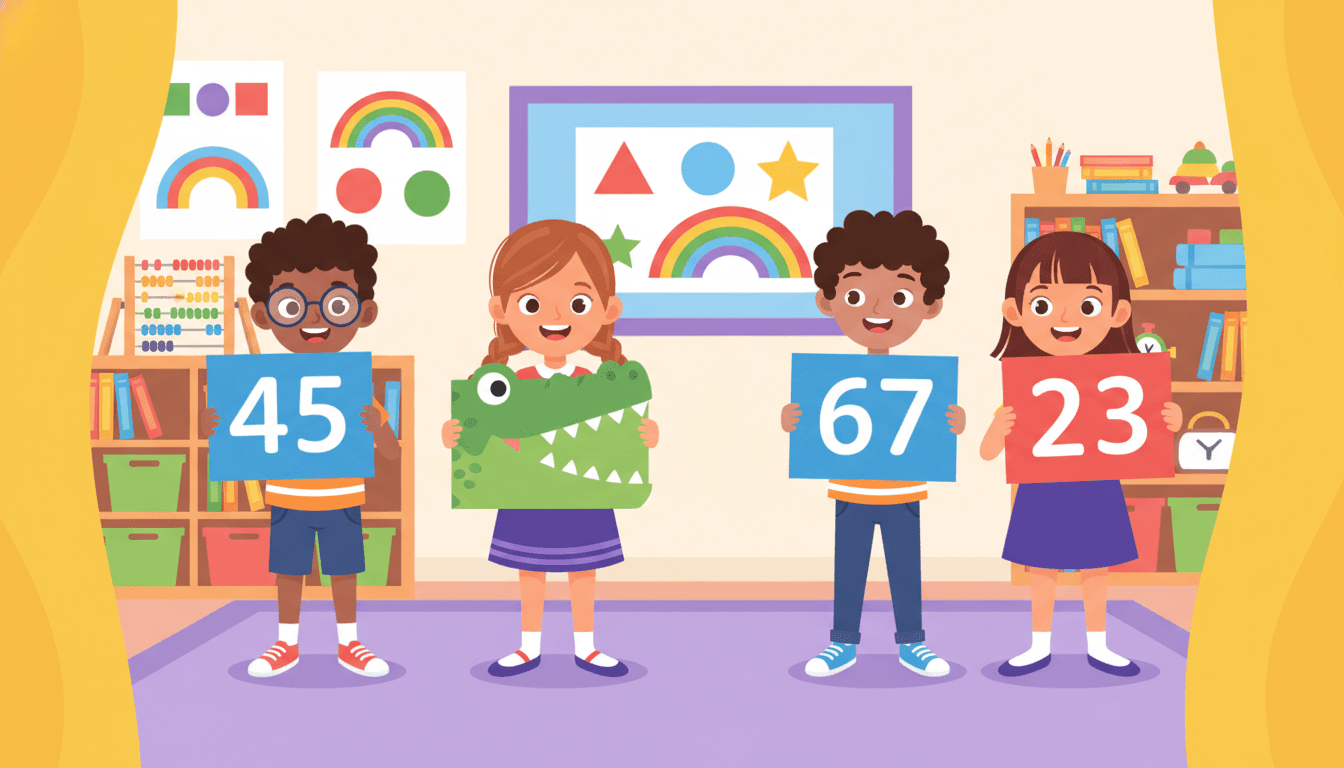
- Play "Alligator Chomp" - hold up two number cards and students call out which symbol the alligator would use.
- Use a number line to compare pairs of numbers by circling the farther-right number as "greater."
- Compare fractions with the same denominator (3/8 vs. 5/8) and same numerator (2/3 vs. 2/5) to build fraction sense.
- Give students three numbers and ask them to write two inequality statements and one equality (if applicable).
Frequently Asked Questions
How do I remember which symbol is greater than and which is less than?
Think of the symbol as an alligator mouth that always eats the bigger number. If the open mouth faces right (>), the left number is bigger. If the open mouth faces left (<), the right number is bigger.
What does the equal sign mean in comparisons?
The equal sign (=) means both sides have the same value. For example, 5 = 5 and 1/2 = 0.5 are both true equality statements.
Can I use greater than and less than with fractions and decimals?
Yes. The same symbols work for any numbers. For example, 0.7 > 0.35 and 3/4 > 1/2. Using a number line helps visualize which value is larger.
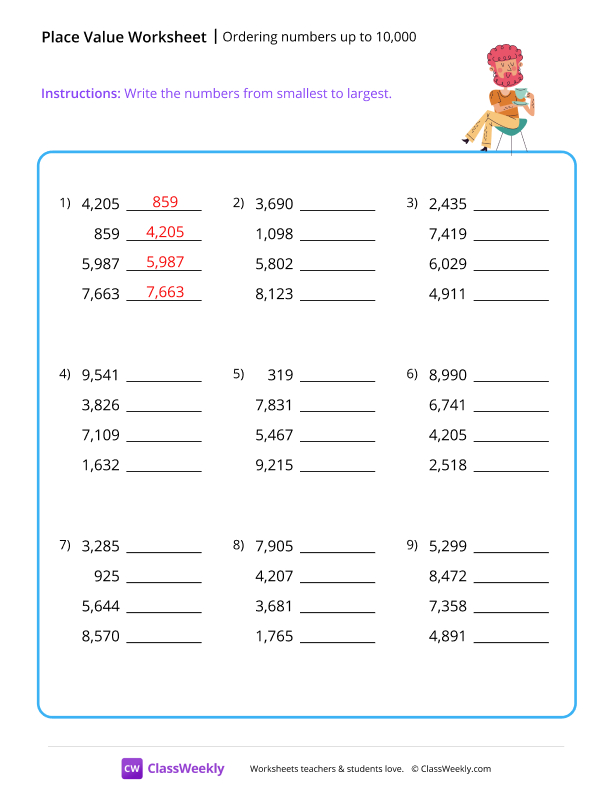
Free Greater Than and Less Than Worksheets
Curriculum-aligned printable worksheets for Kindergarten – 4th Grade. Download free.