Find the Stage Directions in a Play, The Night Hike
Written by Adi Ackerman, Head Teacher
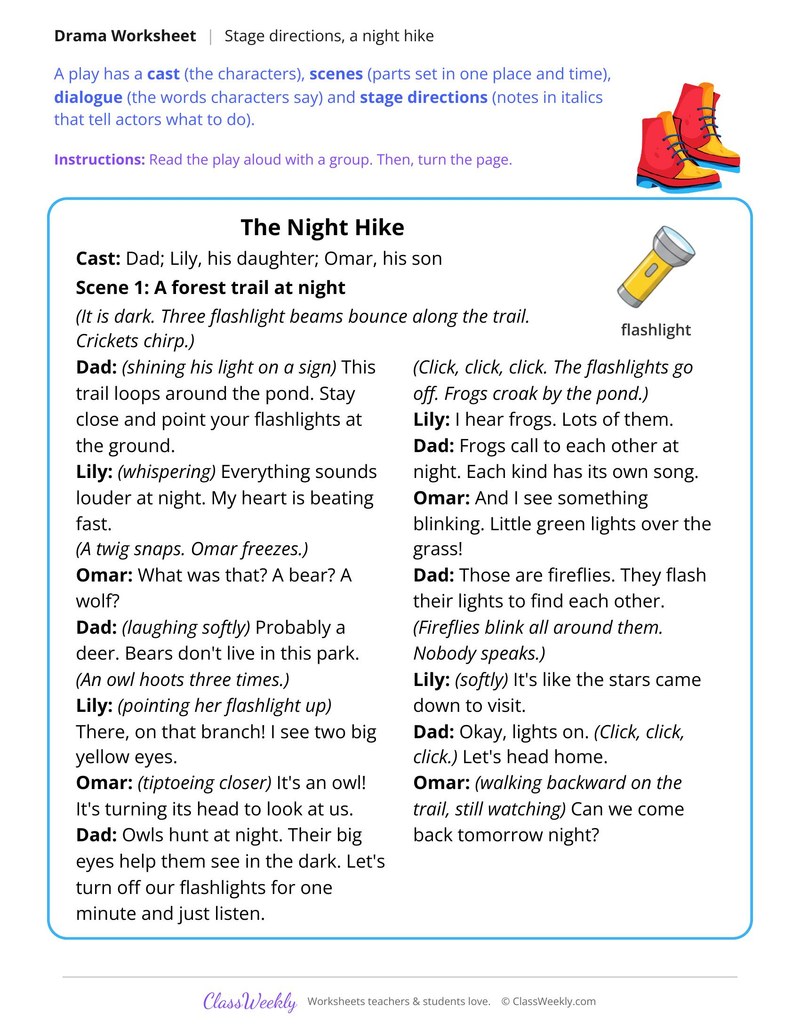
"Find the Stage Directions in a Play, The Night Hike" is written for 4th Grade (Ages 9-10), and it covers Common Core RL.4.5. If your little one is a year younger but already steady on children's stories, the page still works. You may just need to read the instructions out loud. And if they are older and reader's theater never quite stuck, this is a short review rather than busywork.
2 pages in this set
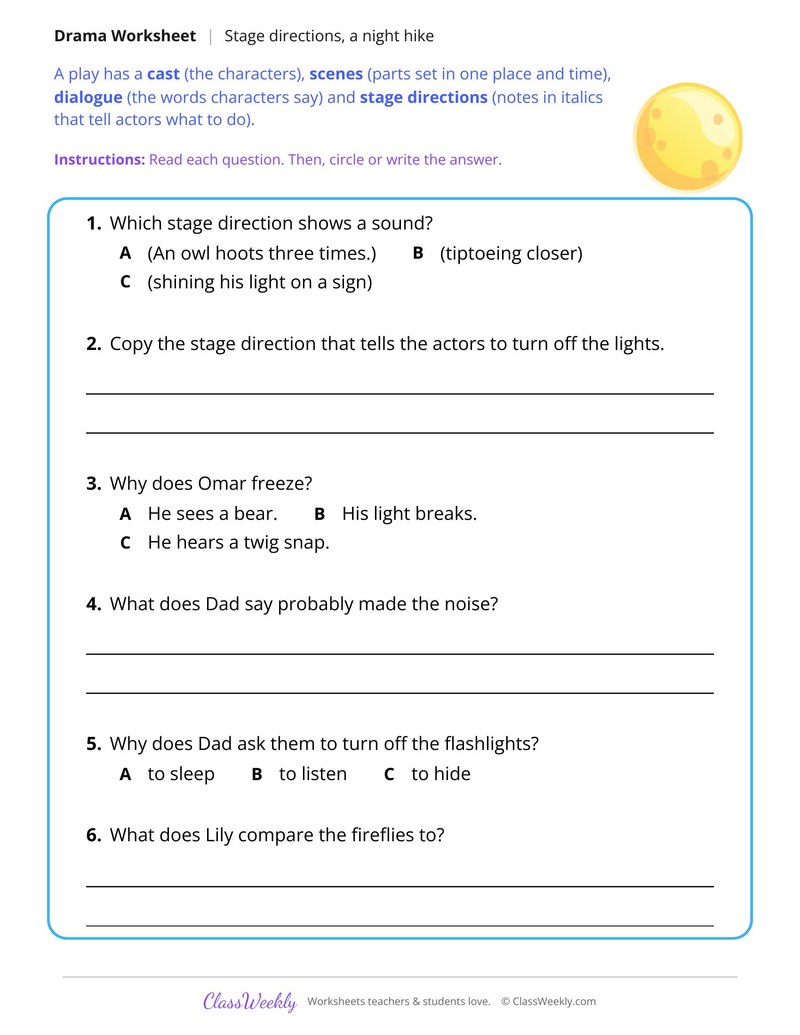
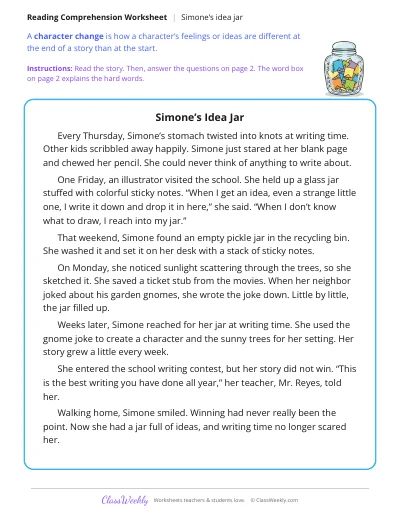
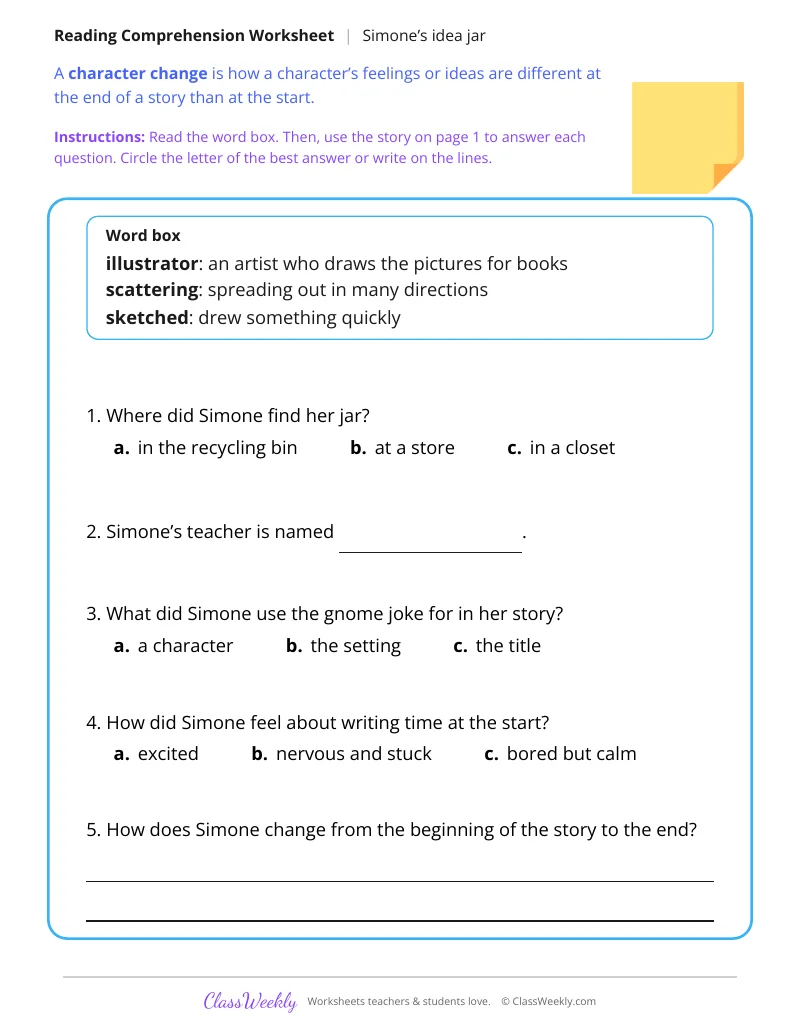
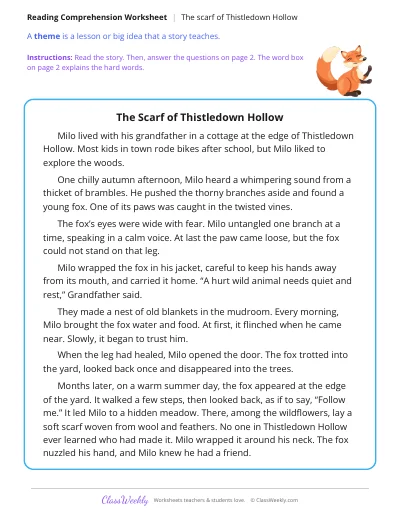
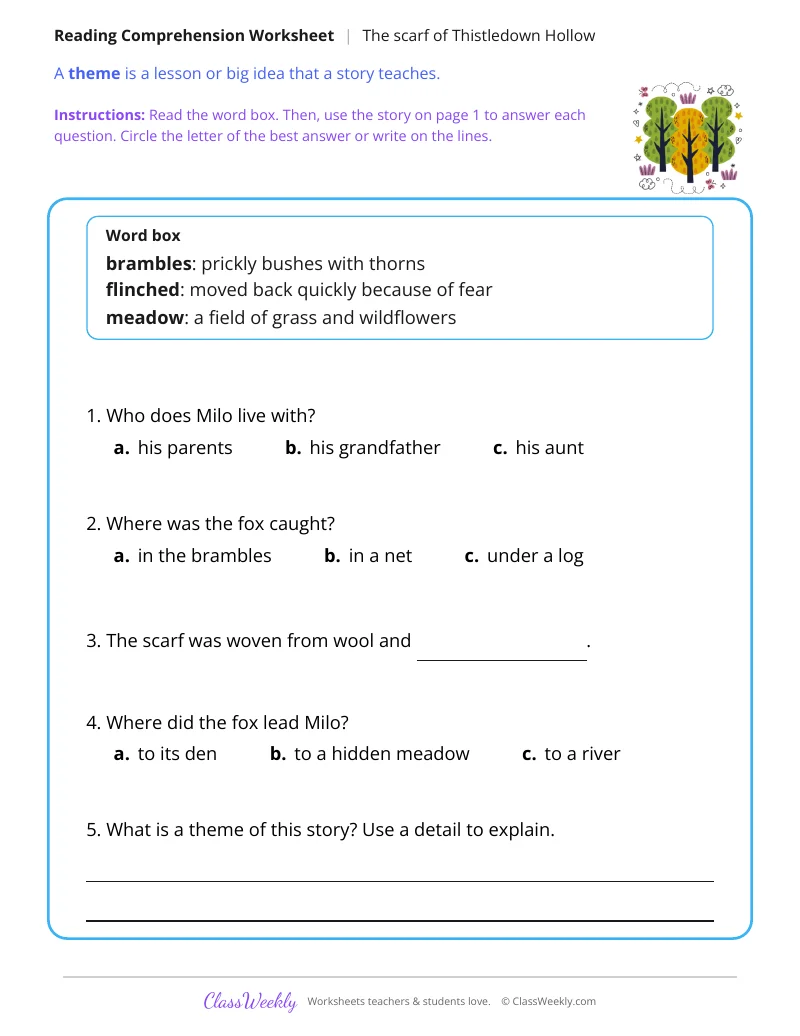
4th grade reading worksheet: read a night hike play, then find and copy stage directions for sounds and actions, and answer questions. Answer key included. Part of our reader's theater children's stories collection. Aligned to Common Core standards.
How do I use this worksheet?
Read each play twice in parts, first for the story and then with expression. Before the questions, have your child point to one line of dialogue and one stage direction. Check the answers with the key.
What students will practice
- Students will read an original play aloud in parts with expression.
- Students will tell dialogue from stage directions and name the setting and cast.
- Students will explain what happens in each scene and how the play ends.

Curriculum Links
Common Core State Standards
Reading · 4th Grade
Find this in the curriculum
Browse the grade, subject, and topic this belongs to.
FAQ
How do I use this reader's theater worksheet?
⌄
Read each play twice in parts, first for the story and then with expression. Before the questions, have your child point to one line of dialogue and one stage direction. Check the answers with the key.
What does this worksheet teach?
⌄
Read a night hike play, then find and copy stage directions for sounds and actions, and answer questions. A play has a cast (the characters), scenes (parts set in one place and time), dialogue (the words characters say) and stage directions (notes in italics that tell actors what to do). The directions on the page read: Read the play aloud with a group. Then, turn the page. On page 2: Read each question. Then, circle or write the answer. The answer key covers the questions on page 2.
Can I use this reader's theater worksheet for homeschool or classroom?
⌄
Yes, both. We made it for 4th Grade children's stories, and the page works the same whether it lands on a kitchen table or a center rotation. At home, most families go through it together and talk the answers out loud, and that talking is where most of the learning happens with reader's theater. In class it runs well as independent work while you pull a small group. Print one copy or thirty, whichever the day needs.
How is a play different from a story?
⌄
A play is written to be performed. It has a cast list, a setting for each scene, dialogue after each character's name and stage directions, in place of paragraphs told by a narrator. Telling these parts apart is part of RL.4.5.
How many readers does each script need?
⌄
Each 4th grade script has three or four parts, and two of them include a narrator. That makes them a good fit for a small reading group or a family read aloud.
What do the mystery and three scene plays add?
⌄
The Bake Sale Mystery asks children to name the detective, follow the clues and tell the lesson. The Bridge Builders asks them to tell what happens in each of its three scenes, which shows how the parts of a play build on each other.
Is there an answer key for each worksheet?
⌄
Yes. All six 4th grade reader's theater sheets have an answer key for the questions on page two.
What reading skills do fourth-grade children's stories worksheets build?
⌄
Fourth graders practice determining theme and drawing on details to support it (CCSS RL.4.2), describing characters using specific details from the text (RL.4.3), and referring to the text explicitly when explaining what it says and when drawing inferences (RL.4.1). Original stories with grade-level vocabulary embedded in context also build word knowledge alongside comprehension, since students meet new words the way they will in real reading, not on an isolated list.
How long should a fourth grader spend on a children's story worksheet?
⌄
A typical fourth-grade comprehension passage runs 500 to 900 words, similar in length to what appears on state reading assessments. Most students read the passage in 5 to 8 minutes and complete the questions in another 10 to 15. If a student is taking much longer, check whether the slowdown is decoding (sounding out words), vocabulary (not knowing what a word means), or the comprehension questions themselves, since each points to a different fix.
How can I use a children's story worksheet to build discussion, not just fill-in-the-blank answers?
⌄
Before handing over the questions, ask the student to retell the story in three sentences. This forces them to identify what actually mattered instead of everything that happened. Then use the worksheet questions as discussion prompts rather than a silent quiz: ask the student to point to the exact line that supports their answer. This habit, called citing text evidence, is exactly what CCSS RL.4.1 requires and it transfers directly to how test questions are scored.
Ratings & Reviews
No reviews yet. Be the first to share what you think.
Reviews are for ClassWeekly members.
Make a Request
Spotted something to fix, or want a worksheet we don't have yet? Tell us and we'll make it.
Worksheet Details
| Grade | 4th Grade |
| Subject | Reading |
| Topic | Children's Stories |
| Standard | RL.4.5 |
| Pages | 2 pages |
| Difficulty | Medium |
What is ClassWeekly?
ClassWeekly offers free worksheets and printable learning resources for kids in preschool to grade 5. All worksheets are aligned to Common Core, NGSS, and C3 Framework standards and designed by educators. Become a member to access the full library and download unlimited PDFs.