Make and Check Predictions in a Story About a Pet Parrot
Written by Adi Ackerman, Head Teacher
"Make and Check Predictions in a Story About a Pet Parrot" is written for 3rd Grade (Ages 8-9), and it covers Common Core RL.3.1. If your little one is a year younger but already steady on making inferences and predictions, the page still works. You may just need to read the instructions out loud. And if they are older and making predictions never quite stuck, this is a short review rather than busywork.
2 pages in this set
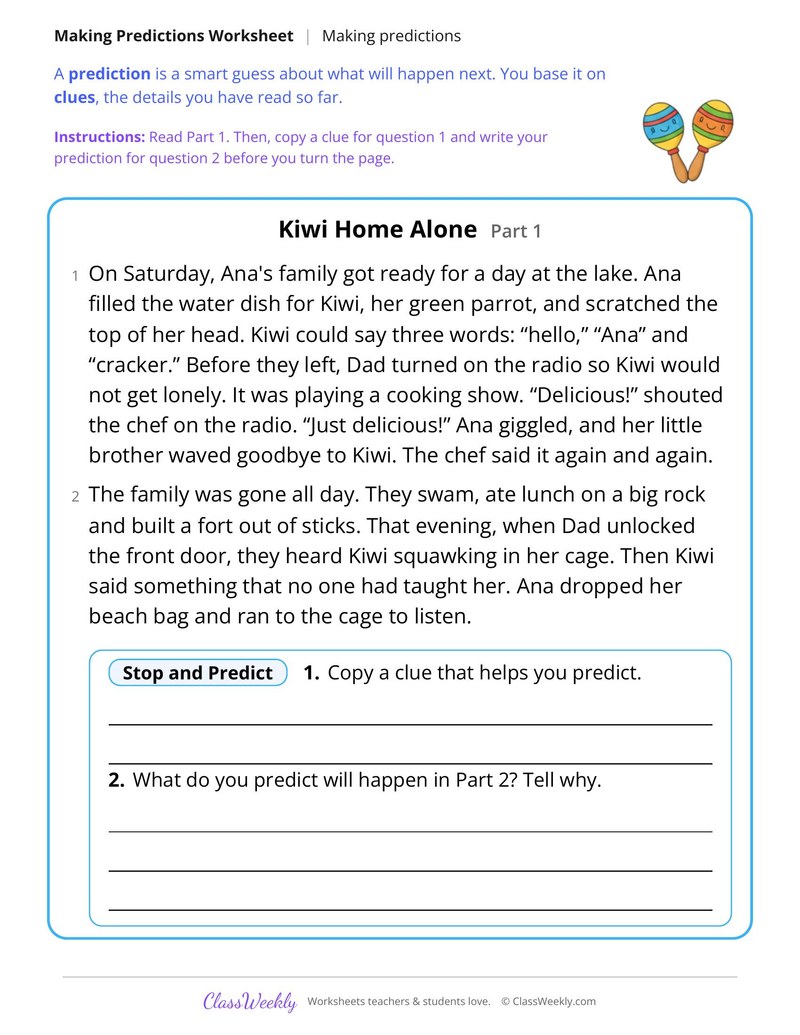
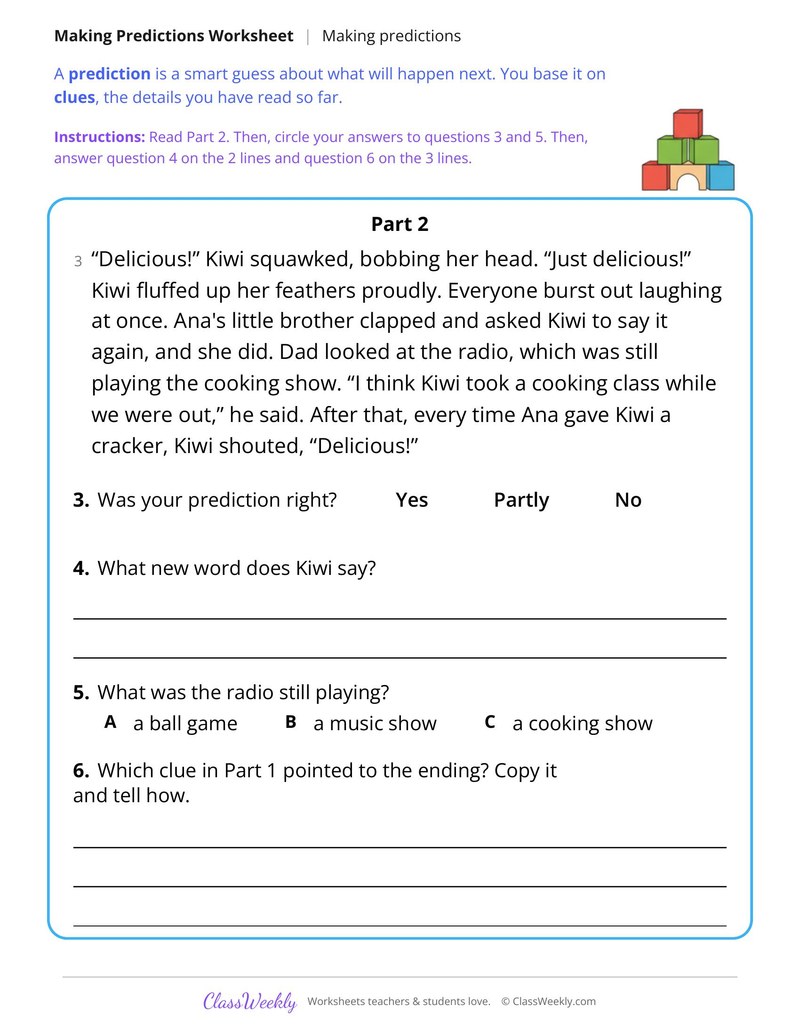
3rd grade reading worksheet: predict what Kiwi the parrot learns from a radio cooking show while the family is away, then check it. Answer key included. Part of our making predictions collection. Aligned to Common Core standards.
How do I use this worksheet?
Fold or cover the second page so your child writes the prediction before reading Part 2. Afterward, ask which clue helped most and whether a different clue would have led to a better guess.
What students will practice
- Students will copy a clue from Part 1 of a story and use it to make a prediction.
- Students will read Part 2 and tell whether their prediction was right.
- Students will copy the Part 1 clue that pointed to the ending and tell how.

Curriculum Links
Common Core State Standards
Reading: Literature · 3rd Grade
Standard: Ask and answer questions to demonstrate understanding of a text, referring explicitly to the text as the basis for the answers.
View all RL.3.1 worksheets →Find this in the curriculum
Browse the grade, subject, and topic this belongs to.
FAQ
How do I use this making predictions worksheet?
⌄
Fold or cover the second page so your child writes the prediction before reading Part 2. Afterward, ask which clue helped most and whether a different clue would have led to a better guess.
What does this worksheet teach?
⌄
Predict what Kiwi the parrot learns from a radio cooking show while the family is away, then check it. A prediction is a smart guess about what will happen next. You base it on clues, the details you have read so far. The directions on the page read: Read Part 1. Then, copy a clue for question 1 and write your prediction for question 2 before you turn the page. On page 2: Read Part 2. Then, circle your answers to questions 3 and 5. Then, answer question 4 on the 2 lines and question 6 on the 3 lines. An answer key is included.
Can I use this making predictions worksheet for homeschool or classroom?
⌄
Yes, both. We made it for 3rd Grade making inferences and predictions, and the page works the same whether it lands on a kitchen table or a center rotation. At home, most families go through it together and talk the answers out loud, and that talking is where most of the learning happens with making predictions. In class it runs well as independent work while you pull a small group. Print one copy or thirty, whichever the day needs.
What is a prediction?
⌄
A prediction is a smart guess about what will happen next in a story. You base it on clues, the details you have read so far. A prediction can turn out wrong and still be a good one, as long as it fits the clues.
How do the two part stories work?
⌄
Part 1 is on the first page. Children copy a clue and write a prediction before they turn the page. Part 2 tells the ending, and children circle Yes, Partly or No to say whether the prediction was right.
What if my child's prediction was wrong?
⌄
That is fine and worth talking about. Reread Part 1 together and look for the clue the author planted, like the kite's long ribbon tail or the seed that looked like the ones in Grandma's bird feeder. The last question on each sheet asks for that clue.
Is there an answer key for each worksheet?
⌄
Yes. All six making predictions sheets have an answer key for both pages. Predictions differ, so the key gives a sample clue and prediction to compare with.
What is the difference between an inference and a prediction?
⌄
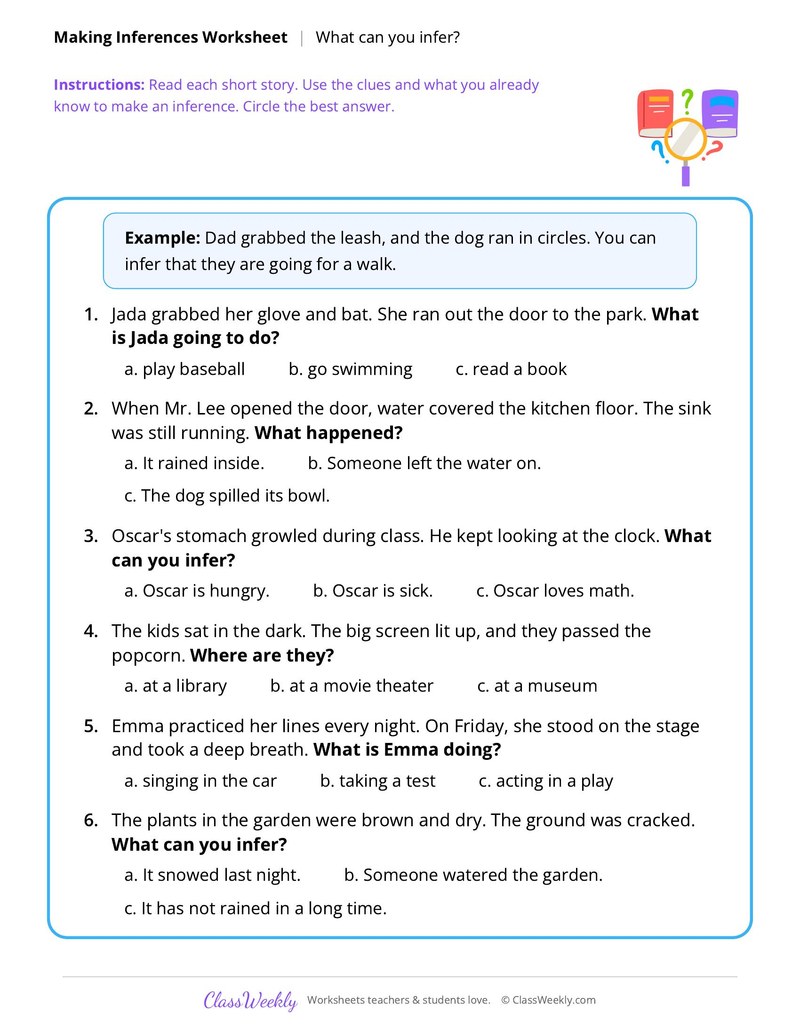
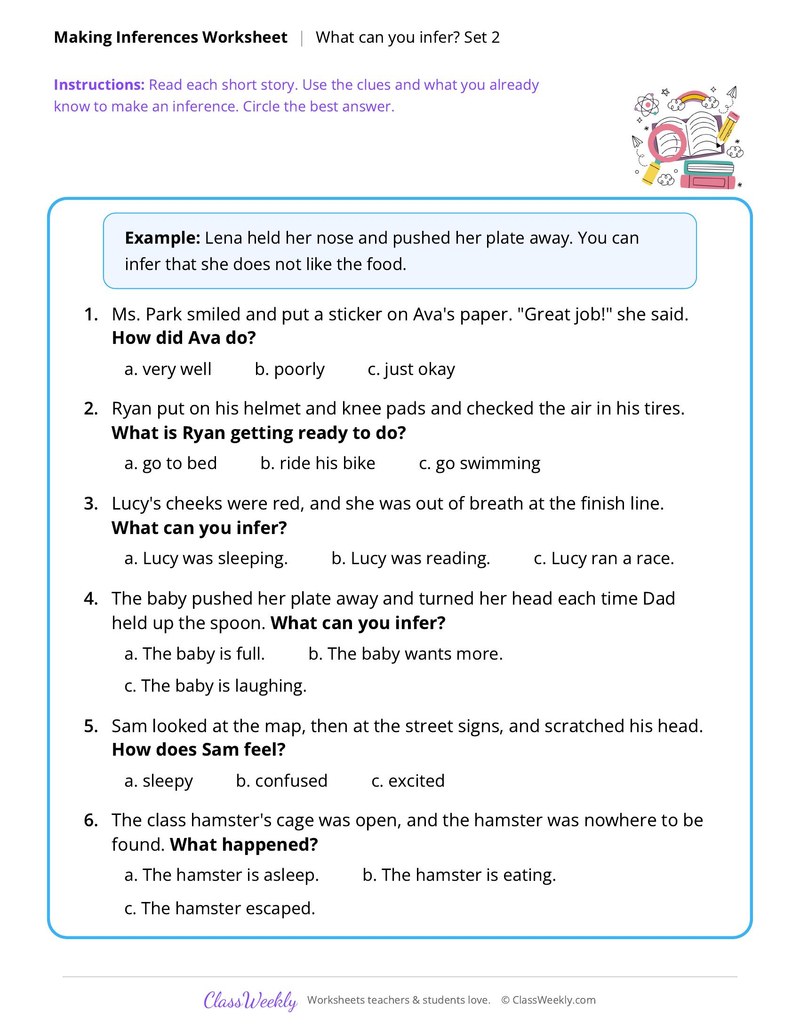
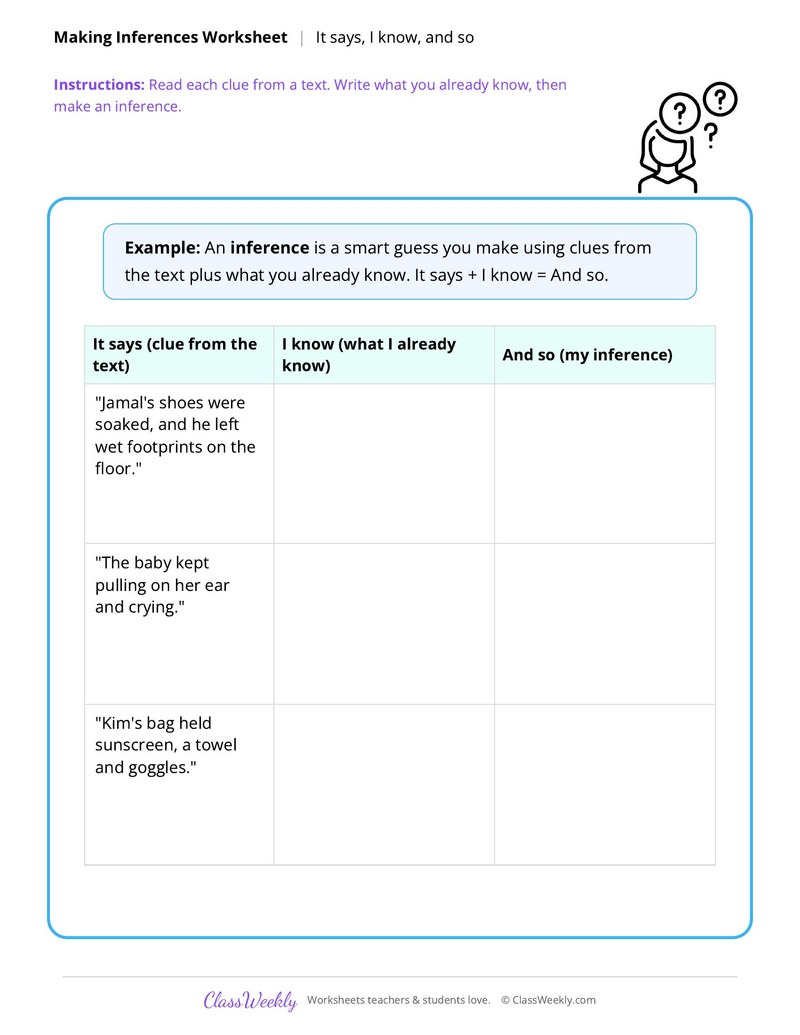
An inference is an idea about what is true right now that the story does not say, like how a character feels. A prediction is a smart guess about what will happen next. Both come from clues in the story plus what you already know (RL.3.1).
How do the clue charts work?
⌄
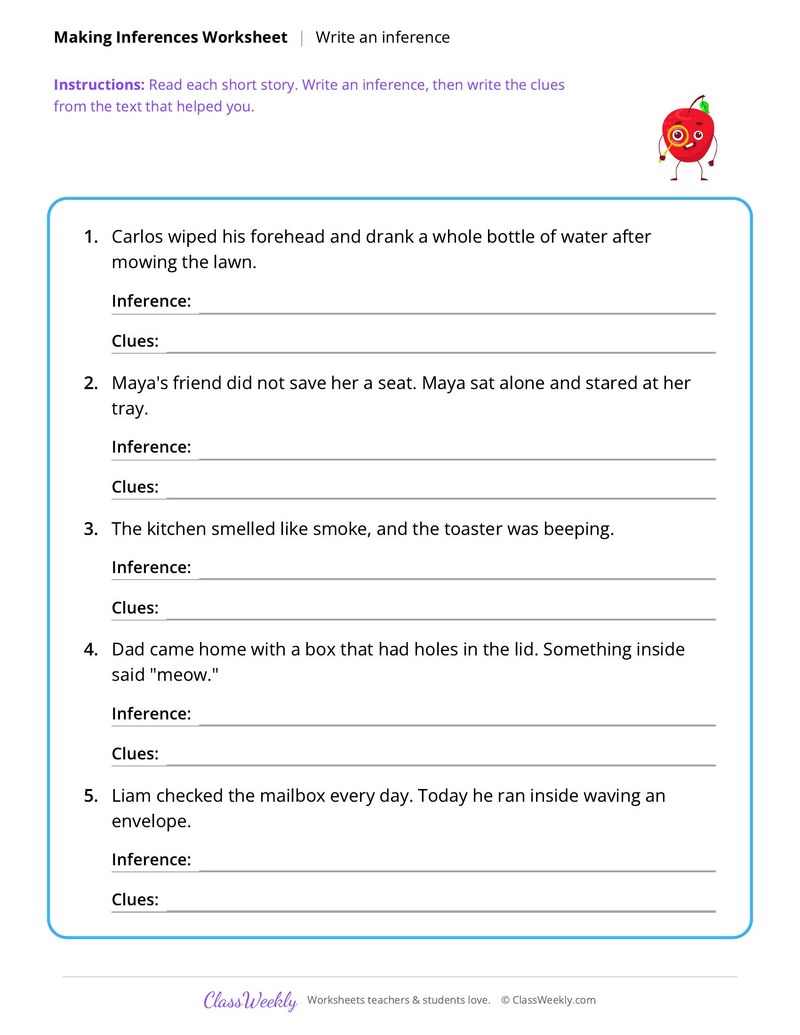
Each chart row quotes a sentence from the story with its paragraph number. Children write what the clue shows, such as a feeling, the setting or something that happened offstage, and how the clue shows it. Two multiple choice questions and one more inference follow.
How can I practice inferences at home?
⌄
Point out clues in everyday life and ask what they tell you, like wet umbrellas by the door or a sibling's slammed door. Then ask how your child knows. Giving the clue along with the idea is the same habit these sheets build.
Ratings & Reviews
No reviews yet. Be the first to share what you think.
Reviews are for ClassWeekly members.
Make a Request
Spotted something to fix, or want a worksheet we don't have yet? Tell us and we'll make it.
Worksheet Details
| Grade | 3rd Grade |
| Subject | Reading |
| Topic | Making Inferences and Predictions |
| Standard | RL.3.1 |
| Pages | 2 pages |
| Difficulty | Medium |
Learn More
What is ClassWeekly?
ClassWeekly offers free worksheets and printable learning resources for kids in preschool to grade 5. All worksheets are aligned to Common Core, NGSS, and C3 Framework standards and designed by educators. Become a member to access the full library and download unlimited PDFs.