Magnets Pull Without Touching, Read and Answer
Written by Adi Ackerman, Head Teacher
"Magnets Pull Without Touching, Read and Answer" is written for 3rd Grade (Ages 8-9), and it covers NGSS 3-PS2-3. If your little one is a year younger but already steady on electricity and magnetism, the page still works. You may just need to read the instructions out loud. And if they are older and contact and non-contact forces never quite stuck, this is a short review rather than busywork.
2 pages in this set
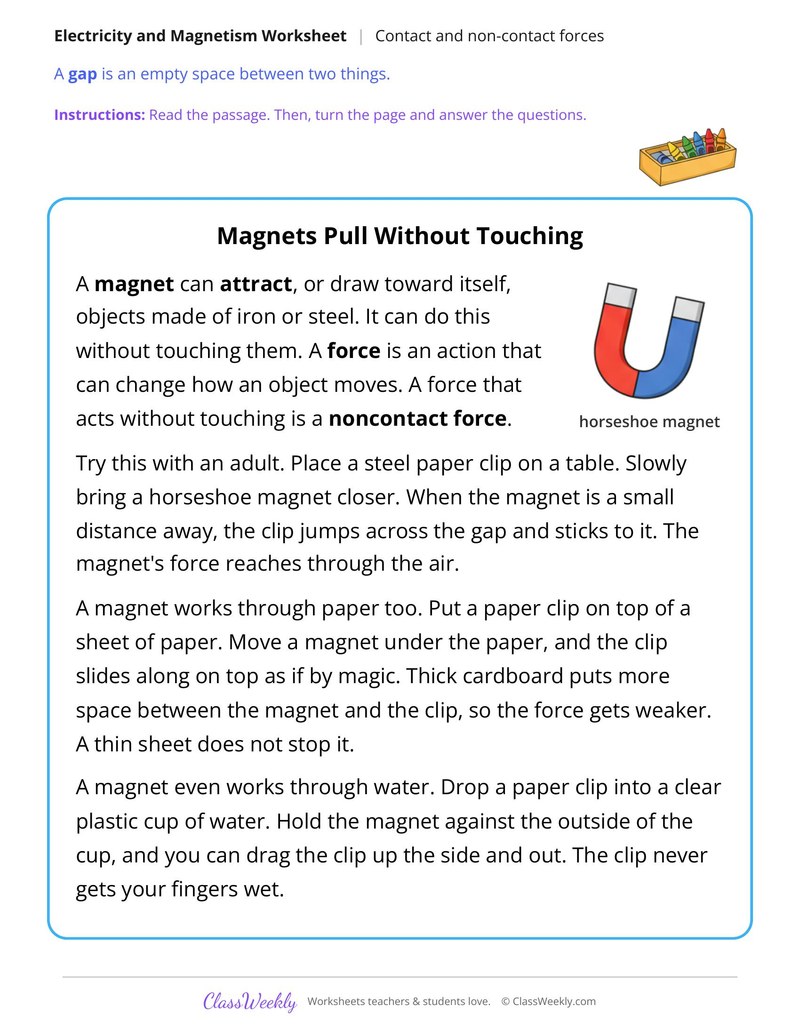
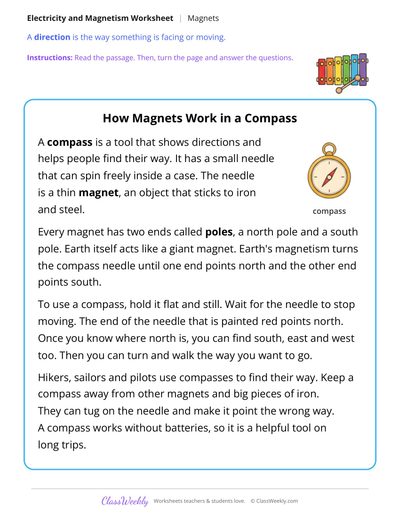
3rd grade science worksheet: read how a magnet pulls a paper clip across a gap, through paper and through water. Answer key included. Part of our contact and non-contact forces electricity and magnetism collection. Aligned to NGSS standards.
How do I use this worksheet?
Try the paper clip and cup of water test from the page together with a fridge magnet. Then ask your child to point out one contact force and one noncontact force in the room.
What students will practice
- Students will sort forces into contact and noncontact.
- Students will name gravity, magnetism and static electricity as forces that act at a distance.
- Students will explain how a magnet's pull passes through paper and water.


Curriculum Links
Next Generation Science Standards
Science · 3rd Grade
Find this in the curriculum
Browse the grade, subject, and topic this belongs to.
FAQ
How do I use this contact and non-contact forces worksheet?
⌄
Try the paper clip and cup of water test from the page together with a fridge magnet. Then ask your child to point out one contact force and one noncontact force in the room.
What does this worksheet teach?
⌄
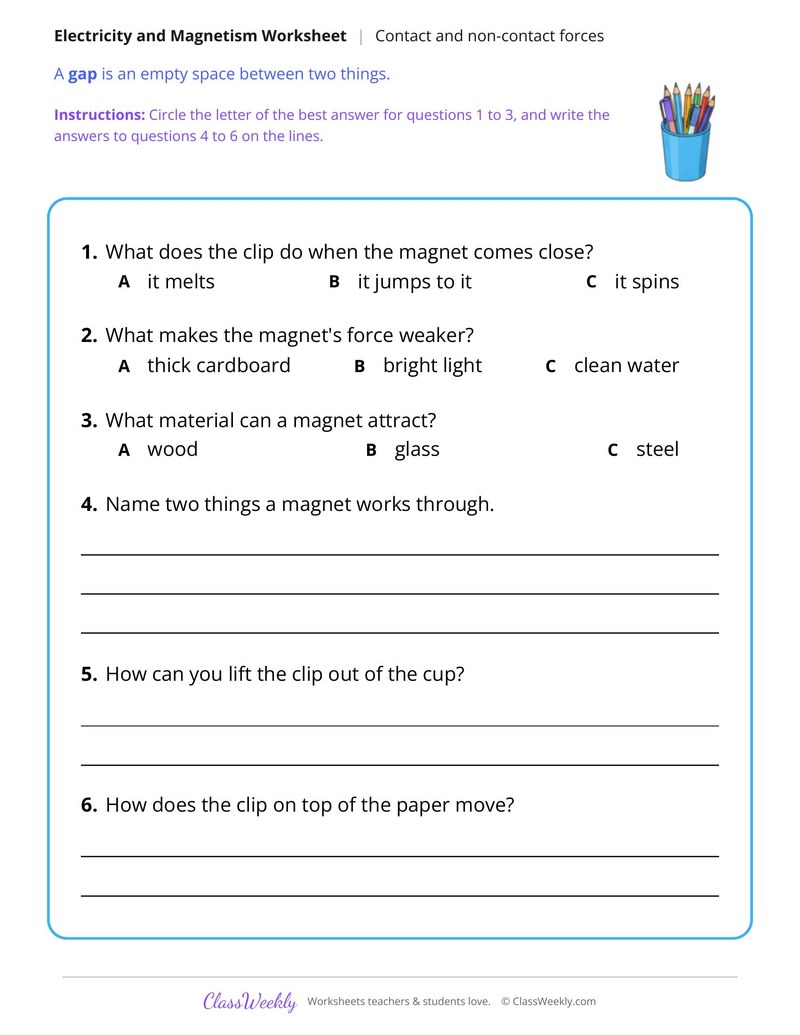
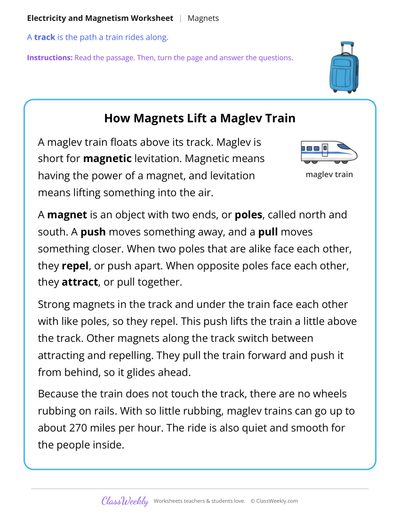
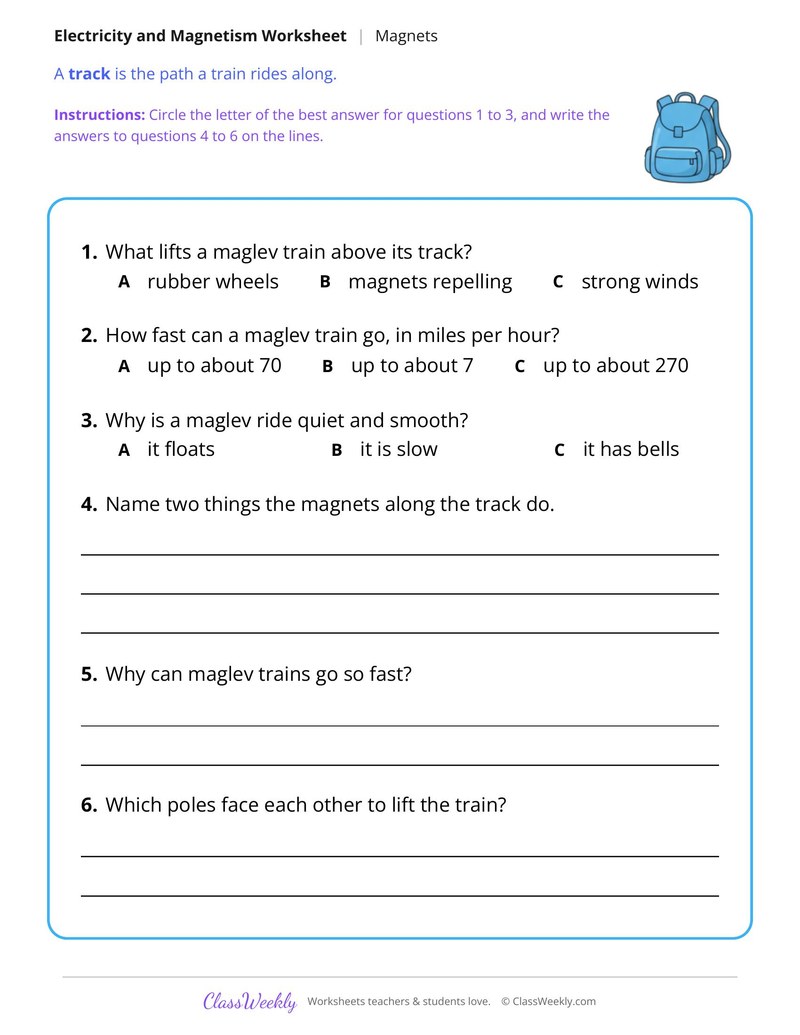
Read how a magnet pulls a paper clip across a gap, through paper and through water. A gap is an empty space between two things. The directions on the page read: Read the passage. Then, turn the page and answer the questions. On page 2: Circle the letter of the best answer for questions 1 to 3, and write the answers to questions 4 to 6 on the lines. The answer key covers the questions on page 2.
Can I use this contact and non-contact forces worksheet for homeschool or classroom?
⌄
Yes, both. We made it for 3rd Grade electricity and magnetism, and the page works the same whether it lands on a kitchen table or a center rotation. At home, most families go through it together and talk the answers out loud, and that talking is where most of the learning happens with contact and non-contact forces. In class it runs well as independent work while you pull a small group. Print one copy or thirty, whichever the day needs.
What does contact and non-contact forces teach third graders?
⌄
This topic teaches students that not all forces require objects to touch, gravity pulls a falling apple even before it hits the ground, and magnets attract metal objects across a gap. Third graders sort familiar forces into contact and non-contact categories, identify examples in everyday life, and explain the key difference between the two types. The concept provides an important organizing framework for all force and motion learning in Grade 3 and beyond.
When do third graders learn about contact and non-contact forces?
⌄
Contact and non-contact forces is typically introduced early in the Grade 3 forces and motion unit as a foundational organizing concept. At ages 8-9, students benefit from having a clear category structure before they dive into specific forces like gravity, friction, and magnetism. Understanding this distinction makes it easier to analyze new force examples they encounter throughout the year.
How can I use these worksheets at home?
⌄
Ask your child to walk through a room and find five examples of forces in action, then classify each as contact or non-contact using the worksheet vocabulary. The sorting and classification activities are straightforward enough for independent practice, while the open-response questions benefit from a brief conversation first. Making the connection to real experiences your child has every day, opening a door, picking up a toy, grounds the science in something concrete and familiar.
How many 3rd Grade contact and non-contact forces worksheets are there?
⌄
3 printable worksheets, all free to preview. Downloads are included with a ClassWeekly free trial, and every page prints on standard 8.5 x 11 paper.
What age are contact and non-contact forces worksheets for?
⌄
These are written for 3rd Grade students, roughly ages 8-9. Many teachers also use them a grade up for review or a grade down as an extension, so use the preview to judge the fit for a particular child.
Are these contact and non-contact forces worksheets aligned to NGSS?
⌄
Yes. Each one shows the NGSS code it covers on its own page, so you can check the alignment yourself rather than taking our word for it.
Ratings & Reviews
No reviews yet. Be the first to share what you think.
Reviews are for ClassWeekly members.
Make a Request
Spotted something to fix, or want a worksheet we don't have yet? Tell us and we'll make it.
Worksheet Details
| Grade | 3rd Grade |
| Subject | Science |
| Topic | Electricity and Magnetism |
| Standard | 3-PS2-3 |
| Pages | 2 pages |
| Difficulty | Medium |
Learn More
What is ClassWeekly?
ClassWeekly offers free worksheets and printable learning resources for kids in preschool to grade 5. All worksheets are aligned to Common Core, NGSS, and C3 Framework standards and designed by educators. Become a member to access the full library and download unlimited PDFs.