Rough and Smooth Ramps, Read a Test Chart and Answer
Written by Adi Ackerman, Head Teacher
"Rough and Smooth Ramps, Read a Test Chart and Answer" is written for 3rd Grade (Ages 8-9), and it covers NGSS 3-PS2-1. If your little one is a year younger but already steady on forces and motion, the page still works. You may just need to read the instructions out loud. And if they are older and friction never quite stuck, this is a short review rather than busywork.
2 pages in this set
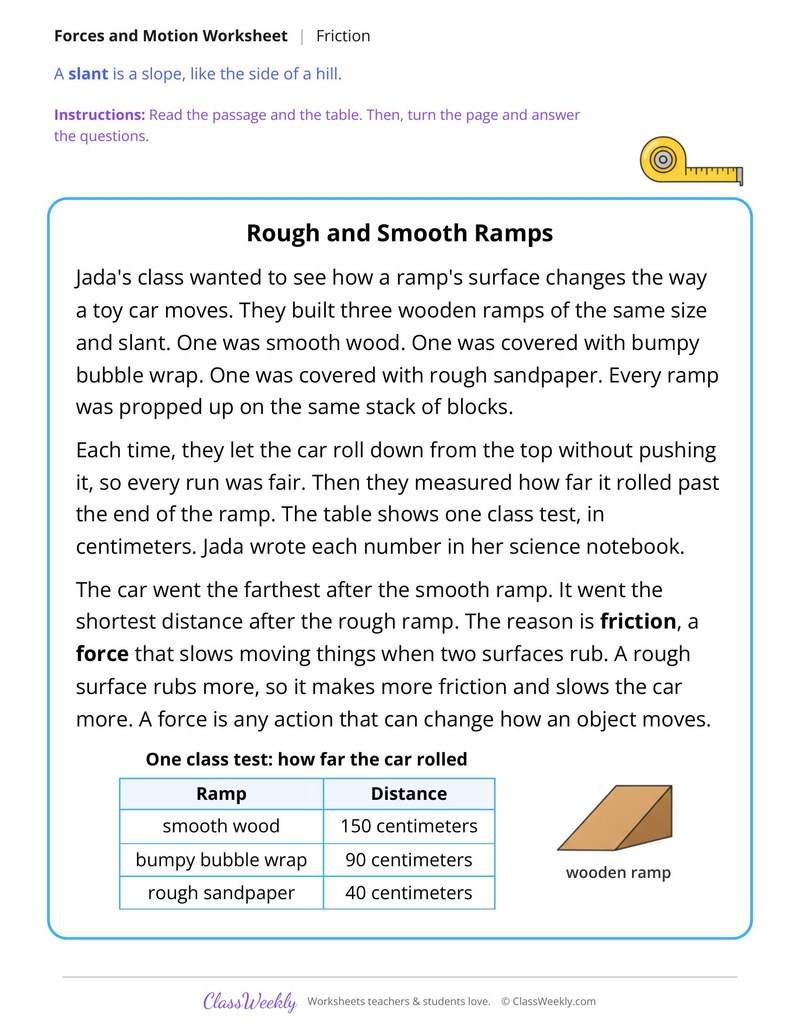
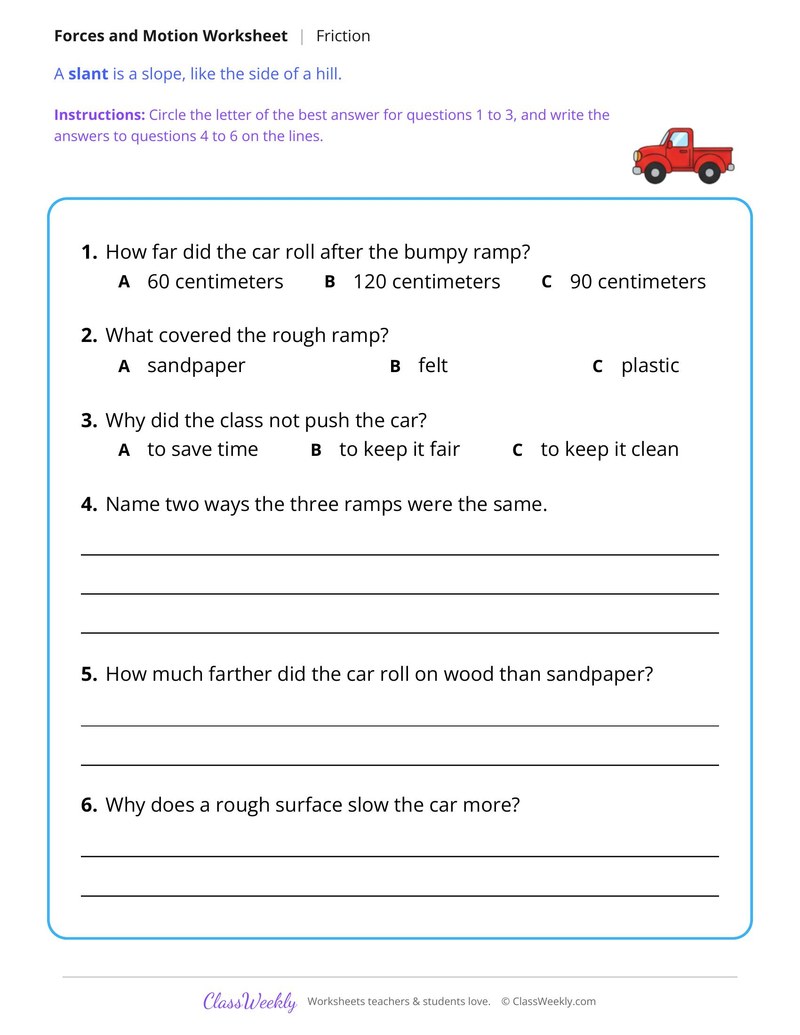
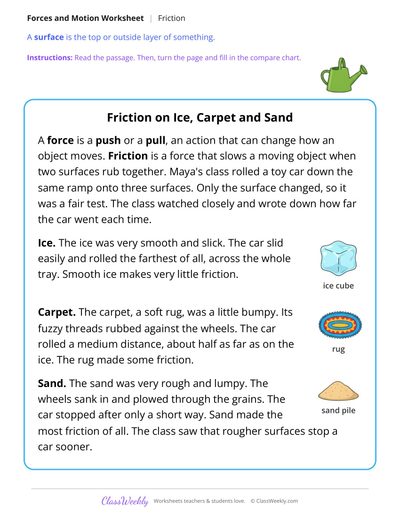
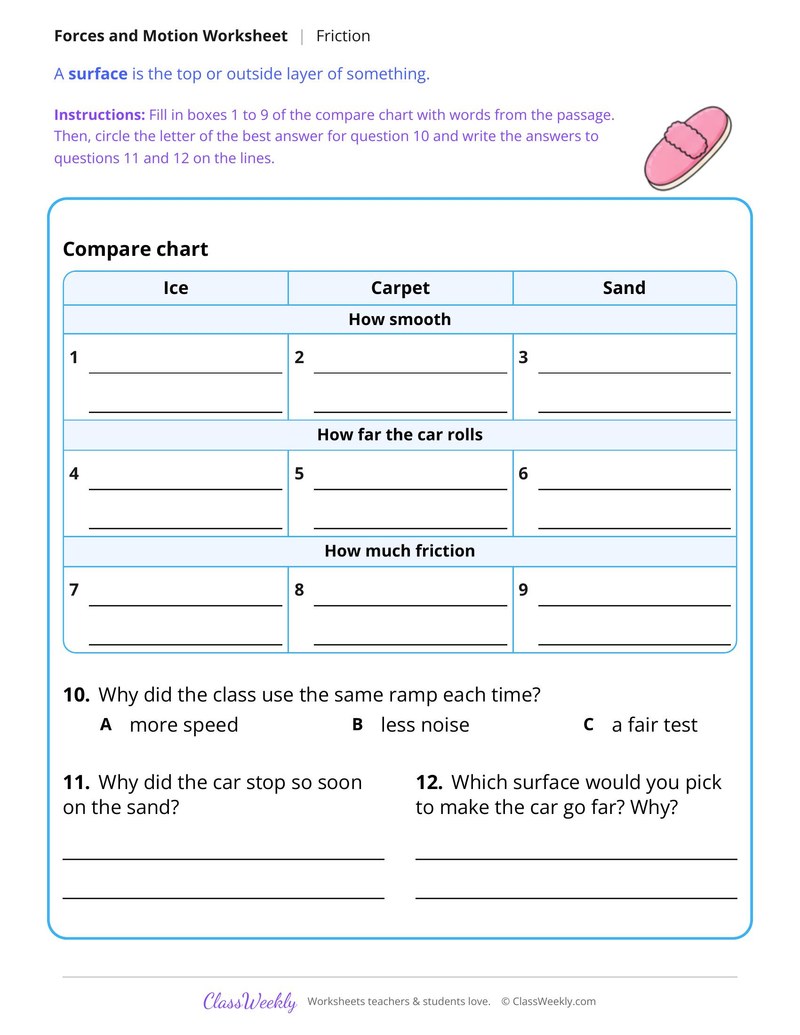
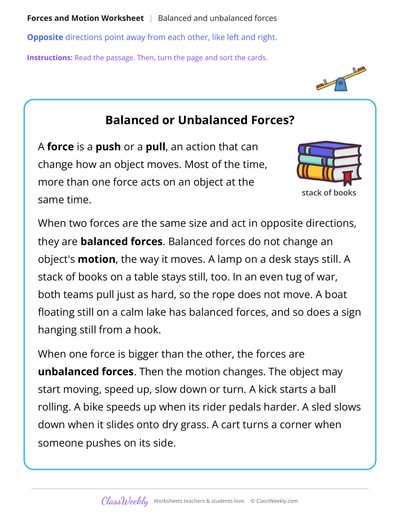
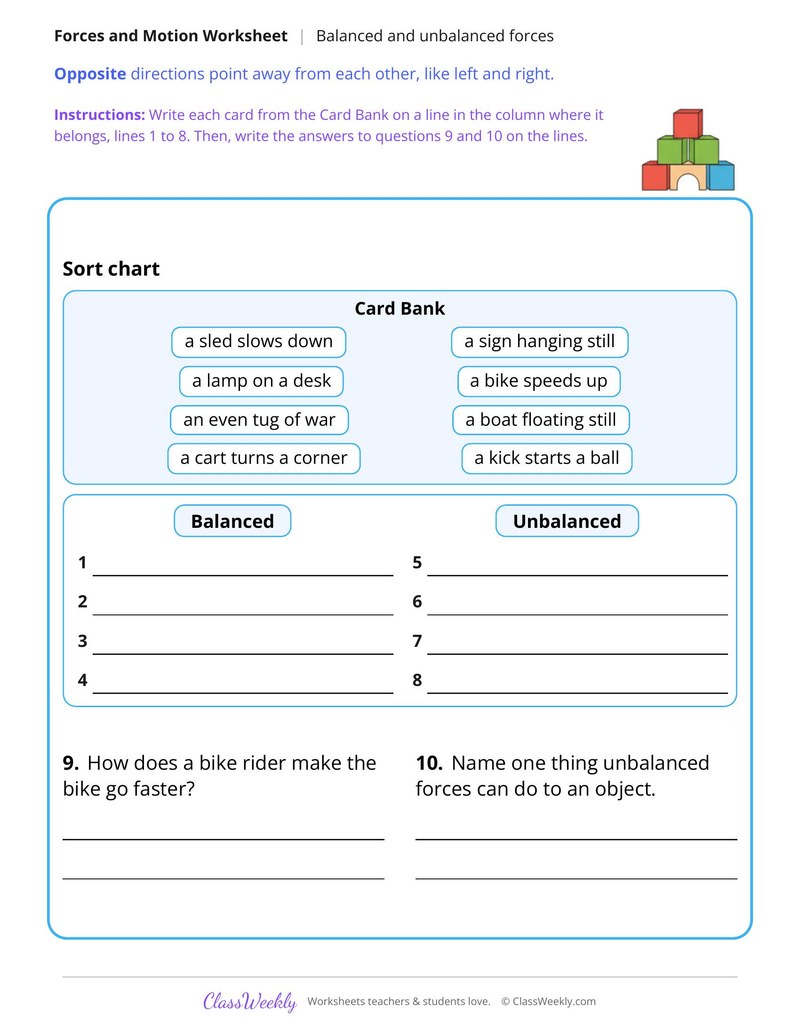
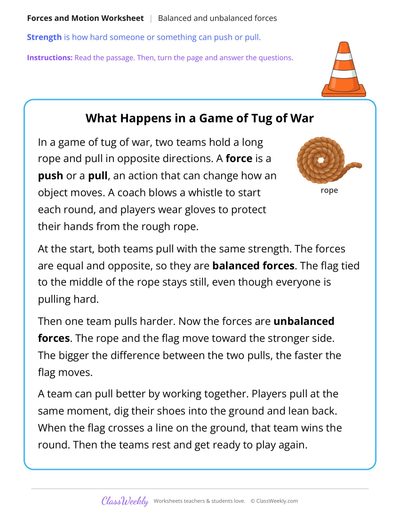
3rd grade science worksheet: read a test table of a toy car rolling off smooth, bubble wrap and sandpaper ramps and compare friction. Answer key included. Part of our friction forces and motion collection. Aligned to NGSS standards.
How do I use this worksheet?
Roll a toy car across a rug, a tile floor and a towel and measure how far it goes, keeping the push the same each time. Talk about why the test is only fair if one thing changes.
What students will practice
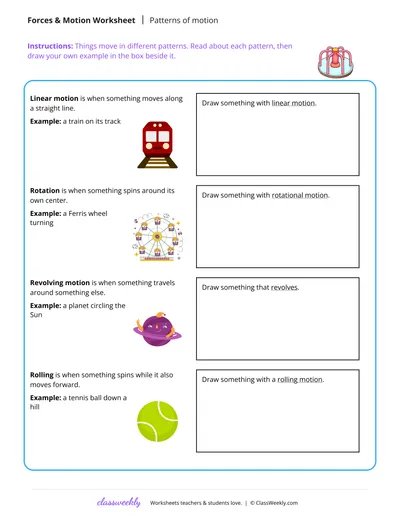
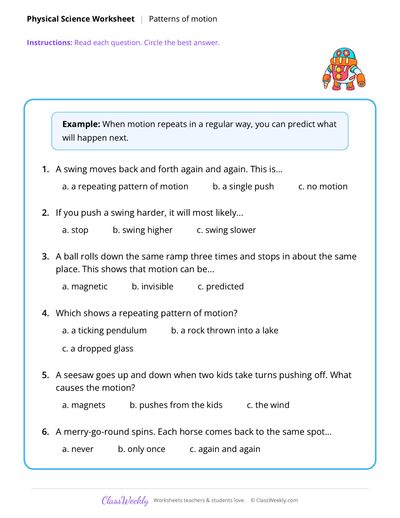
- Students will compare the friction of smooth and rough surfaces.
- Students will read a test table to find which surface slows a car most.
- Students will explain how brakes use friction to stop a bike.


Curriculum Links
Next Generation Science Standards
Science · 3rd Grade
Find this in the curriculum
Browse the grade, subject, and topic this belongs to.
FAQ
How do I use this friction worksheet?
⌄
Roll a toy car across a rug, a tile floor and a towel and measure how far it goes, keeping the push the same each time. Talk about why the test is only fair if one thing changes.
What does this worksheet teach?
⌄
Read a test table of a toy car rolling off smooth, bubble wrap and sandpaper ramps and compare friction. A slant is a slope, like the side of a hill. The directions on the page read: Read the passage and the table. Then, turn the page and answer the questions. On page 2: Circle the letter of the best answer for questions 1 to 3, and write the answers to questions 4 to 6 on the lines. The answer key covers the questions on page 2.
Can I use this friction worksheet for homeschool or classroom?
⌄
Yes, both. We made it for 3rd Grade forces and motion, and the page works the same whether it lands on a kitchen table or a center rotation. At home, most families go through it together and talk the answers out loud, and that talking is where most of the learning happens with friction. In class it runs well as independent work while you pull a small group. Print one copy or thirty, whichever the day needs.
What does friction teach third graders?
⌄
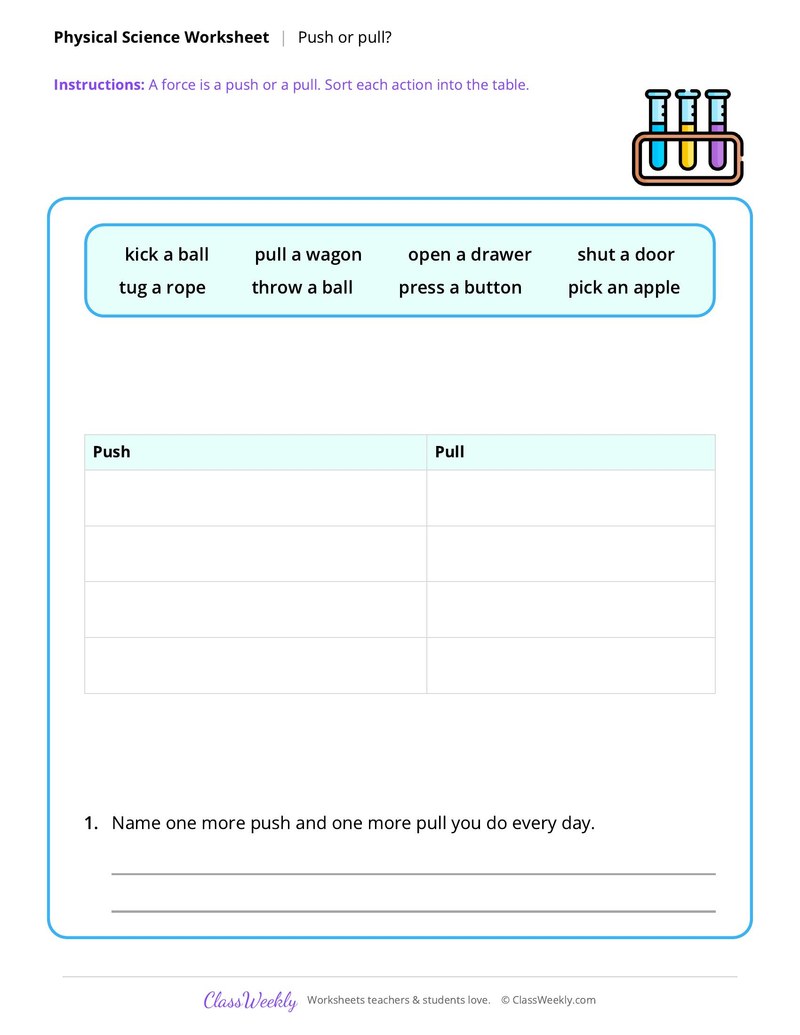
Friction teaches students that when two surfaces touch and slide against each other, a force is created that resists motion and slows things down. Third graders learn to compare the friction produced by different surface pairs, smooth vs. rough, wet vs. dry, and explain practical examples like why car brakes work or why it's hard to slide on carpet. The concept connects directly to engineering design challenges about reducing or increasing friction.
When do third graders learn about friction?
⌄
Friction is typically introduced in Grade 3 physical science as part of the forces and motion unit, alongside gravity and balanced and unbalanced forces. At ages 8-9, students are ready to investigate variables systematically, for example, testing which surface a toy car rolls farthest on, which makes friction an ideal hands-on investigation topic. It also pairs naturally with engineering design challenges.
How can I use these worksheets at home?
⌄
Slide a book across different surfaces at home, tile, carpet, wood, and ask your child to rank them by friction using the worksheet's vocabulary. The comparison and prediction activities in the worksheets mirror these hands-on tests, so doing both together reinforces the concept from multiple angles. Physical science concepts like friction are among the easiest to explore at home without any special materials.
How many 3rd Grade friction worksheets are there?
⌄
3 printable worksheets, all free to preview. Downloads are included with a ClassWeekly free trial, and every page prints on standard 8.5 x 11 paper.
What age are friction worksheets for?
⌄
These are written for 3rd Grade students, roughly ages 8-9. Many teachers also use them a grade up for review or a grade down as an extension, so use the preview to judge the fit for a particular child.
Are these friction worksheets aligned to NGSS?
⌄
Yes. Each one shows the NGSS code it covers on its own page, so you can check the alignment yourself rather than taking our word for it.
Ratings & Reviews
No reviews yet. Be the first to share what you think.
Reviews are for ClassWeekly members.
Make a Request
Spotted something to fix, or want a worksheet we don't have yet? Tell us and we'll make it.
Worksheet Details
| Grade | 3rd Grade |
| Subject | Science |
| Topic | Forces and Motion |
| Standard | 3-PS2-1 |
| Pages | 2 pages |
| Difficulty | Medium |
What is ClassWeekly?
ClassWeekly offers free worksheets and printable learning resources for kids in preschool to grade 5. All worksheets are aligned to Common Core, NGSS, and C3 Framework standards and designed by educators. Become a member to access the full library and download unlimited PDFs.