Choose the Best Synonym in Each Sentence
Written by Adi Ackerman, Head Teacher
"Choose the Best Synonym in Each Sentence" is written for 3rd Grade (Ages 8-9). If your little one is a year younger but already steady on synonyms and antonyms, the page still works. You may just need to read the instructions out loud. And if they are older and write-in synonyms never quite stuck, this is a short review rather than busywork.
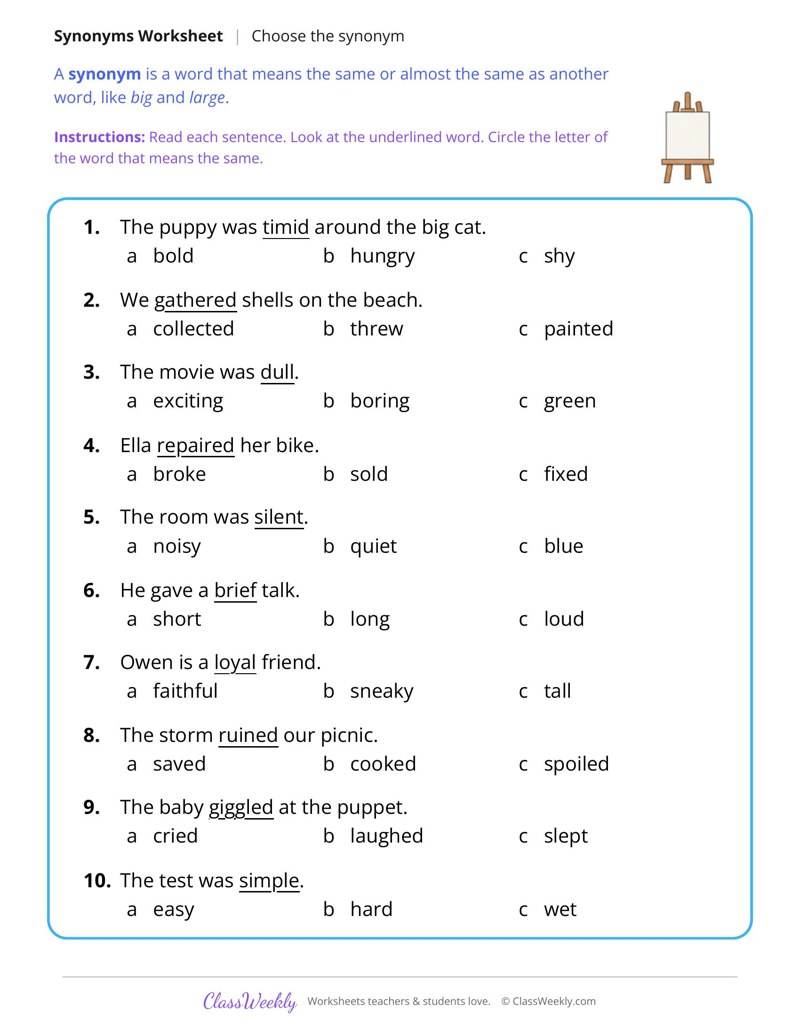
3rd grade vocabulary worksheet: circle the synonym for the underlined word in 10 sentences, like shy for timid and quiet for silent. Answer key included. Part of our write-in synonyms collection.
How do I use this worksheet?
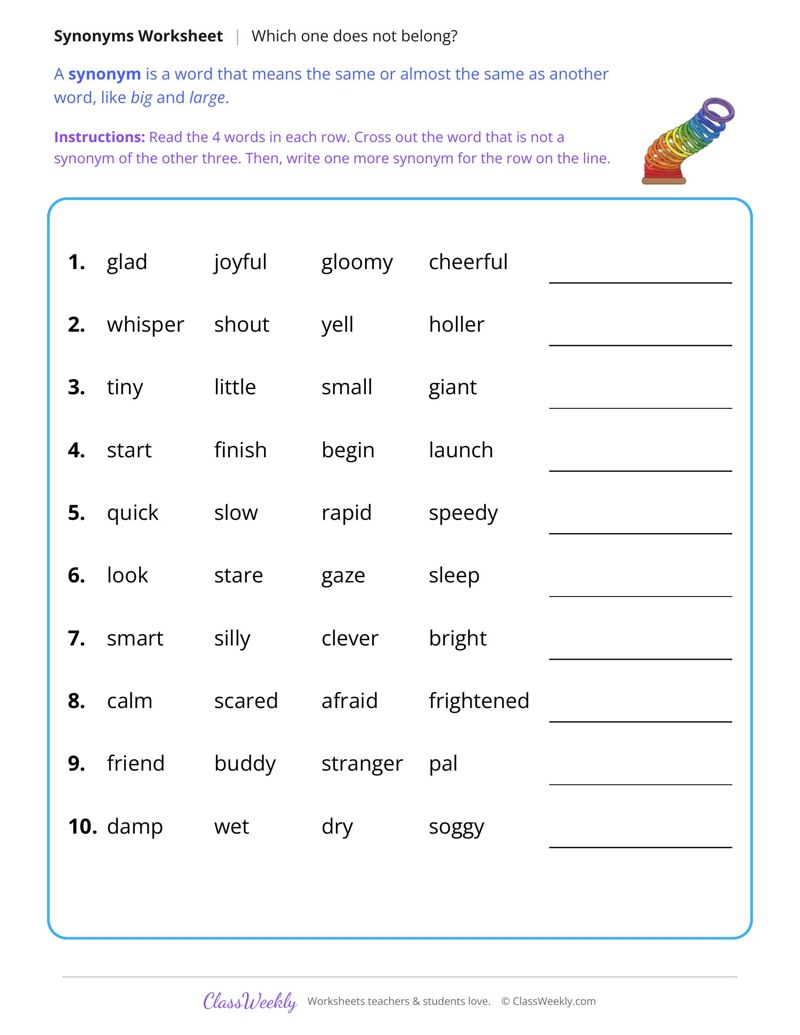
Have your child read each sentence aloud with the new word to check that the meaning stays the same. On the odd one out page, ask why the crossed out word does not fit. Check with the answer key, and accept any good extra synonym.
What students will practice
- Students will read 10 sentences with one underlined word, like timid or dull.
- Students will circle the synonym out of 3 choices, such as boring for dull.
- Students will rule out an antonym and an unrelated word in each set of choices.


Curriculum Links
Find this in the curriculum
Browse the grade, subject, and topic this belongs to.
FAQ
How do I use this write-in synonyms worksheet?
⌄
Have your child read each sentence aloud with the new word to check that the meaning stays the same. On the odd one out page, ask why the crossed out word does not fit. Check with the answer key, and accept any good extra synonym.
What does this worksheet teach?
⌄
Circle the synonym for the underlined word in 10 sentences, like shy for timid and quiet for silent. A synonym is a word that means the same or almost the same as another word, like big and large. The directions on the page read: Read each sentence. Look at the underlined word. Circle the letter of the word that means the same. An answer key is included.
Can I use this write-in synonyms worksheet for homeschool or classroom?
⌄
Yes, both. We made it for 3rd Grade synonyms and antonyms, and the page works the same whether it lands on a kitchen table or a center rotation. At home, most families go through it together and talk the answers out loud, and that talking is where most of the learning happens with write-in synonyms. In class it runs well as independent work while you pull a small group. Print one copy or thirty, whichever the day needs.
What is a synonym?
⌄
A word that means nearly the same as another, like happy and glad. Synonyms usually take a bit more thought than antonyms, since "nearly the same" is a fuzzier idea than a clean opposite.
What does this worksheet ask my child to do?
⌄
Choose the Best Synonym in Each Sentence. Choosing from options keeps the focus on the idea rather than on spelling, which is useful when you want to check understanding without handwriting getting in the way.
How do I build this vocabulary away from the page?
⌄
Bring it into everyday talk. At dinner or in the car, say a word and ask for a synonym or an antonym on the spot. Vocabulary sticks best when it's tied to a real moment, not just a worksheet.
What does "nearly the same" mean in this context?
⌄
True synonyms, identical in every situation, are rarer than students expect. Happy and glad are close, but glad reads a little more grown-up, and noticing that difference is the real skill.
Which page should my child start with?
⌄
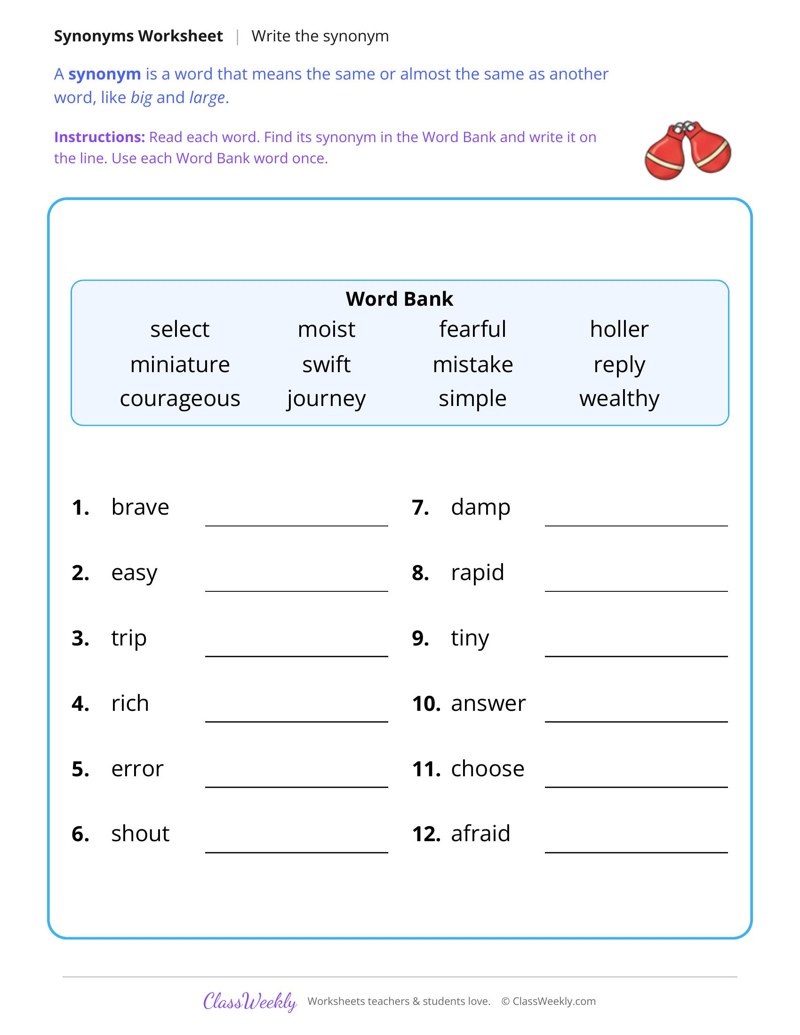
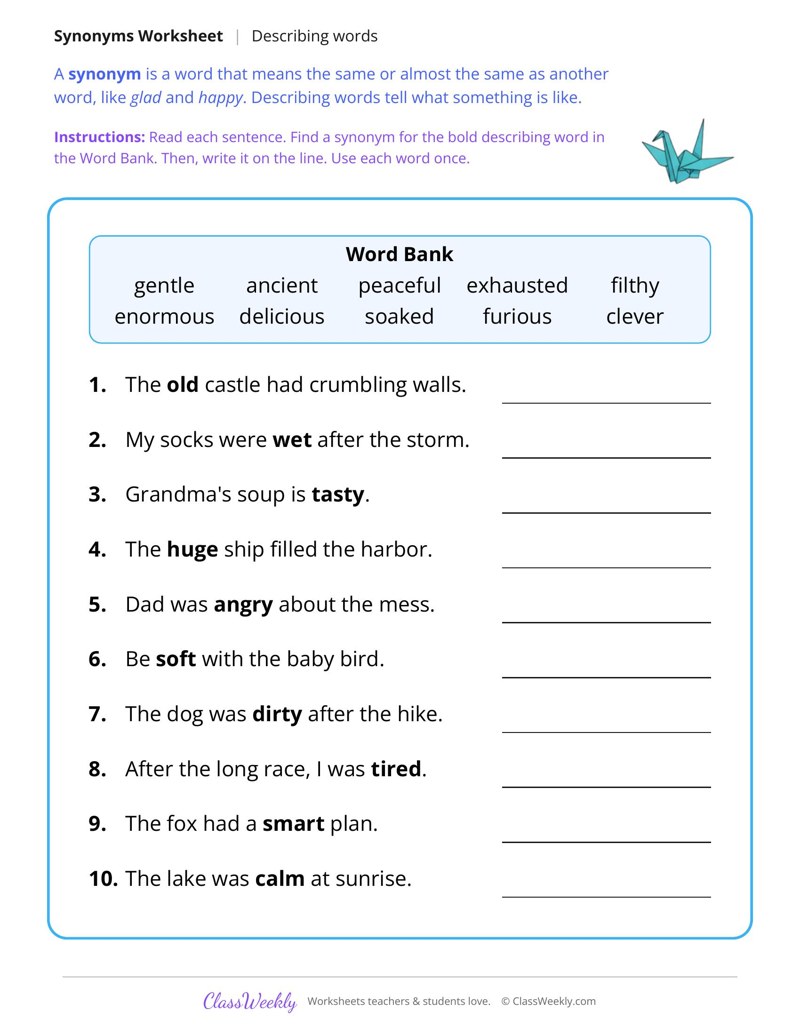
Start with Write a Synonym From the Word Bank, where each bank word fits one given word. Then do the describing words page and Choose the Best Synonym in Each Sentence. Cross Out the Word That Is Not a Synonym comes last, since your child also writes one more synonym for each row.
How can I extend this practice?
⌄
Ask your child to explain why their synonym isn't a perfect match for the original word. That question pushes past simple matching into real vocabulary range.
Is there an answer key for each worksheet?
⌄
Yes. All 5 write-in synonyms sheets have an answer key. On the odd one out page the extra synonym is a sample, so accept any word that fits the row.
How does third grade synonym and antonym work go beyond simple matching?
⌄
Third grade pages ask children to choose among close words, not just draw lines. They write a Word Bank synonym for words like rapid and damp, pick the synonym for an underlined word in a sentence, cross out the word that is not a synonym in a row of 4, and write synonyms and antonyms on their own. The synonym crossword adds a puzzle layer, since each answer must fit the crossing letters.
What should I do if my child writes a synonym or antonym that's technically correct but unusual?
⌄
Accept it, and use it as a chance to talk about precision. Sluggish is a perfectly good antonym for fast even if slow was the expected answer, and noticing that more than one correct answer can exist is itself a small vocabulary lesson about how flexible word relationships really are.
Why do some words seem to have more than one antonym?
⌄
Because opposite can mean different things depending on which quality of the word you're opposing. The opposite of hot could be cold (temperature) or the opposite of hot could be mild if you're talking about spice level. Third graders start noticing this kind of context-dependence, which is a genuine step up from the one-right-answer antonym pairs they met in earlier grades.
Ratings & Reviews
No reviews yet. Be the first to share what you think.
Reviews are for ClassWeekly members.
Make a Request
Spotted something to fix, or want a worksheet we don't have yet? Tell us and we'll make it.
Worksheet Details
| Grade | 3rd Grade |
| Subject | Vocabulary |
| Topic | Synonyms and Antonyms |
| Pages | 1 page |
| Difficulty | Medium |
What is ClassWeekly?
ClassWeekly offers free worksheets and printable learning resources for kids in preschool to grade 5. All worksheets are aligned to Common Core, NGSS, and C3 Framework standards and designed by educators. Become a member to access the full library and download unlimited PDFs.