Change Y to I Before Adding Er and Est
Written by Adi Ackerman, Head Teacher
"Change Y to I Before Adding Er and Est" is written for 4th Grade (Ages 9-10), and it covers Common Core L.4.2.D. If your little one is a year younger but already steady on adjectives, the page still works. You may just need to read the instructions out loud. And if they are older and comparing adjectives never quite stuck, this is a short review rather than busywork.
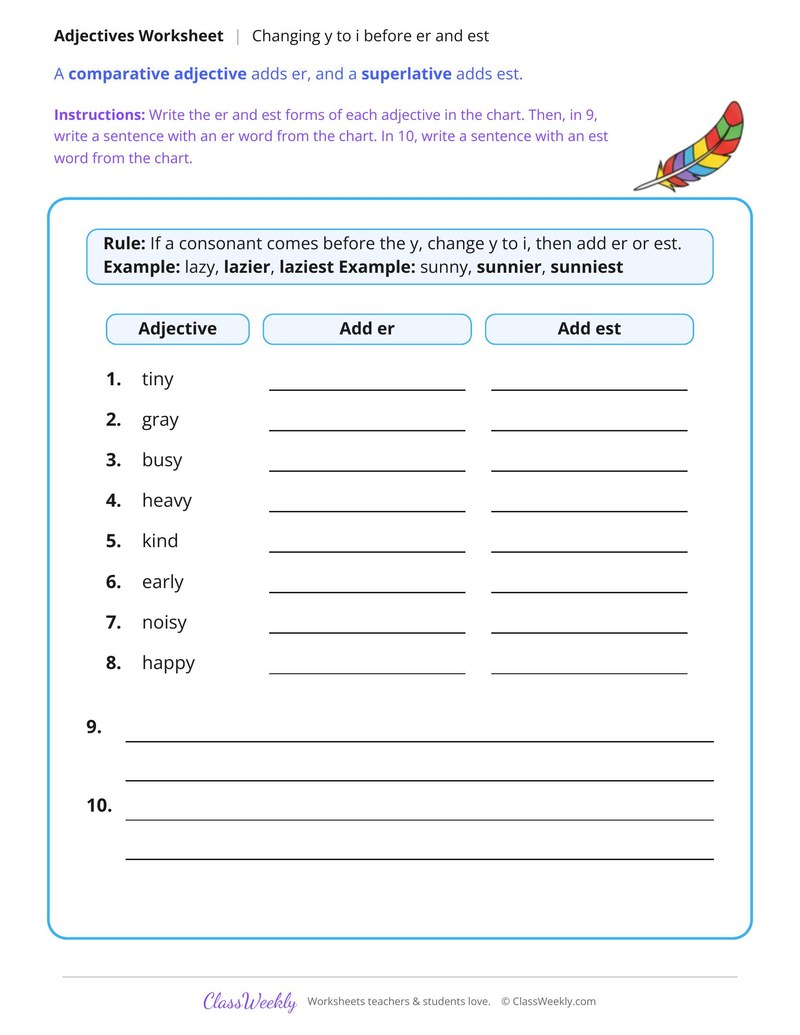
4th grade grammar worksheet: change y to i before adding er and est to adjectives like tiny and busy, but not to gray or kind. Answer key included. Part of our comparing adjectives collection. Aligned to Common Core standards.
How do I use this worksheet?
Before each item, have your child hold up fingers for how many things are being compared. Say mistakes like gooder out loud and ask what sounds right instead. Check with the answer key.
What students will practice
- Students will count what a sentence compares and choose bad, worse or worst.
- Students will use little, less and least for amounts that cannot be counted.
- Students will change y to i before adding er or est and fix double comparisons like more better.
Curriculum Links
Common Core State Standards
Language · 4th Grade
Standard: Spell grade-appropriate words correctly, consulting references as needed.
View all L.4.2.D worksheets →Find this in the curriculum
Browse the grade, subject, and topic this belongs to.
FAQ
How do I use this comparing adjectives worksheet?
⌄
Before each item, have your child hold up fingers for how many things are being compared. Say mistakes like gooder out loud and ask what sounds right instead. Check with the answer key.
What does this worksheet teach?
⌄
Change y to i before adding er and est to adjectives like tiny and busy, but not to gray or kind. A comparative adjective adds er, and a superlative adds est. The directions on the page read: Write the er and est forms of each adjective in the chart. Then, in 9, write a sentence with an er word from the chart. In 10, write a sentence with an est word from the chart. An answer key is included.
Can I use this comparing adjectives worksheet for homeschool or classroom?
⌄
Yes, both. We made it for 4th Grade adjectives, and the page works the same whether it lands on a kitchen table or a center rotation. At home, most families go through it together and talk the answers out loud, and that talking is where most of the learning happens with comparing adjectives. In class it runs well as independent work while you pull a small group. Print one copy or thirty, whichever the day needs.
When do you use a comparative or a superlative adjective?
⌄
Use a comparative, like worse or busier, to compare two things. Use a superlative, like worst or busiest, for three or more. Each sheet starts by asking children to count what the sentence compares.
Why do bad, good and little change form?
⌄
They are irregular, so they do not take er and est. Bad becomes worse and worst, good becomes better and best, and little, for amounts you cannot count, becomes less and least.
When do you change y to i before er and est?
⌄
Change y to i when a consonant comes before the y, as in tiny, tinier, tiniest. When a vowel comes before it, as in gray, keep the y: grayer and grayest.
Is there an answer key for each worksheet?
⌄
Yes. All four comparing adjectives sheets have an answer key, with the six fixes for the field day report and sample sentences for the lines children write themselves.
What adjective skills are expected in fourth grade?
⌄
Fourth graders should use adjectives to make their writing precise and vivid, including forming comparative (bigger, more beautiful) and superlative (biggest, most beautiful) forms correctly (CCSS L.4.1). They should also recognize and use demonstrative adjectives (this, that, these, those), and use adjectives effectively in longer compositions.
How do you teach comparative and superlative adjectives to fourth graders?
⌄
Teach the rules: add -er and -est to most one-syllable adjectives (cold, colder, coldest), use more and most with adjectives of two or more syllables (more careful, most careful), and memorize irregular forms (good, better, best; bad, worse, worst). Worksheets that ask students to complete adjective comparison charts or choose the correct form in context build this skill.
Why is adjective choice important in fourth-grade writing?
⌄
Precise adjective use is a key trait in fourth-grade writing quality. A student who writes the ancient, crumbling castle communicates far more than one who writes the old castle. CCSS W.4.4 expects fourth graders to produce clear and coherent writing, and strong adjective choices directly contribute to that standard. Modeling with mentor texts and revision exercises develop this craft.
Ratings & Reviews
No reviews yet. Be the first to share what you think.
Reviews are for ClassWeekly members.
Make a Request
Spotted something to fix, or want a worksheet we don't have yet? Tell us and we'll make it.
Worksheet Details
| Grade | 4th Grade |
| Subject | Grammar & Writing |
| Topic | Adjectives |
| Standard | L.4.2.D |
| Pages | 1 page |
| Difficulty | Medium |
Learn More
What is ClassWeekly?
ClassWeekly offers free worksheets and printable learning resources for kids in preschool to grade 5. All worksheets are aligned to Common Core, NGSS, and C3 Framework standards and designed by educators. Become a member to access the full library and download unlimited PDFs.