Apostrophe Check In, Short Forms and Owners
Written by Adi Ackerman, Head Teacher
"Apostrophe Check In, Short Forms and Owners" is written for 2nd Grade (Ages 7-8), and it covers Common Core L.2.2.C. If your little one is a year younger but already steady on punctuation, the page still works. You may just need to read the instructions out loud. And if they are older and contractions never quite stuck, this is a short review rather than busywork.
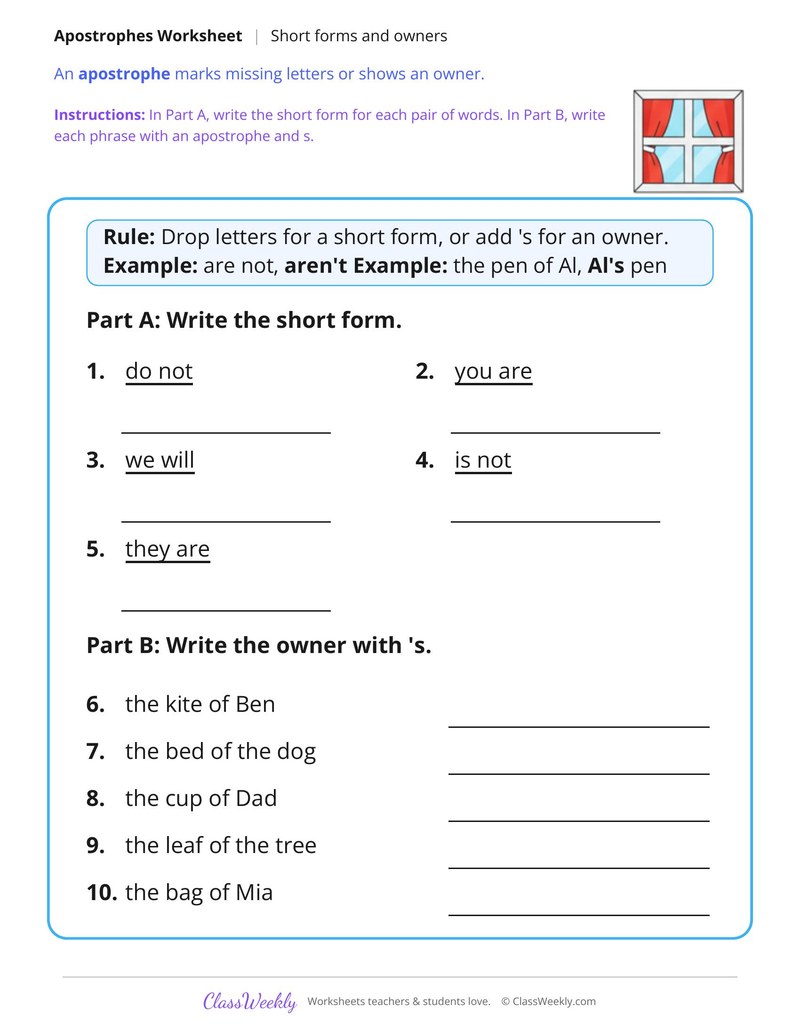
2nd grade grammar worksheet: check in on apostrophes by writing short forms like don't and we'll and owner phrases like Ben's kite. Answer key included. Part of our contractions punctuation collection. Aligned to Common Core standards.
How do I use this worksheet?
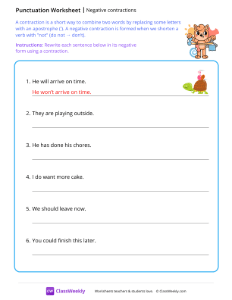
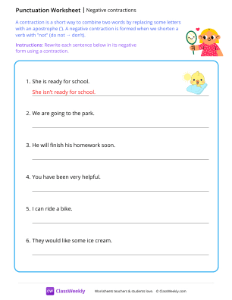
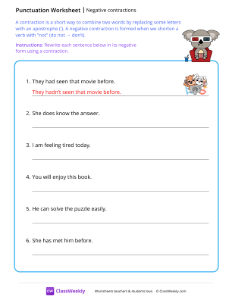
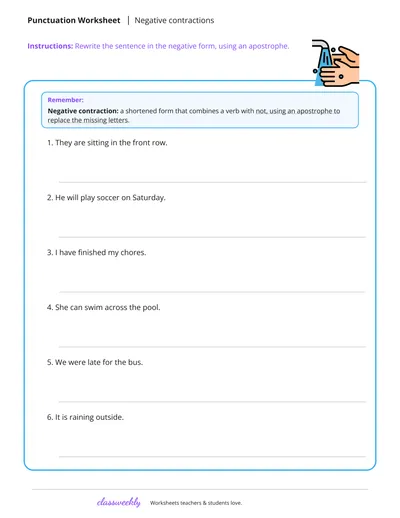
Write the two words, cross out the letters that drop, and put the apostrophe in their place. To tell a contraction from an owner word, try putting back the letters: if it makes two words, it is a short form. Check with the answer key.
What students will practice
- Students will write contractions with is, are, will and have, like he's, we're, I'll and I've.
- Students will write the contraction for two underlined words in a sentence.
- Students will tell a contraction from a word that shows an owner.
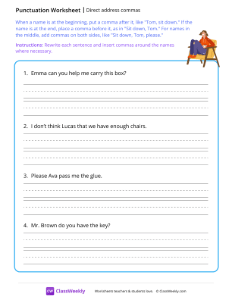
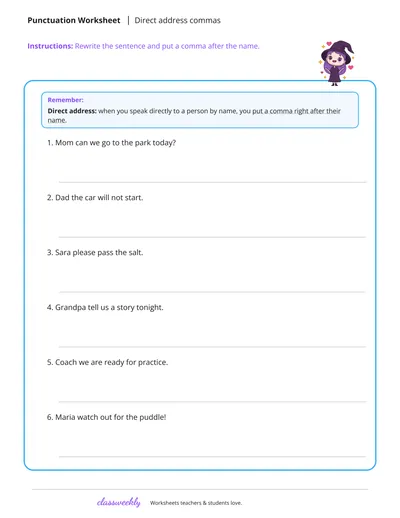
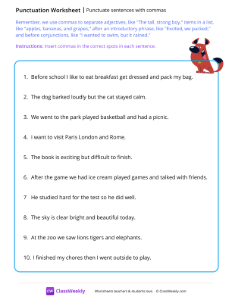
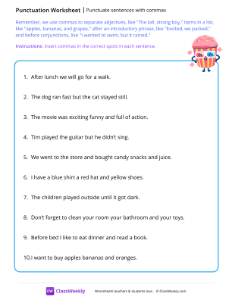

Curriculum Links
Common Core State Standards
Language · 2nd Grade
Standard: Use an apostrophe to form contractions and frequently occurring possessives.
View all L.2.2.C worksheets →Find this in the curriculum
Browse the grade, subject, and topic this belongs to.
FAQ
How do I use this contractions worksheet?
⌄
Write the two words, cross out the letters that drop, and put the apostrophe in their place. To tell a contraction from an owner word, try putting back the letters: if it makes two words, it is a short form. Check with the answer key.
What does this worksheet teach?
⌄
Check in on apostrophes by writing short forms like don't and we'll and owner phrases like Ben's kite. An apostrophe marks missing letters or shows an owner. The directions on the page read: In Part A, write the short form for each pair of words. In Part B, write each phrase with an apostrophe and s. An answer key is included.
Can I use this contractions worksheet for homeschool or classroom?
⌄
Yes, both. We made it for 2nd Grade punctuation, and the page works the same whether it lands on a kitchen table or a center rotation. At home, most families go through it together and talk the answers out loud, and that talking is where most of the learning happens with contractions. In class it runs well as independent work while you pull a small group. Print one copy or thirty, whichever the day needs.
What contraction types does a comprehensive 2nd grade contractions worksheet include?
⌄
A comprehensive worksheet covers contractions formed with 'not' (don't, can't), with 'am/is/are' (I'm, she's, they're), with 'will' (I'll, we'll), and with 'have/has' (I've, she's), giving students broad contraction coverage.
How do contractions worksheets support reading fluency?
⌄
Recognizing contractions quickly in text helps students read more smoothly, since they can immediately decode a contraction as two words rather than pausing to analyze an unfamiliar form.
Should contractions be taught alongside apostrophe-for-possession lessons?
⌄
Many teachers introduce contractions and possessives close together so students learn that apostrophes have two different functions, which helps prevent the common confusion of mixing up the two uses.
What punctuation should second graders learn?
⌄
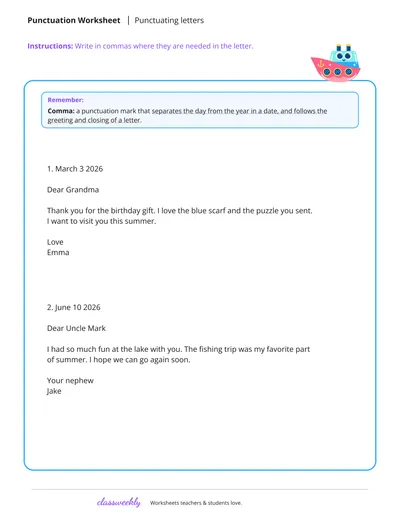
Second graders build on first grade punctuation by adding commas in greetings and closings of letters, apostrophes in contractions and possessives, and more consistent use of end punctuation in longer writing. CCSS L.2.2b covers commas in letter greetings (Dear Mom,) and closings (Love, Ella), while CCSS L.2.2c introduces apostrophes in contractions (can't, I'm, don't). Students should also use commas to separate items in a series of three or more. At this stage, children move from simply placing end punctuation to understanding how punctuation affects meaning and pacing. Worksheets that require students to add missing punctuation to a passage, rather than single sentences, help build real-world editing skills. Activities that compare sentences with and without commas show students how punctuation clarifies meaning. Consistent punctuation practice in second grade creates the foundation for more complex punctuation work in third grade.
How do I teach apostrophes to a second grader?
⌄
Start with contractions because they are concrete and frequently used in speech. Show your child that a contraction is two words joined together with an apostrophe taking the place of missing letters: do not becomes don't, I am becomes I'm, cannot becomes can't. Use a visual approach: write the two words, cross out the removed letters, and place the apostrophe where those letters were. Practice with the most common contractions first (don't, can't, it's, I'm, we're, they're, isn't, wasn't). Worksheets that ask students to match contractions to their expanded forms, or to rewrite sentences replacing two words with a contraction, build fluency. For possessive apostrophes, teach that adding apostrophe s shows that something belongs to someone: "the girl's book" means the book belongs to the girl. CCSS L.2.2c covers contractions specifically, making this a key second grade skill.
What are common punctuation mistakes second graders make?
⌄
The most frequent punctuation errors in second grade include: forgetting commas in a series (I like apples bananas and grapes), placing apostrophes incorrectly in contractions (do'nt instead of don't or dont without any apostrophe), confusing its (possessive) with it's (contraction), and inconsistent use of end punctuation in longer writing where children get focused on their ideas and forget the mechanics. Run-on sentences also become common as children attempt more complex thoughts but do not yet know how to use commas or conjunctions to connect them properly. These errors are normal for this developmental stage. The most effective remediation is regular, short proofreading practice. Worksheets that present a paragraph with several punctuation errors and ask students to find and correct them develop the editing eye that children need. Pairing these exercises with a simple punctuation checklist aligned to CCSS L.2.2 helps students self-monitor their own writing.
Ratings & Reviews
No reviews yet. Be the first to share what you think.
Reviews are for ClassWeekly members.
Make a Request
Spotted something to fix, or want a worksheet we don't have yet? Tell us and we'll make it.
Worksheet Details
| Grade | 2nd Grade |
| Subject | Grammar & Writing |
| Topic | Punctuation |
| Standard | L.2.2.C |
| Pages | 1 page |
| Difficulty | Medium |
Learn More
What is ClassWeekly?
ClassWeekly offers free worksheets and printable learning resources for kids in preschool to grade 5. All worksheets are aligned to Common Core, NGSS, and C3 Framework standards and designed by educators. Become a member to access the full library and download unlimited PDFs.