Expand Sentences With Prepositional Phrases
Written by Adi Ackerman, Head Teacher
"Expand Sentences With Prepositional Phrases" is written for 3rd Grade (Ages 8-9), and it covers Common Core L.3.1.I. If your little one is a year younger but already steady on sentence structure, the page still works. You may just need to read the instructions out loud. And if they are older and building a sentence never quite stuck, this is a short review rather than busywork.
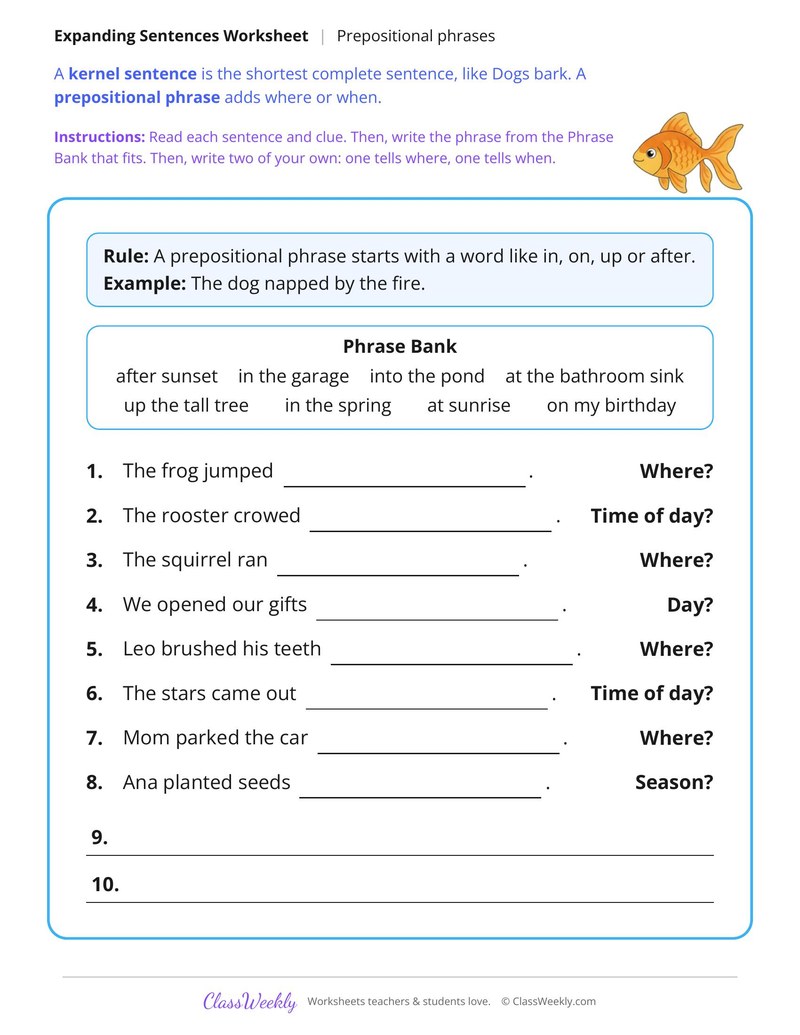
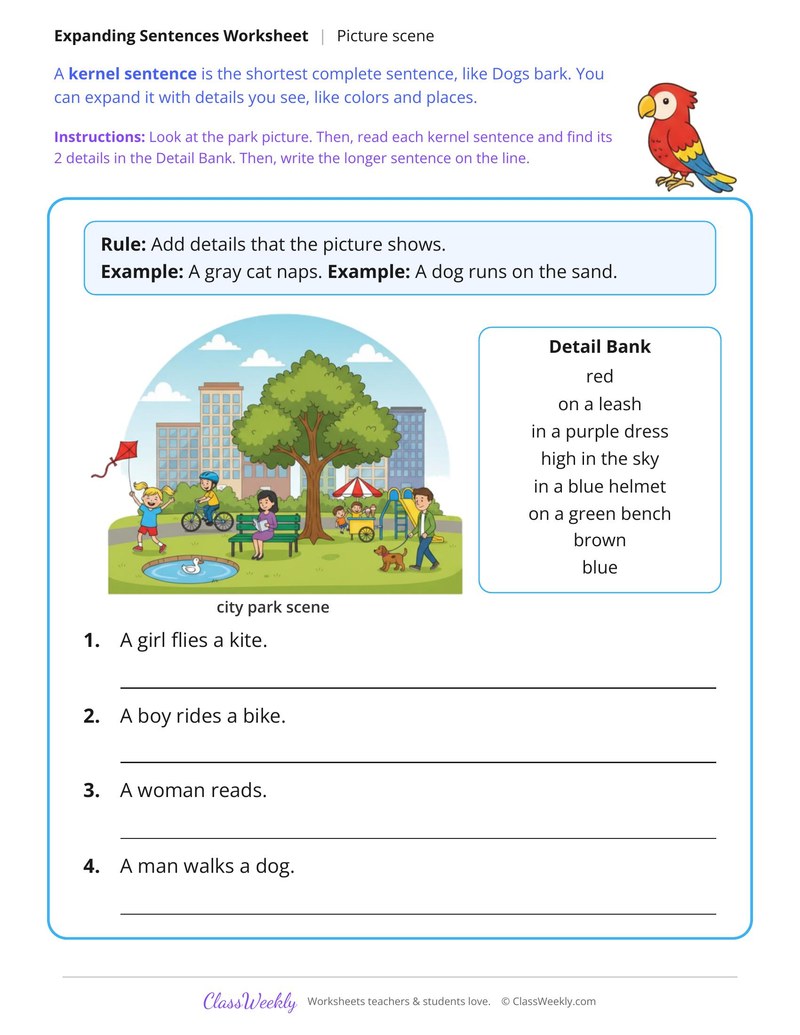
3rd grade grammar worksheet: expand sentences with prepositional phrases from a bank, then write one telling where and one when. Answer key included. Part of our building a sentence collection. Aligned to Common Core standards.
How do I use this worksheet?
Start with the ladder page, since it shows one new part at a time. Have your child read each longer sentence aloud to check that it still makes sense. Check the expanding pages with the answer key.
What students will practice
- Students will unscramble words into a complete sentence.
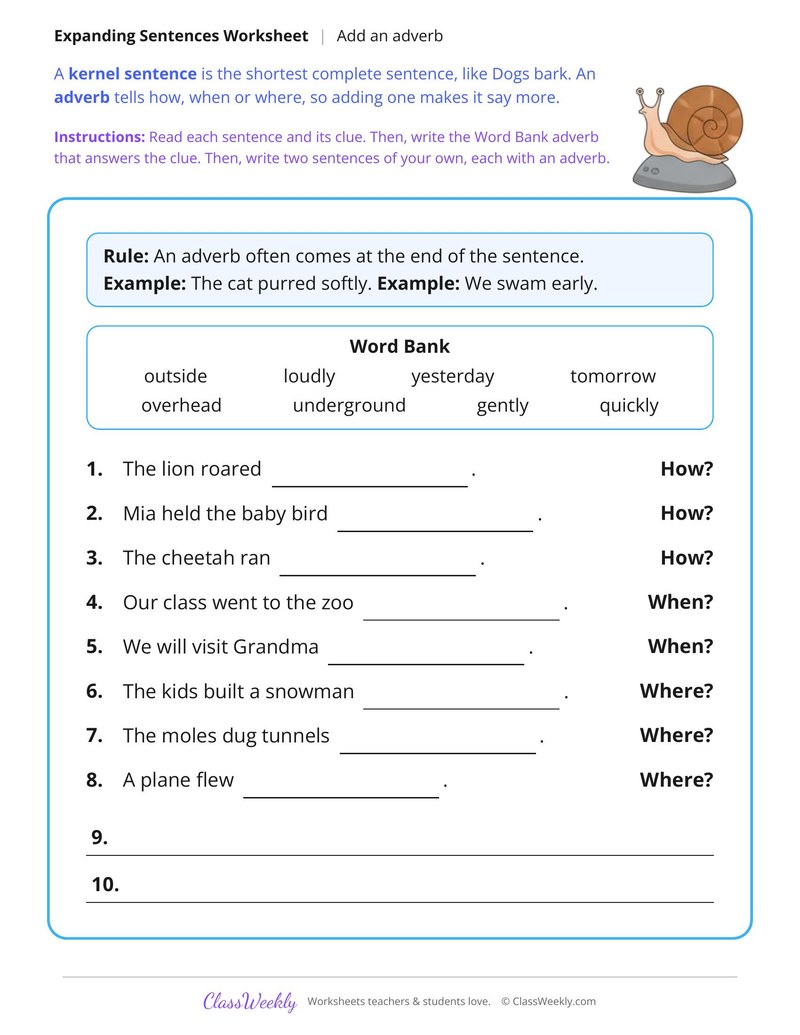
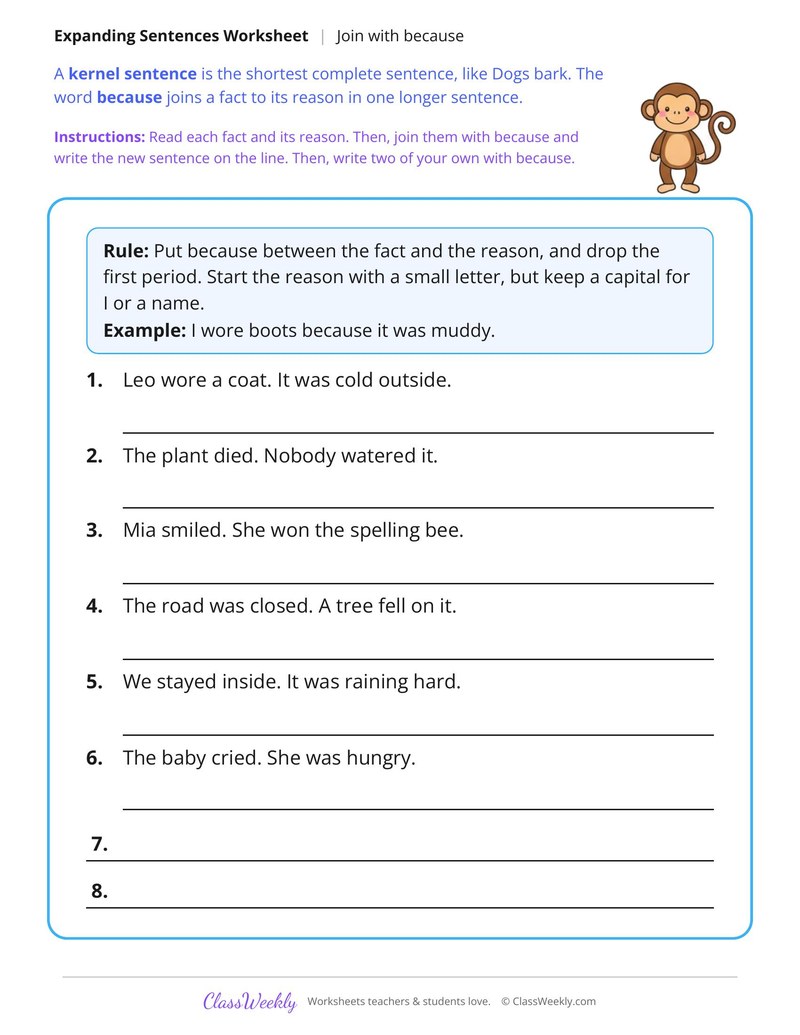
- Students will expand sentences with prepositional phrases, adverbs and because.
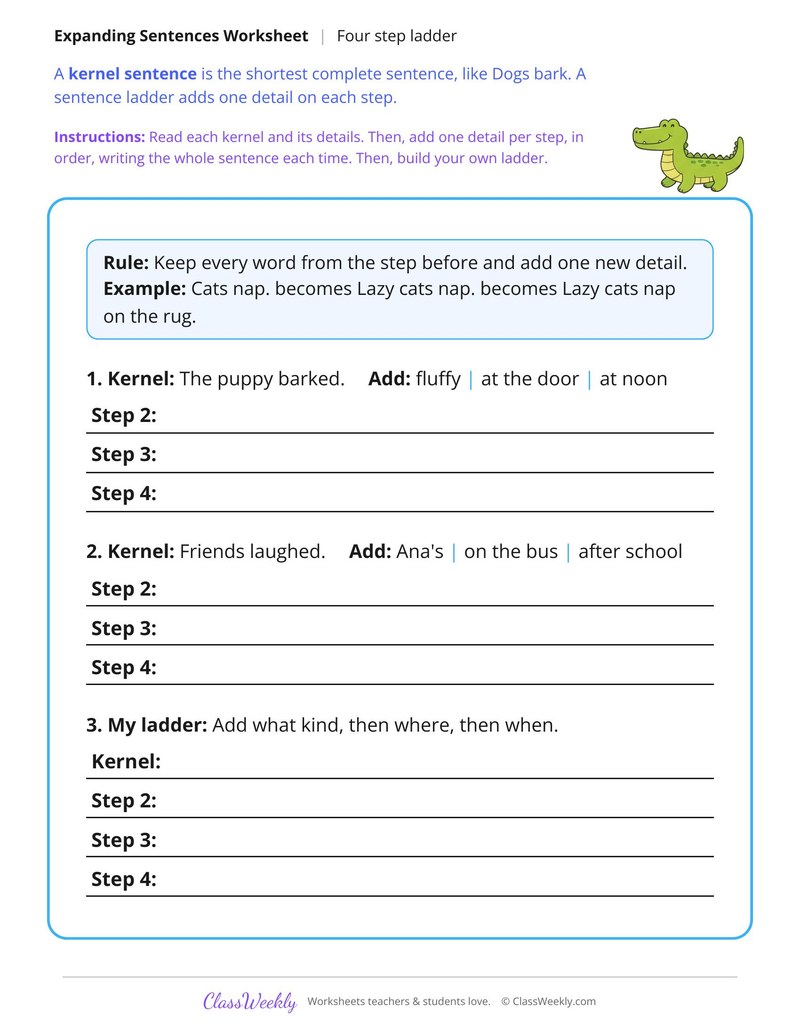
- Students will build a kernel sentence into a detailed one step by step.


Curriculum Links
Common Core State Standards
Language · 3rd Grade
Standard: Produce simple, compound, and complex sentences.
View all L.3.1.I worksheets →Find this in the curriculum
Browse the grade, subject, and topic this belongs to.
FAQ
How do I use this building a sentence worksheet?
⌄
Start with the ladder page, since it shows one new part at a time. Have your child read each longer sentence aloud to check that it still makes sense. Check the expanding pages with the answer key.
What does this worksheet teach?
⌄
Expand sentences with prepositional phrases from a bank, then write one telling where and one when. A kernel sentence is the shortest complete sentence, like Dogs bark. A prepositional phrase adds where or when. The directions on the page read: Read each sentence and clue. Then, write the phrase from the Phrase Bank that fits. Then, write two of your own: one tells where, one tells when. An answer key is included.
Can I use this building a sentence worksheet for homeschool or classroom?
⌄
Yes, both. We made it for 3rd Grade sentence structure, and the page works the same whether it lands on a kitchen table or a center rotation. At home, most families go through it together and talk the answers out loud, and that talking is where most of the learning happens with building a sentence. In class it runs well as independent work while you pull a small group. Print one copy or thirty, whichever the day needs.
What does it mean to expand a sentence?
⌄
Expanding means adding words that tell more, like where, when, how or why. The cat slept becomes The gray cat slept on the porch after lunch. Writing longer, detailed sentences is part of L.3.1.I.
What is a prepositional phrase?
⌄
A prepositional phrase starts with a word like in, on, under, after or before and tells where or when, such as under the bridge or after school. The first expanding page gives a bank of phrases to add.
How does the sentence ladder work?
⌄
Children start with a kernel sentence and add one detail on each step: who, then where, then when or why. Seeing the sentence grow a step at a time shows how each part changes the meaning.
Is there an answer key for each worksheet?
⌄
The six expanding sentences pages have an answer key. The older build a sentence page, where children unscramble words, does not.
What sentence structure skills should third graders develop?
⌄
Third graders should produce simple, compound, and complex sentences, as specified in CCSS L.3.1i. Simple sentences have one independent clause (The dog barked). Compound sentences join two independent clauses with a coordinating conjunction (The dog barked, and the cat ran). Complex sentences combine an independent clause with a dependent clause using a subordinating conjunction (When the dog barked, the cat ran). Students should understand how to vary their sentence structure to create more engaging writing. They should also master subject-verb agreement in these longer structures and maintain consistent verb tense throughout a piece. Worksheets that ask students to identify sentence types, combine simple sentences into compound or complex sentences, and expand sentences with phrases and clauses provide comprehensive structure practice. Third grade represents a significant leap in sentence sophistication, moving from the two-clause compound sentences of second grade to the multi-clause complexity that defines mature writing.
How do I help my third grader write complex sentences?
⌄
Start by teaching subordinating conjunctions as the key that unlocks complex sentences. Common third grade subordinating conjunctions include because, when, if, although, since, while, before, after, and until. Show how these words create a dependent clause that cannot stand alone: "Because it rained" is not a complete thought, but "Because it rained, we stayed inside" is a complex sentence. Practice the two patterns: conjunction at the beginning (comma needed: "When the bell rings, we line up") and conjunction in the middle (no comma needed: "We line up when the bell rings"). Worksheets that give students two related sentences and a subordinating conjunction, asking them to combine them, build this skill step by step. Sentence imitation exercises where students follow the pattern of a model complex sentence with their own content develop structural awareness. Encourage your child to use at least one complex sentence per paragraph in their writing. CCSS L.3.1i makes complex sentences a priority skill because they enable students to express relationships between ideas.
What is the difference between compound and complex sentences for third graders?
⌄
A compound sentence joins two independent clauses (each could be a sentence on its own) with a coordinating conjunction: "I like math, and my sister likes reading." Both parts are equal in importance. A complex sentence joins an independent clause with a dependent clause (one that cannot stand alone as a sentence) using a subordinating conjunction: "I like math because it involves puzzles." The dependent clause ("because it involves puzzles") needs the independent clause to be complete. The simplest test for third graders: cover each part separately. If both parts can stand alone as sentences, it is compound. If one part cannot stand alone, it is complex. Use color coding on worksheets: underline independent clauses in one color and dependent clauses in another. Circle the conjunction and identify whether it is coordinating (compound) or subordinating (complex). This visual approach makes the abstract distinction concrete. CCSS L.3.1i expects students to produce both types, so worksheets that require students to write examples of each and label them correctly build both understanding and production skills.
Ratings & Reviews
No reviews yet. Be the first to share what you think.
Reviews are for ClassWeekly members.
Make a Request
Spotted something to fix, or want a worksheet we don't have yet? Tell us and we'll make it.
Worksheet Details
| Grade | 3rd Grade |
| Subject | Grammar & Writing |
| Topic | Sentence Structure |
| Standard | L.3.1.I |
| Pages | 1 page |
| Difficulty | Medium |
Learn More
What is ClassWeekly?
ClassWeekly offers free worksheets and printable learning resources for kids in preschool to grade 5. All worksheets are aligned to Common Core, NGSS, and C3 Framework standards and designed by educators. Become a member to access the full library and download unlimited PDFs.