Roll Stack or Both Solid Shapes
Written by Adi Ackerman, Head Teacher
"Roll Stack or Both Solid Shapes" is written for 1st Grade (Ages 6-7), and it covers Common Core 1.G.A.1. If your little one is a year younger but already steady on geometry, the page still works. You may just need to read the instructions out loud. And if they are older and names of 3d shapes never quite stuck, this is a short review rather than busywork.
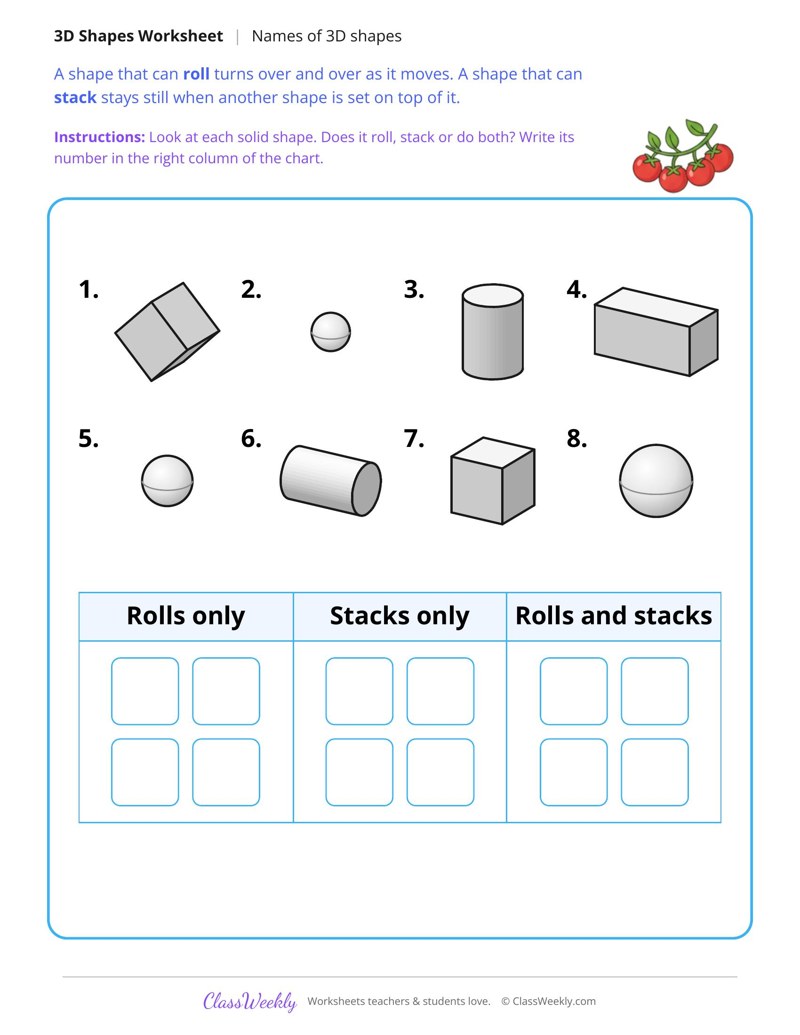
1st grade math worksheet: sort 8 solids into a chart of rolls only, stacks only, or rolls and stacks by writing their numbers. Answer key included. Part of our names of 3d shapes geometry collection. Aligned to Common Core standards.
How do I use this worksheet?
Before handing out the worksheet, briefly introduce the concept with a short oral warm-up or a visual model on the board. Let students work through the first item together as a class, then finish the rest independently or with a partner, encouraging them to talk through their thinking: "What strategy are you using? How do you know that is right?" After completing the worksheet, review any missed problems together and discuss the reasoning rather than just the answer. For extra support, let students use manipulatives or draw pictures alongside the written problems. These names of 3d shapes worksheets work well as daily practice, homework, or a focused review activity.
What students will practice
- Students will learn what it means for a solid shape to roll and to stack.
- Students will decide whether each of 8 solids rolls, stacks or does both.
- Students will sort the solids by writing their numbers in the right column of a chart.


Curriculum Links
Common Core State Standards
Geometry · 1st Grade
Standard: Distinguish between defining attributes (e.g., triangles are closed and three-sided) versus non-defining attributes (e.g., color, orientation, overall size); build and draw shapes to possess defining attributes.
View all 1.G.A.1 worksheets →Find this in the curriculum
Browse the grade, subject, and topic this belongs to.
FAQ
How do I use this names of 3d shapes worksheet?
⌄
Before handing out the worksheet, briefly introduce the concept with a short oral warm-up or a visual model on the board. Let students work through the first item together as a class, then finish the rest independently or with a partner, encouraging them to talk through their thinking: "What strategy are you using? How do you know that is right?" After completing the worksheet, review any missed problems together and discuss the reasoning rather than just the answer. For extra support, let students use manipulatives or draw pictures alongside the written problems. These names of 3d shapes worksheets work well as daily practice, homework, or a focused review activity.
What does this worksheet teach?
⌄
Sort 8 solids into a chart of rolls only, stacks only, or rolls and stacks by writing their numbers. A shape that can roll turns over and over as it moves. A shape that can stack stays still when another shape is set on top of it. The directions on the page read: Look at each solid shape. Does it roll, stack or do both? Write its number in the right column of the chart. An answer key is included.
Can I use this names of 3d shapes worksheet for homeschool or classroom?
⌄
Yes, both. We made it for 1st Grade geometry, and the page works the same whether it lands on a kitchen table or a center rotation. At home, most families go through it together and talk the answers out loud, and that talking is where most of the learning happens with names of 3d shapes. In class it runs well as independent work while you pull a small group. Print one copy or thirty, whichever the day needs.
What 3D shapes are typically introduced in 1st grade?
⌄
First graders learn to identify spheres, cubes, rectangular prisms, cylinders, cones, and pyramids by name and visual appearance.
How do these worksheets help students distinguish 2D from 3D shapes?
⌄
Activities highlight the differences between flat shapes and solid figures, helping students understand that 3D shapes have depth, faces, edges, and vertices.
Are these worksheets suitable for hands-on geometry lessons?
⌄
Yes - they pair well with classroom manipulatives like blocks and real-world object comparisons to reinforce 3D shape recognition.
What geometry do 1st graders learn?
⌄
CCSS 1.G.A.1 asks 1st graders to tell defining attributes, like 3 sides, from non-defining ones, like color or size, and to draw shapes that have the defining attributes. 1.G.A.2 adds building with flat and solid shapes, such as a rocket made of a cone, a cylinder and a cube.
Which solid shapes should a 1st grader know?
⌄
The cube, sphere, cone, cylinder and rectangular prism. The names of 3D shapes pages match them to objects like a basketball, a cereal box and a birthday hat, and ask which solids roll, which stack and which do both.
What shape patterns do 1st graders work on?
⌄
Patterns with longer units, such as ABC, AABB and ABBC, patterns that change color and shape at once, growing patterns and patterns where a shape turns or flips. Finding the pattern unit, the part that repeats, is the key step.
Do these 1st grade geometry worksheets have answer keys?
⌄
Yes. All 30 sheets have an answer key. Drawing pages, where answers vary, show a sample drawing and what to accept.
Ratings & Reviews
No reviews yet. Be the first to share what you think.
Reviews are for ClassWeekly members.
Make a Request
Spotted something to fix, or want a worksheet we don't have yet? Tell us and we'll make it.
What is ClassWeekly?
ClassWeekly offers free worksheets and printable learning resources for kids in preschool to grade 5. All worksheets are aligned to Common Core, NGSS, and C3 Framework standards and designed by educators. Become a member to access the full library and download unlimited PDFs.