Start at the Number and Count On to Find the Next Three
Written by Adi Ackerman, Head Teacher
"Start at the Number and Count On to Find the Next Three" is written for Kindergarten (Ages 5-6), and it covers Common Core K.CC.A.2. If your little one is a year younger but already steady on counting, the page still works. You may just need to read the instructions out loud. And if they are older and count on never quite stuck, this is a short review rather than busywork.
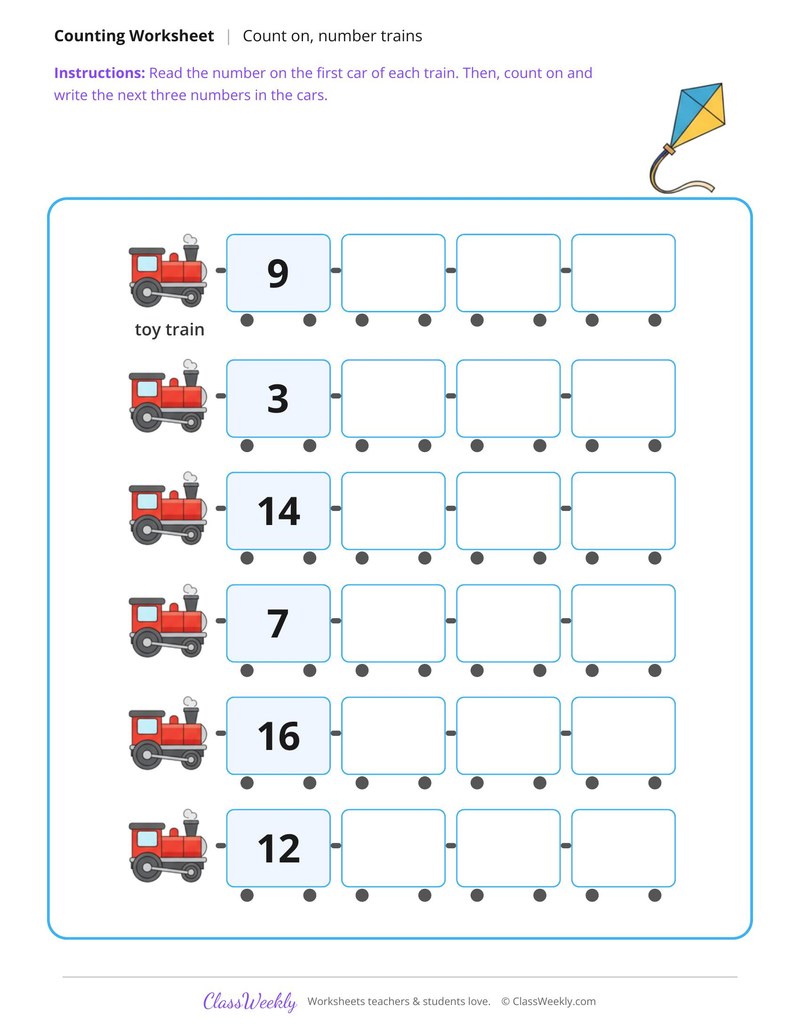
Kindergarten math worksheet: read the first number on each train and count on to write the next three in the cars. Answer key included. Part of our count on counting collection. Aligned to Common Core standards.
How do I use this worksheet?
Say the starting number together and tap it, then count on out loud while your child points. Use a finger on each number path. Check with the answer key.
What students will practice
- Students will count forward from a given number instead of starting at 1.
- Students will count on from 5 or 10 to find how many in all.
- Students will write the missing numbers on a number line from 0 to 20.


Curriculum Links
Common Core State Standards
Counting and Cardinality · Kindergarten
Standard: Count forward beginning from a given number within the known sequence (instead of having to begin at 1).
View all K.CC.A.2 worksheets →Find this in the curriculum
Browse the grade, subject, and topic this belongs to.
FAQ
How do I use this count on worksheet?
⌄
Say the starting number together and tap it, then count on out loud while your child points. Use a finger on each number path. Check with the answer key.
What does this worksheet teach?
⌄
Read the first number on each train and count on to write the next three in the cars. The directions on the page read: Read the number on the first car of each train. Then, count on and write the next three numbers in the cars. An answer key is included.
Can I use this count on worksheet for homeschool or classroom?
⌄
Yes, both. We made it for Kindergarten counting, and the page works the same whether it lands on a kitchen table or a center rotation. At home, most families go through it together and talk the answers out loud, and that talking is where most of the learning happens with count on. In class it runs well as independent work while you pull a small group. Print one copy or thirty, whichever the day needs.
What does count on mean?
⌄
Counting on means starting from a number you already know and counting up from there, instead of starting again at 1. If a ten frame shows 10, a child says 10 and then counts 11, 12, 13 for the extra strawberries.
Why is counting on important in kindergarten?
⌄
Counting forward from a given number is part of K.CC.A.2. It is also the first step toward adding, since 5 and 3 more can be found by counting on 6, 7, 8.
How can I help my child count on at home?
⌄
Put 5 toys in a cup and say there are 5 inside. Add 2 more one at a time and have your child count on, 6, 7, without dumping out the cup. Then try the number train page.
Is there an answer key for each worksheet?
⌄
Yes. All five count on sheets have an answer key.
When do kindergarteners learn to count to 100?
⌄
Counting to 100 by ones and by tens is the Common Core standard K.CC.A.1, expected by the end of kindergarten. Most students reliably count to 20-30 by midyear, then use skip-counting by tens as a bridge to 100 in the spring.
What is one-to-one correspondence, and why does it matter?
⌄
One-to-one correspondence is touching or pointing to one object for each number word said aloud (CCSS K.CC.B.4), rather than reciting numbers separately from the objects being counted. It's the skill that turns counting from a memorized chant into an understanding of quantity, and it's usually the biggest gap between a child who can count and one who can't yet tell you how many.
How can I tell if my kindergartener needs more counting practice?
⌄
Watch for accurate counting of a small group of objects (10-20) without skipping or double-counting, and whether they can write the numerals 0-20 to match. A child who recites numbers quickly but loses track when actually counting objects needs more one-to-one correspondence practice before moving on to bigger numbers.
Ratings & Reviews
No reviews yet. Be the first to share what you think.
Reviews are for ClassWeekly members.
Make a Request
Spotted something to fix, or want a worksheet we don't have yet? Tell us and we'll make it.
Worksheet Details
| Grade | Kindergarten |
| Subject | Math |
| Topic | Counting |
| Standard | K.CC.A.2 |
| Pages | 1 page |
| Difficulty | Medium |
Learn More
What is ClassWeekly?
ClassWeekly offers free worksheets and printable learning resources for kids in preschool to grade 5. All worksheets are aligned to Common Core, NGSS, and C3 Framework standards and designed by educators. Become a member to access the full library and download unlimited PDFs.