Fable of the Crab Who Wanted a Bigger Shell
Written by Adi Ackerman, Head Teacher
"Fable of the Crab Who Wanted a Bigger Shell" is written for 3rd Grade (Ages 8-9), and it covers Common Core RL.3.2. If your little one is a year younger but already steady on fables, the page still works. You may just need to read the instructions out loud. And if they are older and myths, fables and folktales never quite stuck, this is a short review rather than busywork.
2 pages in this set
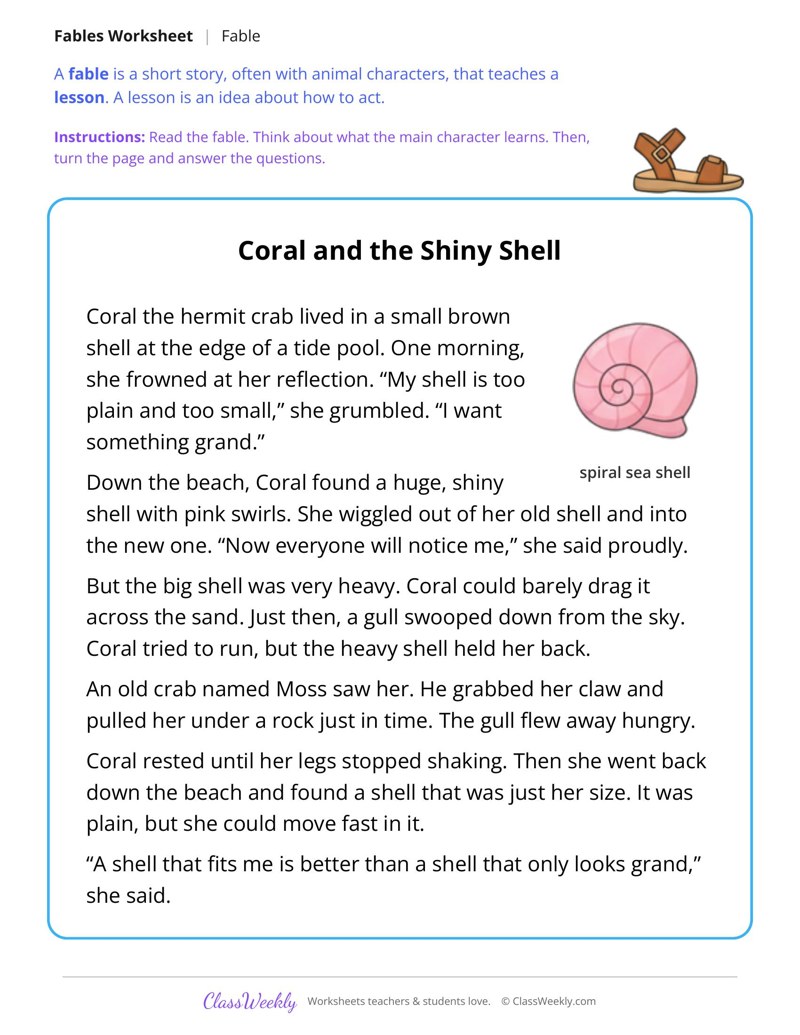
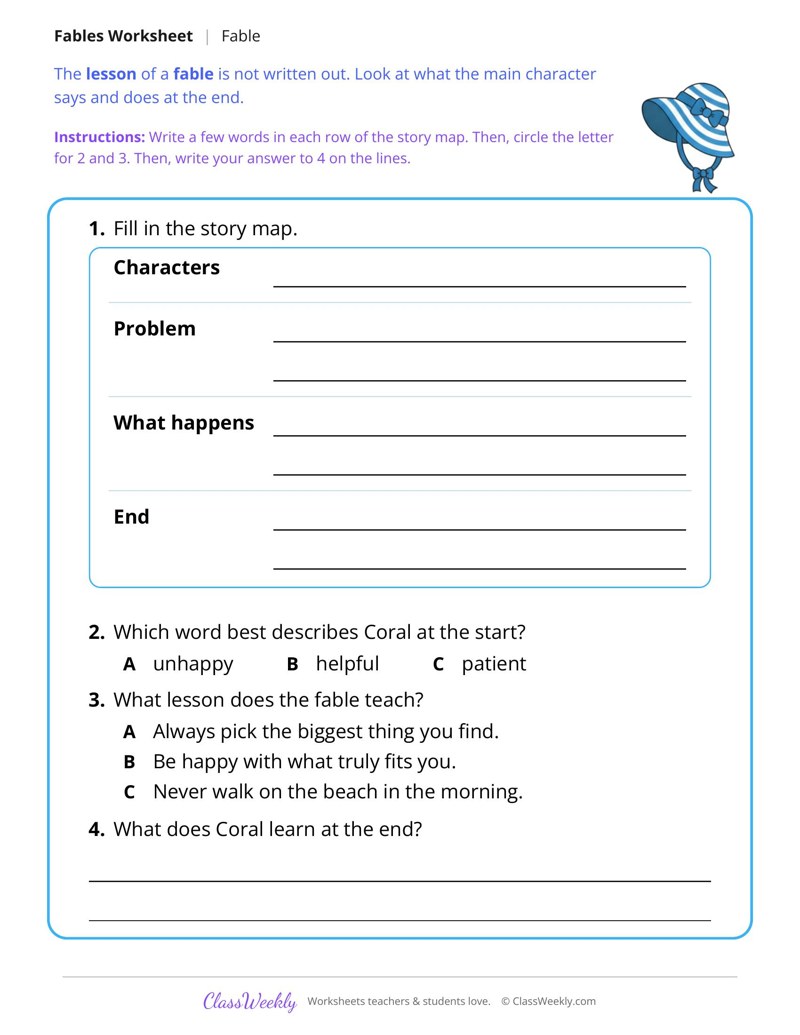
3rd grade reading worksheet: read a fable about Coral the hermit crab and a big shiny shell, fill in a story map and tell the lesson. Answer key included. Part of our myths, fables and folktales collection. Aligned to Common Core standards.
How do I use this worksheet?
Read the short definition at the top of the sheet aloud first, so your child knows what kind of tale it is. After reading, talk about what the main character learned before your child writes the lesson.
What students will practice
- Students will read a fable about Coral the hermit crab, who trades her plain shell for a big shiny one.
- Students will fill in a story map from the heavy shell and the hungry gull to Moss pulling her to safety.
- Students will tell the lesson that a shell that fits is better than one that only looks grand.





Curriculum Links
Common Core State Standards
Reading: Literature · 3rd Grade
Standard: Recount stories, including fables, folktales, and myths from diverse cultures; determine the central message, lesson, or moral and explain how it is conveyed through key details in the text.
View all RL.3.2 worksheets →Find this in the curriculum
Browse the grade, subject, and topic this belongs to.
FAQ
How do I use this myths, fables and folktales worksheet?
⌄
Read the short definition at the top of the sheet aloud first, so your child knows what kind of tale it is. After reading, talk about what the main character learned before your child writes the lesson.
What does this worksheet teach?
⌄
Read a fable about Coral the hermit crab and a big shiny shell, fill in a story map and tell the lesson. A fable is a short story, often with animal characters, that teaches a lesson. A lesson is an idea about how to act. The directions on the page read: Read the fable. Think about what the main character learns. Then, turn the page and answer the questions. On page 2: Write a few words in each row of the story map. Then, circle the letter for 2 and 3. Then, write your answer to 4 on the lines. The answer key covers the questions on page 2.
Can I use this myths, fables and folktales worksheet for homeschool or classroom?
⌄
Yes, both. We made it for 3rd Grade fables, and the page works the same whether it lands on a kitchen table or a center rotation. At home, most families go through it together and talk the answers out loud, and that talking is where most of the learning happens with myths, fables and folktales. In class it runs well as independent work while you pull a small group. Print one copy or thirty, whichever the day needs.
What is the difference between a myth, a fable and a folktale?
⌄
A fable is a short story, often about animals, that teaches how to act, like the goose who learns to listen to good advice. A folktale is a story people pass along by telling it aloud. A myth explains something in nature with a powerful being, like the giant who made the mountains.
What are pourquoi tales, trickster tales and tall tales?
⌄
A pourquoi tale is a made up story, not a science fact, about why something in nature is so, like why the zebra has stripes. In a trickster tale, a clever character wins by fooling others, the way little Mouse fools Elephant. A tall tale tells of a hero with exaggeration, like Bess throwing her lasso so high that it tickled the sun.
How do I help my child find the lesson of a tale?
⌄
Ask what the main character wanted, what they did and what happened because of it. The lesson usually sits in that last step, as when Pip says he took more than he needed and still went hungry.
Is there an answer key for each worksheet?
⌄
Yes. All 15 myths, fables and folktales sheets have an answer key, with sample chart or story map answers, the multiple choice answers and a sample lesson.
Ratings & Reviews
No reviews yet. Be the first to share what you think.
Reviews are for ClassWeekly members.
Make a Request
Spotted something to fix, or want a worksheet we don't have yet? Tell us and we'll make it.
What is ClassWeekly?
ClassWeekly offers free worksheets and printable learning resources for kids in preschool to grade 5. All worksheets are aligned to Common Core, NGSS, and C3 Framework standards and designed by educators. Become a member to access the full library and download unlimited PDFs.