Animals That Hide With Camouflage, Read and Match
Written by Adi Ackerman, Head Teacher
"Animals That Hide With Camouflage, Read and Match" is written for 2nd Grade (Ages 7-8). If your little one is a year younger but already steady on animals, the page still works. You may just need to read the instructions out loud. And if they are older and animal adaptations never quite stuck, this is a short review rather than busywork.
2 pages in this set
2nd grade science worksheet: read about camouflage, then match each animal to the place where it hides and answer questions. Answer key included. Part of our animal adaptations animals collection.
How do I use this worksheet?
Read each passage together and ask what problem the animal has, such as cold, hunger or a predator, and how it solves it. Check with the answer key.
What students will practice
- Students will explain how a body part or behavior helps an animal survive.
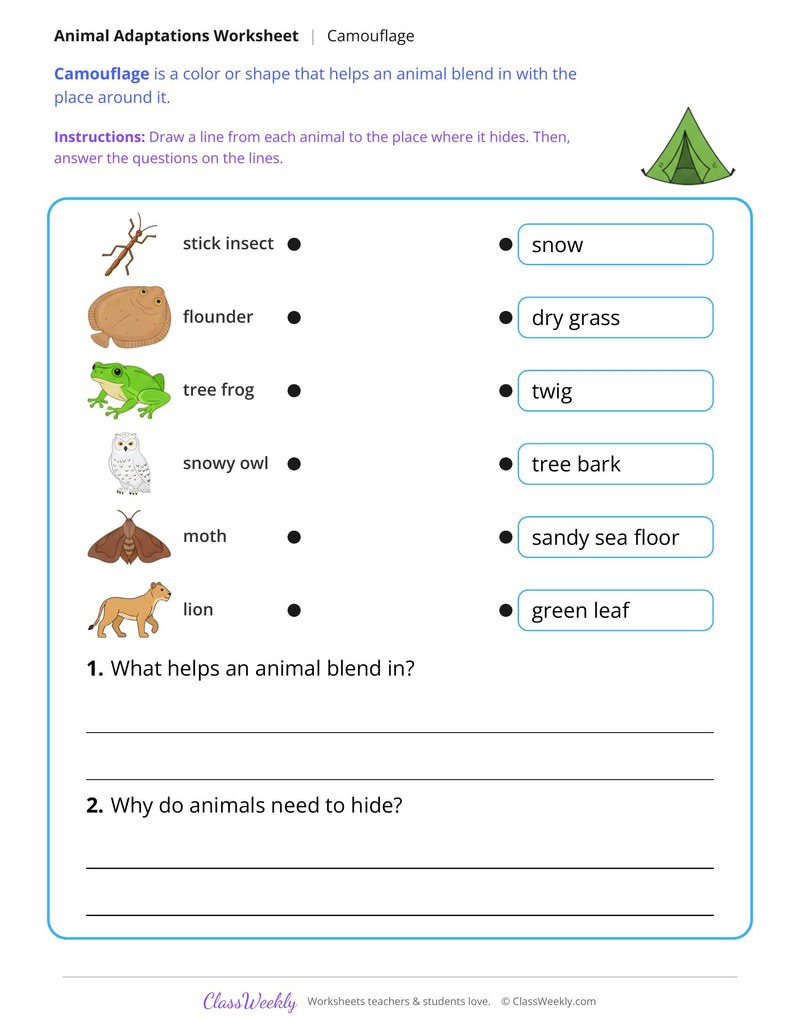
- Students will match animals to the places where their camouflage hides them.
- Students will compare how animals get ready for winter.


Curriculum Links
Find this in the curriculum
Browse the grade, subject, and topic this belongs to.
FAQ
How do I use this animal adaptations worksheet?
⌄
Read each passage together and ask what problem the animal has, such as cold, hunger or a predator, and how it solves it. Check with the answer key.
What does this worksheet teach?
⌄
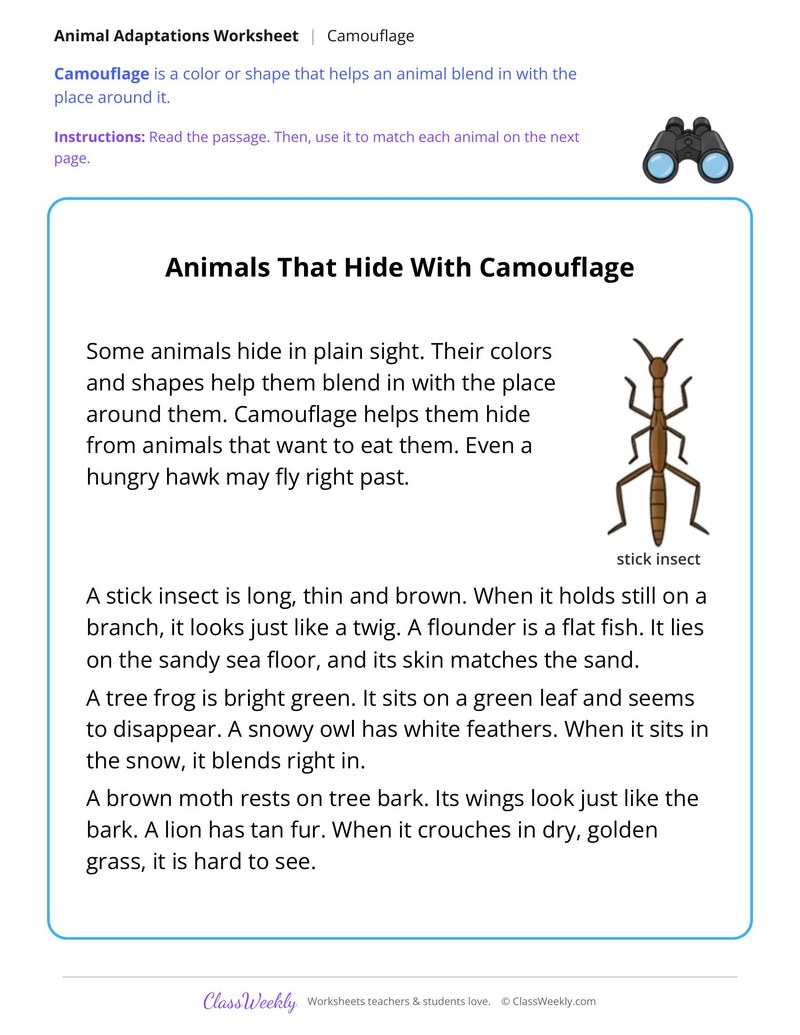
Read about camouflage, then match each animal to the place where it hides and answer questions. Camouflage is a color or shape that helps an animal blend in with the place around it. The directions on the page read: Read the passage. Then, use it to match each animal on the next page. On page 2: Draw a line from each animal to the place where it hides. Then, answer the questions on the lines. The answer key covers the questions on page 2.
Can I use this animal adaptations worksheet for homeschool or classroom?
⌄
Yes, both. We made it for 2nd Grade animals, and the page works the same whether it lands on a kitchen table or a center rotation. At home, most families go through it together and talk the answers out loud, and that talking is where most of the learning happens with animal adaptations. In class it runs well as independent work while you pull a small group. Print one copy or thirty, whichever the day needs.
What do animal adaptations worksheets teach second graders?
⌄
Students learn that animals have physical structures and behaviors that help them find food, avoid predators, and survive in specific environments. For 7-8 year olds, matching adaptations to functions (e.g., sharp claws = catch prey) builds both vocabulary and analytical thinking.
When do second graders learn about animal adaptations?
⌄
Animal adaptations are introduced in Grade 2 life science, often in units on habitats and ecosystems. Most science standards address this topic as part of helping students understand how living things are suited to their environments.
How can I use these worksheets at home?
⌄
Watch a nature documentary together and pause to point out adaptations, a bird's beak shape, a fish's streamlined body, a porcupine's quills. Then use the worksheets to record and categorize what your child noticed. This connects screen time to real learning.
How many 2nd Grade animal adaptations worksheets are there?
⌄
6 printable worksheets, all free to preview. Downloads are included with a ClassWeekly free trial, and every page prints on standard 8.5 x 11 paper.
What age are animal adaptations worksheets for?
⌄
These are written for 2nd Grade students, roughly ages 7-8. Many teachers also use them a grade up for review or a grade down as an extension, so use the preview to judge the fit for a particular child.
Ratings & Reviews
No reviews yet. Be the first to share what you think.
Reviews are for ClassWeekly members.
Make a Request
Spotted something to fix, or want a worksheet we don't have yet? Tell us and we'll make it.
Learn More
What is ClassWeekly?
ClassWeekly offers free worksheets and printable learning resources for kids in preschool to grade 5. All worksheets are aligned to Common Core, NGSS, and C3 Framework standards and designed by educators. Become a member to access the full library and download unlimited PDFs.