Paper Bags and Cloth Bags, Read and Compare
Written by Adi Ackerman, Head Teacher
"Paper Bags and Cloth Bags, Read and Compare" is written for 2nd Grade (Ages 7-8), and it covers NGSS 2-PS1-2. If your little one is a year younger but already steady on material properties, the page still works. You may just need to read the instructions out loud. And if they are older and materials and their uses never quite stuck, this is a short review rather than busywork.
2 pages in this set
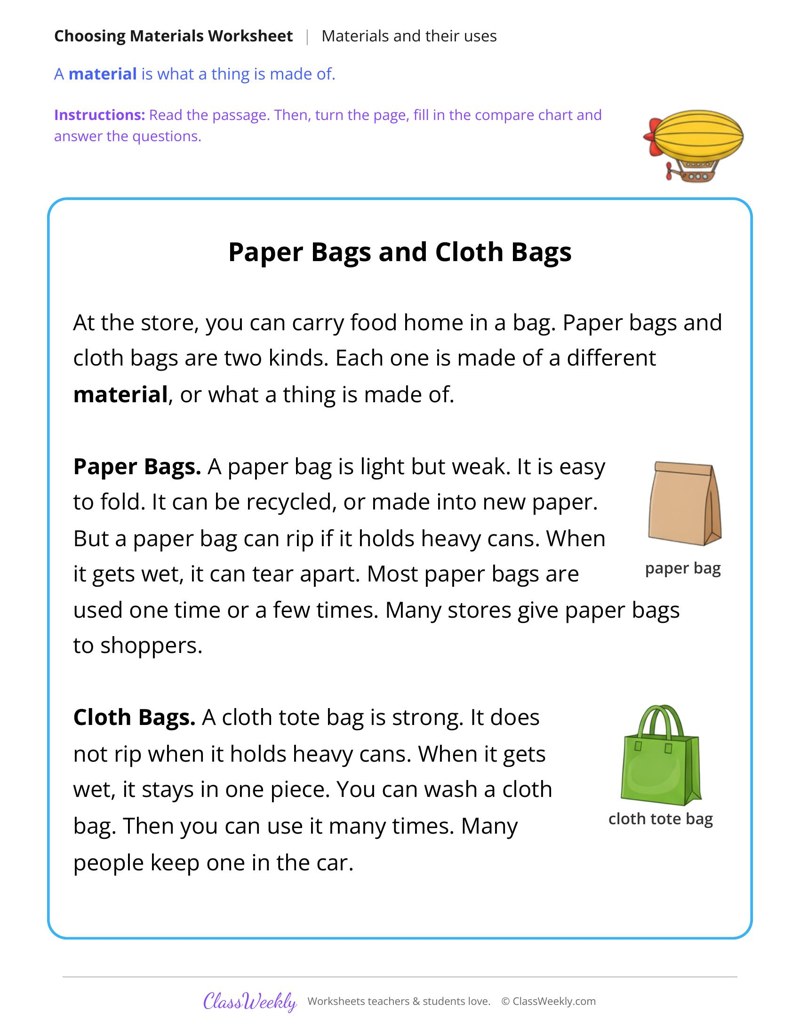
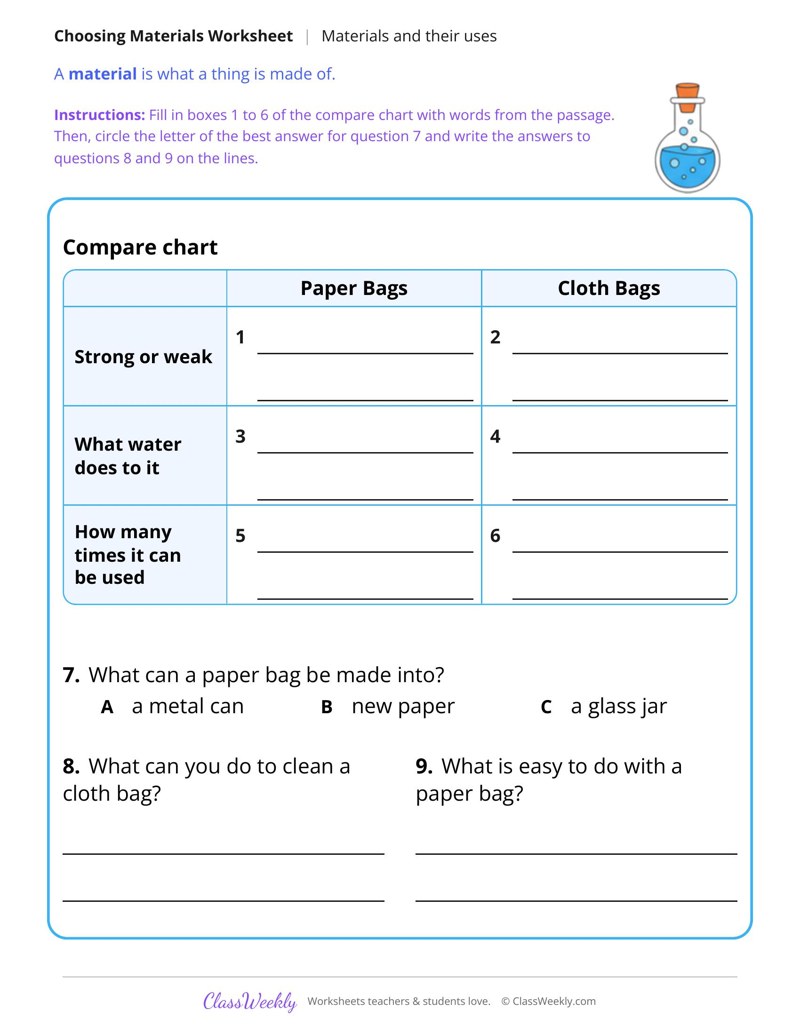
2nd grade science worksheet: compare a light paper bag that can rip or tear when wet with a strong cloth tote you can wash and reuse. Answer key included. Part of our materials and their uses material properties collection. Aligned to NGSS standards.
How do I use this worksheet?
Before reading, let your child drip a little water on a paper towel, a plastic bag and a cotton sock and say what happens. Then read the passage together and check each page with the answer key.
What students will practice
- Students will explain why a material is chosen for a job, using its properties.
- Students will read a table from a simple materials test and tell which material worked best.
- Students will compare two materials, such as wool and rubber, for the same kind of job.


Curriculum Links
Next Generation Science Standards
Science · 2nd Grade
Find this in the curriculum
Browse the grade, subject, and topic this belongs to.
FAQ
How do I use this materials and their uses worksheet?
⌄
Before reading, let your child drip a little water on a paper towel, a plastic bag and a cotton sock and say what happens. Then read the passage together and check each page with the answer key.
What does this worksheet teach?
⌄
Compare a light paper bag that can rip or tear when wet with a strong cloth tote you can wash and reuse. A material is what a thing is made of. The directions on the page read: Read the passage. Then, turn the page, fill in the compare chart and answer the questions. On page 2: Fill in boxes 1 to 6 of the compare chart with words from the passage. Then, circle the letter of the best answer for question 7 and write the answers to questions 8 and 9 on the lines. The answer key covers the questions on page 2.
Can I use this materials and their uses worksheet for homeschool or classroom?
⌄
Yes, both. We made it for 2nd Grade material properties, and the page works the same whether it lands on a kitchen table or a center rotation. At home, most families go through it together and talk the answers out loud, and that talking is where most of the learning happens with materials and their uses. In class it runs well as independent work while you pull a small group. Print one copy or thirty, whichever the day needs.
Why do people choose different materials for different jobs?
⌄
Each material has properties, things you can observe, such as how it feels and what water does to it. A raincoat is made of plastic or has a waterproof coating, so raindrops roll off, while a cotton sweatshirt soaks up rain. People pick the material whose properties fit the job (2-PS1-2).
How can second graders test which material is best?
⌄
Try the same test on each material and keep everything else the same. In one class's test, a paper roof got soggy, a cloth roof dripped and a plastic roof kept a toy dog dry. In another, a wool sock and bubble wrap kept an ice cube frozen 60 minutes, while a cube with no wrap melted in 15.
Can a material be good for one job and poor for another?
⌄
Yes. Wool mittens keep hands warm on a dry, cold day but soak up snow, while thin rubber gloves keep hands dry for washing dishes but do not keep them very warm. A paper bag is easy to fold but can rip, and a cloth bag is strong and can be washed and used many times.
Do these worksheets have answer keys?
⌄
Yes. All 7 sheets have an answer key, and the newer two page sheets point to the paragraph or table that holds each answer.
Ratings & Reviews
No reviews yet. Be the first to share what you think.
Reviews are for ClassWeekly members.
Make a Request
Spotted something to fix, or want a worksheet we don't have yet? Tell us and we'll make it.
Worksheet Details
| Grade | 2nd Grade |
| Subject | Science |
| Topic | Material Properties |
| Standard | 2-PS1-2 |
| Pages | 2 pages |
| Difficulty | Medium |
Learn More
What is ClassWeekly?
ClassWeekly offers free worksheets and printable learning resources for kids in preschool to grade 5. All worksheets are aligned to Common Core, NGSS, and C3 Framework standards and designed by educators. Become a member to access the full library and download unlimited PDFs.