Hook the Reader in a Fantasy Story Opening
Written by Adi Ackerman, Head Teacher
"Hook the Reader in a Fantasy Story Opening" is written for 5th Grade (Ages 10-11), and it covers Common Core W.5.3.A. If your little one is a year younger but already steady on narrative writing, the page still works. You may just need to read the instructions out loud. And if they are older and fantasy writing never quite stuck, this is a short review rather than busywork.
2 pages in this set
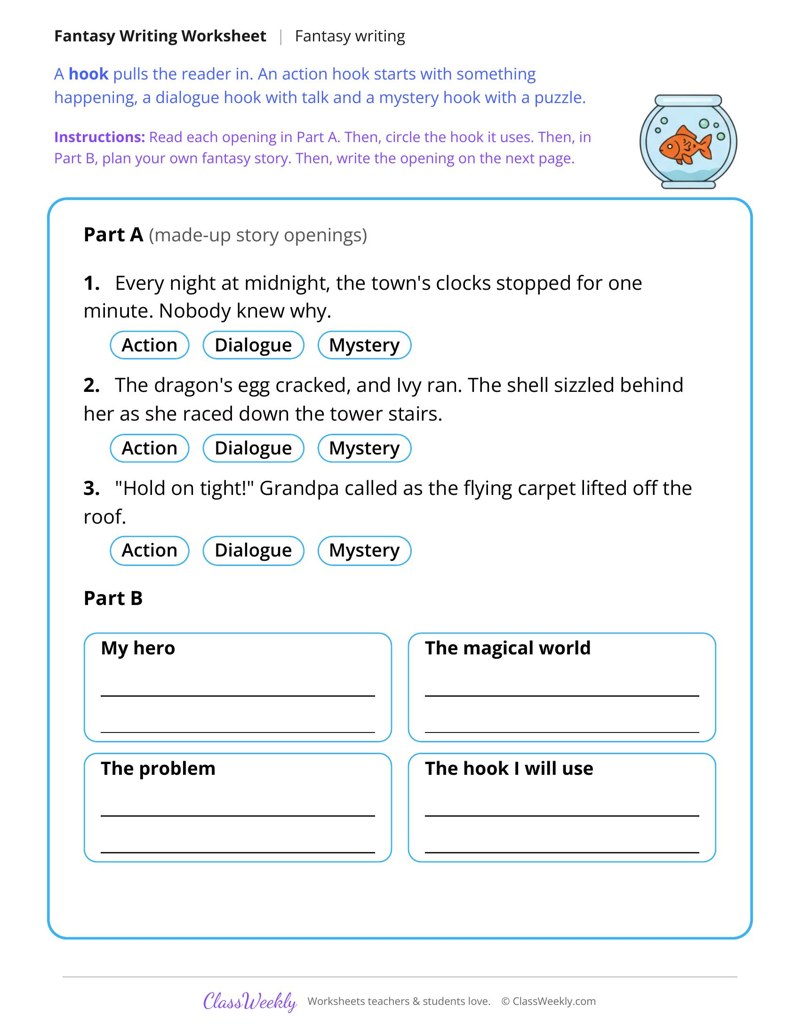
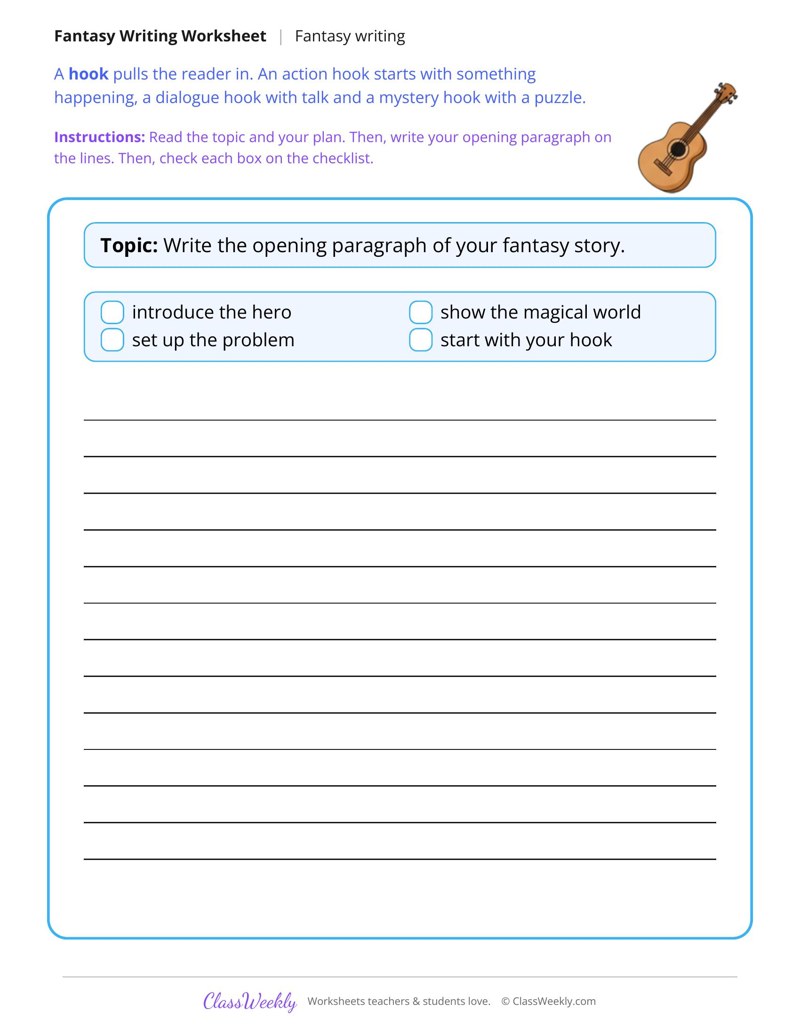
5th grade writing worksheet: name the action, dialogue or mystery hook in 3 fantasy openings, then plan and write your own opening. Answer key included. Part of our fantasy writing collection. Aligned to Common Core standards.
How do I use this worksheet?
Introduce the skill with a brief whole-class activity, such as calling out examples and asking students to give a thumbs up when they hear fantasy writing in a sentence. Then let students work through it independently and self-check their own work against an answer key before you review it as a class, referring to a class anchor chart if one is available. When reviewing answers, ask students to explain why an answer is correct rather than just confirming it. These fantasy writing worksheets work well as a focused practice activity, a homework assignment, or a warm-up at the start of a language arts lesson.
What students will practice
- Students will read 3 fantasy story openings and circle the action, dialogue or mystery hook each uses.
- Students will plan a hero, a magical world, a problem and the hook they will use.
- Students will write the opening paragraph of their own fantasy story on page 2.


Curriculum Links
Common Core State Standards
Writing · 5th Grade
Standard: Orient the reader by establishing a situation and introducing a narrator and/or characters; organize an event sequence that unfolds naturally.
View all W.5.3.A worksheets →Find this in the curriculum
Browse the grade, subject, and topic this belongs to.
FAQ
How do I use this fantasy writing worksheet?
⌄
Introduce the skill with a brief whole-class activity, such as calling out examples and asking students to give a thumbs up when they hear fantasy writing in a sentence. Then let students work through it independently and self-check their own work against an answer key before you review it as a class, referring to a class anchor chart if one is available. When reviewing answers, ask students to explain why an answer is correct rather than just confirming it. These fantasy writing worksheets work well as a focused practice activity, a homework assignment, or a warm-up at the start of a language arts lesson.
What does this worksheet teach?
⌄
Name the action, dialogue or mystery hook in 3 fantasy openings, then plan and write your own opening. A hook pulls the reader in. An action hook starts with something happening, a dialogue hook with talk and a mystery hook with a puzzle. The directions on the page read: Read each opening in Part A. Then, circle the hook it uses. Then, in Part B, plan your own fantasy story. Then, write the opening on the next page. On page 2: Read the topic and your plan. Then, write your opening paragraph on the lines. Then, check each box on the checklist. An answer key is included.
Can I use this fantasy writing worksheet for homeschool or classroom?
⌄
Yes, both. We made it for 5th Grade narrative writing, and the page works the same whether it lands on a kitchen table or a center rotation. At home, most families go through it together and talk the answers out loud, and that talking is where most of the learning happens with fantasy writing. In class it runs well as independent work while you pull a small group. Print one copy or thirty, whichever the day needs.
What is the difference between reality and fantasy in a story?
⌄
Reality could happen in real life, like a dog digging a hole in the yard. Fantasy could not, like a teapot singing a lullaby. One page sorts 12 details, then has children write one of each about a lighthouse keeper.
Why does magic in a fantasy story need rules?
⌄
If magic can fix everything, there is no problem left to solve. A rule and a cost, like magic that only works when the moon is out, make the hero work for the ending. One planner walks children through both.
What is a hook in a story opening?
⌄
A hook pulls the reader in. An action hook starts with something happening, a dialogue hook starts with talk and a mystery hook starts with a puzzle, such as clocks that stop every night at midnight.
Is there an answer key for each worksheet?
⌄
Yes. All 5 fantasy writing sheets have an answer key. The planning and writing pages show a sample answer, since every child's story will differ.
Ratings & Reviews
No reviews yet. Be the first to share what you think.
Reviews are for ClassWeekly members.
Make a Request
Spotted something to fix, or want a worksheet we don't have yet? Tell us and we'll make it.
Worksheet Details
| Grade | 5th Grade |
| Subject | Grammar & Writing |
| Topic | Narrative Writing |
| Standard | W.5.3.A |
| Pages | 2 pages |
| Difficulty | Medium |
What is ClassWeekly?
ClassWeekly offers free worksheets and printable learning resources for kids in preschool to grade 5. All worksheets are aligned to Common Core, NGSS, and C3 Framework standards and designed by educators. Become a member to access the full library and download unlimited PDFs.