Indefinite Pronouns and Their Verbs in a News Report
Written by Adi Ackerman, Head Teacher
"Indefinite Pronouns and Their Verbs in a News Report" is written for 5th Grade (Ages 10-11), and it covers Common Core L.5.1. If your little one is a year younger but already steady on pronouns, the page still works. You may just need to read the instructions out loud. And if they are older and possessive, relative and indefinite pronouns never quite stuck, this is a short review rather than busywork.
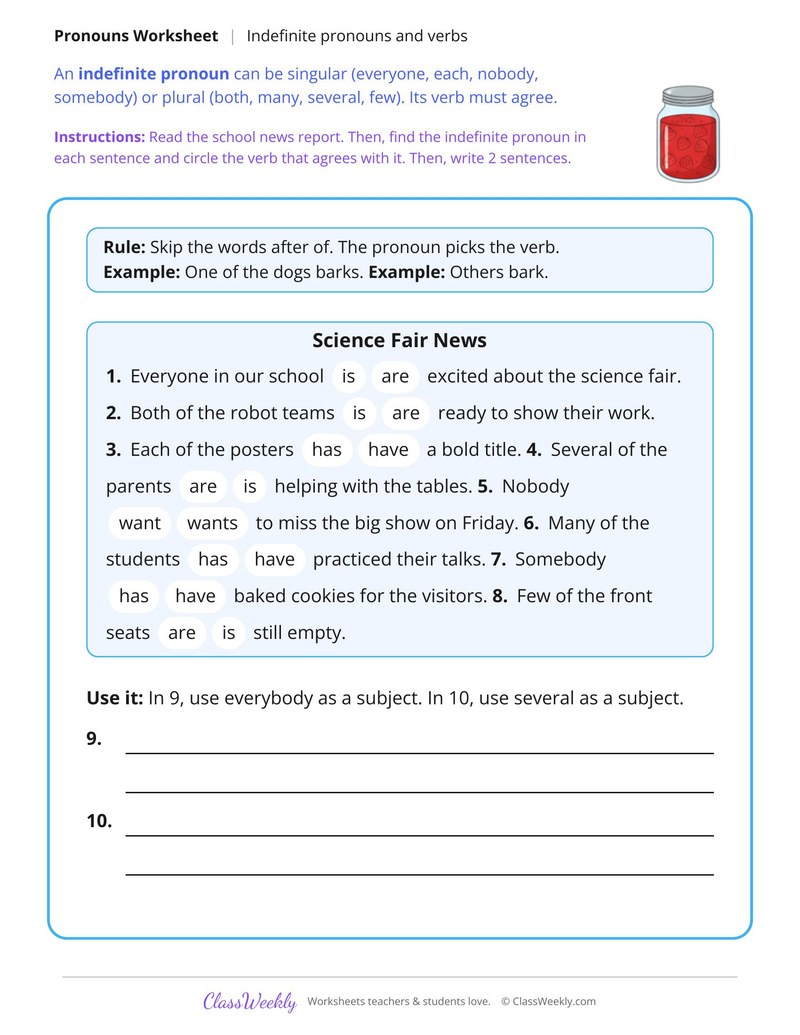
5th grade grammar worksheet: circle verbs that agree with indefinite pronouns like each, both and nobody in a science fair report. Answer key included. Part of our possessive, relative and indefinite pronouns collection. Aligned to Common Core standards.
How do I use this worksheet?
On the news report, have your child skip the words after of and match the verb to the pronoun alone, as in Each of the posters has. Check with the answer key.
What students will practice
- Students will choose the correct possessive, relative or indefinite pronoun.
- Students will tell singular indefinite pronouns from plural ones.
- Students will choose a verb that agrees with an indefinite pronoun.


Curriculum Links
Common Core State Standards
Language · 5th Grade
Standard: Demonstrate command of the conventions of standard English grammar and usage when writing or speaking.
View all L.5.1 worksheets →Find this in the curriculum
Browse the grade, subject, and topic this belongs to.
FAQ
How do I use this possessive, relative and indefinite pronouns worksheet?
⌄
On the news report, have your child skip the words after of and match the verb to the pronoun alone, as in Each of the posters has. Check with the answer key.
What does this worksheet teach?
⌄
Circle verbs that agree with indefinite pronouns like each, both and nobody in a science fair report. An indefinite pronoun can be singular (everyone, each, nobody, somebody) or plural (both, many, several, few). Its verb must agree. The directions on the page read: Read the school news report. Then, find the indefinite pronoun in each sentence and circle the verb that agrees with it. Then, write 2 sentences. An answer key is included.
Can I use this possessive, relative and indefinite pronouns worksheet for homeschool or classroom?
⌄
Yes, both. We made it for 5th Grade pronouns, and the page works the same whether it lands on a kitchen table or a center rotation. At home, most families go through it together and talk the answers out loud, and that talking is where most of the learning happens with possessive, relative and indefinite pronouns. In class it runs well as independent work while you pull a small group. Print one copy or thirty, whichever the day needs.
What is the difference between possessive, relative, and indefinite pronouns?
⌄
Possessive pronouns (mine, theirs) show ownership; relative pronouns (who, which, that) introduce clauses; and indefinite pronouns (everyone, something) refer to non-specific people or things.
Why are these three pronoun types grouped together for 5th grade?
⌄
By 5th grade, students are expected to command the full range of pronoun types - this worksheet brings them together to compare and contrast their roles.
Are these pronoun types tested on standardized assessments?
⌄
Yes - pronoun usage and agreement across all types is a Language strand standard assessed in Grade 5 ELA evaluations.
What pronoun skills are covered in fifth grade?
⌄
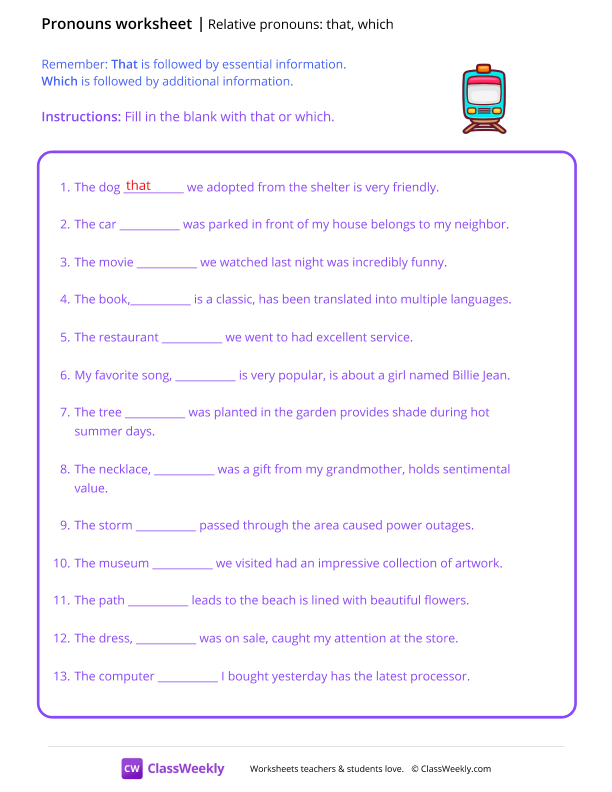
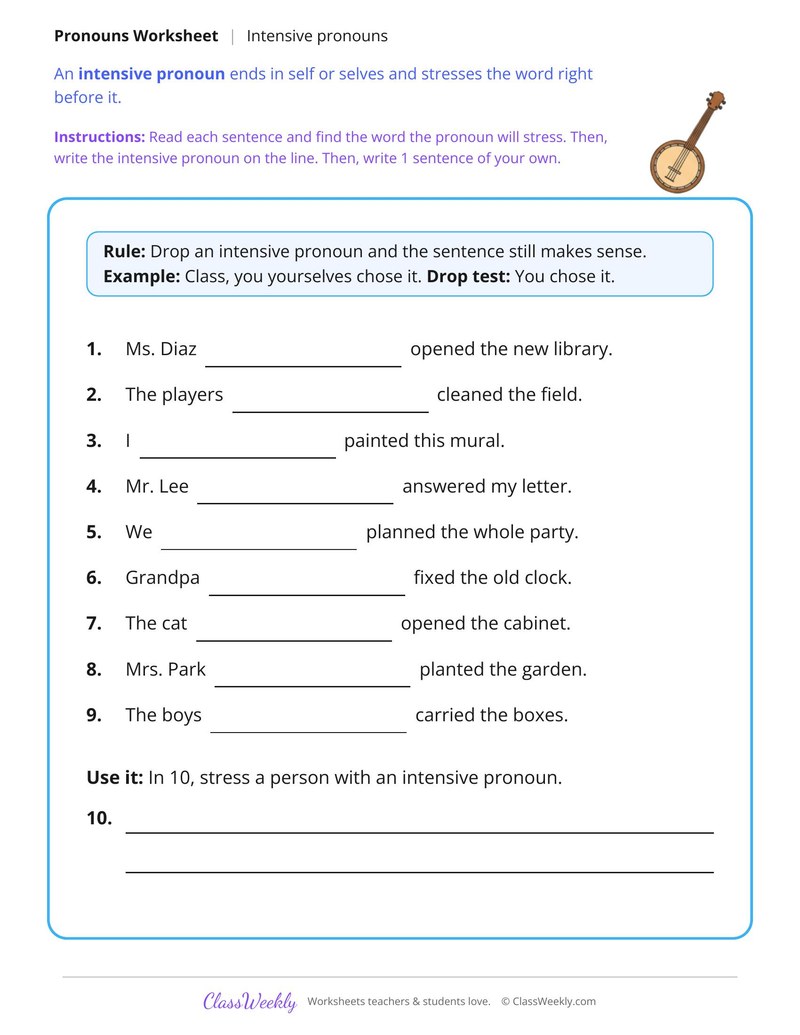
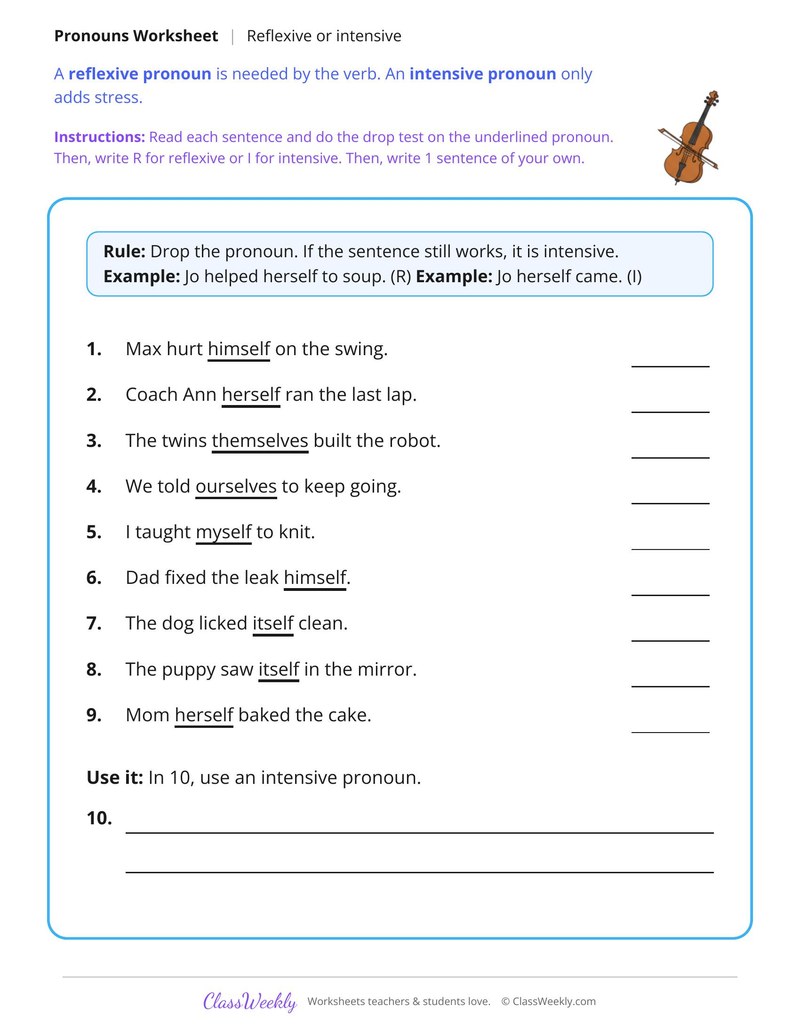
Fifth graders work on pronoun-antecedent agreement (CCSS L.5.1) ensuring pronouns match their antecedents in number and gender. They address vague or ambiguous pronoun references in their writing and learn to use intensive pronouns (myself, himself, themselves) for emphasis rather than as subjects.
What is pronoun-antecedent agreement?
⌄
Pronoun-antecedent agreement means a pronoun must match the noun it refers to in number (singular/plural) and gender. For example, Everyone should bring his or her pencil uses singular forms to match Everyone. CCSS L.5.1 requires students to recognize and correct agreement errors in writing.
How do you fix vague pronoun references?
⌄
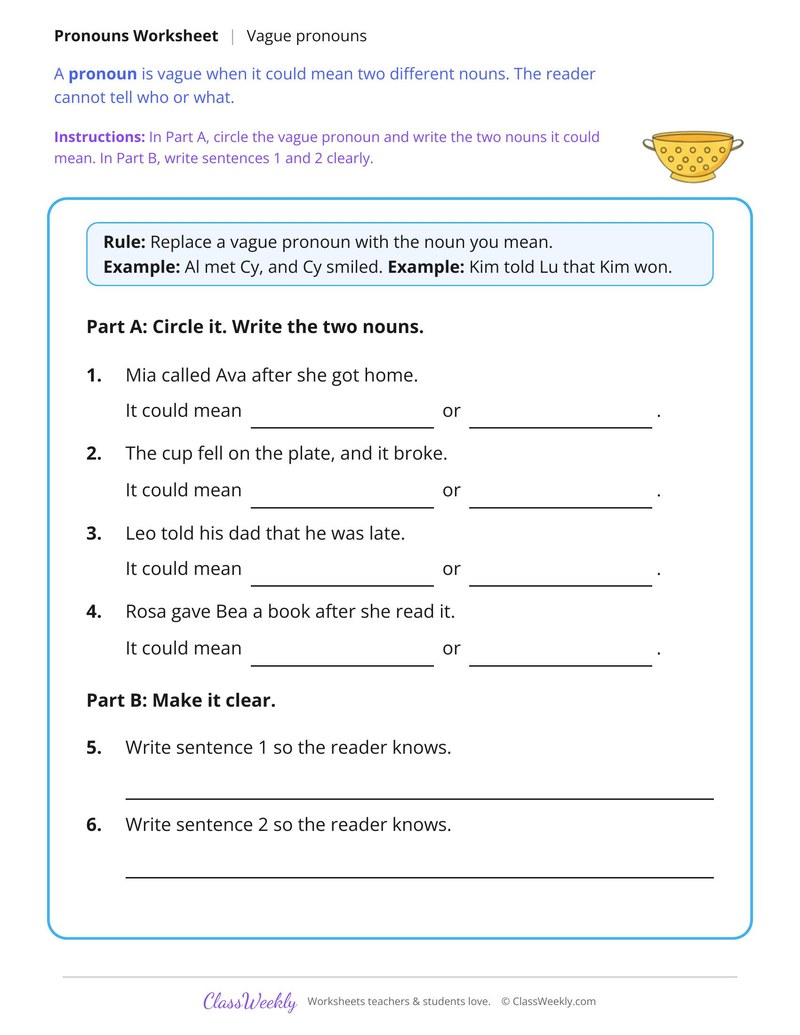
A vague pronoun reference occurs when it is unclear which noun a pronoun replaces (Sam told Tom that he won - who won?). To fix it, replace the pronoun with the specific noun or rewrite the sentence. Worksheets that present sentences with ambiguous pronouns and ask students to rewrite them for clarity build editing skills.
Ratings & Reviews
No reviews yet. Be the first to share what you think.
Reviews are for ClassWeekly members.
Make a Request
Spotted something to fix, or want a worksheet we don't have yet? Tell us and we'll make it.
Worksheet Details
| Grade | 5th Grade |
| Subject | Grammar & Writing |
| Topic | Pronouns |
| Standard | L.5.1 |
| Pages | 1 page |
| Difficulty | Medium |
Learn More
What is ClassWeekly?
ClassWeekly offers free worksheets and printable learning resources for kids in preschool to grade 5. All worksheets are aligned to Common Core, NGSS, and C3 Framework standards and designed by educators. Become a member to access the full library and download unlimited PDFs.