Sort Snacks Into Groups and Count
Written by Adi Ackerman, Head Teacher
"Sort Snacks Into Groups and Count" is written for Kindergarten (Ages 5-6), and it covers Common Core K.MD.B.3. If your little one is a year younger but already steady on data and graphing, the page still works. You may just need to read the instructions out loud. And if they are older and sort and count never quite stuck, this is a short review rather than busywork.
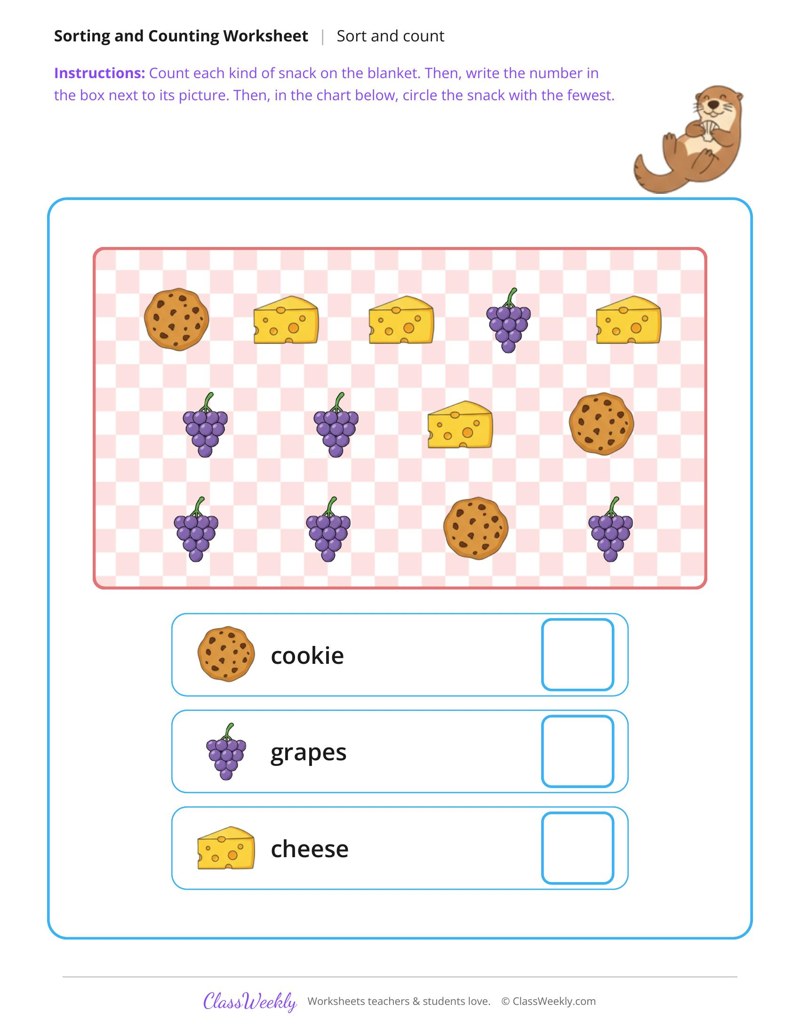
Kindergarten math worksheet: count the cookies, grapes and cheese on a picnic blanket and circle the snack with the fewest. Answer key included. Part of our sort and count data and graphing collection. Aligned to Common Core standards.
How do I use this worksheet?
Name the kinds with your child before counting, then count one kind at a time, touching or lightly crossing off each picture. When every box is filled, ask which group has the most and which has the fewest before your child circles it.
What students will practice
- Students will count the cookies, grapes and cheese on a picnic blanket.
- Students will write how many of each snack in its box.
- Students will circle the snack with the fewest pieces.


Curriculum Links
Common Core State Standards
Measurement and Data · Kindergarten
Standard: Classify objects into given categories; count the numbers of objects in each category and sort the categories by count.
View all K.MD.B.3 worksheets →Find this in the curriculum
Browse the grade, subject, and topic this belongs to.
FAQ
How do I use this sort and count worksheet?
⌄
Name the kinds with your child before counting, then count one kind at a time, touching or lightly crossing off each picture. When every box is filled, ask which group has the most and which has the fewest before your child circles it.
What does this worksheet teach?
⌄
Count the cookies, grapes and cheese on a picnic blanket and circle the snack with the fewest. The directions on the page read: Count each kind of snack on the blanket. Then, write the number in the box next to its picture. Then, in the chart below, circle the snack with the fewest. An answer key is included.
Can I use this sort and count worksheet for homeschool or classroom?
⌄
Yes, both. We made it for Kindergarten data and graphing, and the page works the same whether it lands on a kitchen table or a center rotation. At home, most families go through it together and talk the answers out loud, and that talking is where most of the learning happens with sort and count. In class it runs well as independent work while you pull a small group. Print one copy or thirty, whichever the day needs.
What does sort and count mean in kindergarten?
⌄
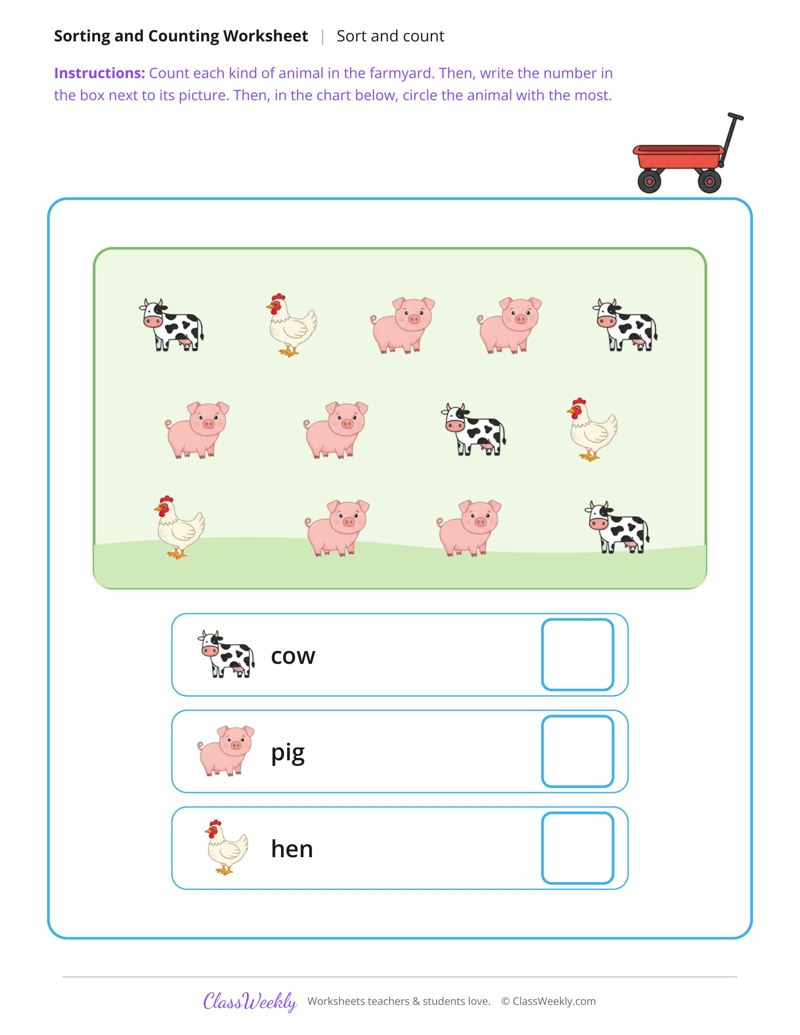
Sorting puts things that are alike into groups, such as cows, pigs and hens, or red, blue and yellow shapes. Counting each group then tells how many are in it. CCSS K.MD.B.3 asks kindergartners to sort objects into categories, count each one and sort the categories by count, with no more than 10 in a group.
How can my child keep track while counting a busy picture?
⌄
Count one kind at a time. Have your child touch or lightly cross off each picture as they count it, write the number in that kind's box, then move on to the next kind.
What kinds of sorting are on these pages?
⌄
Most pages sort by kind, such as bugs, toys or snacks. One sorts shapes by color, one sorts leaves into big and small, one sorts socks into striped, dotted and plain, and one sorts the days on a calendar by weather.
Is there an answer key?
⌄
Yes. All 10 sheets have an answer key that shows every count and the circled group.
What data and graphing activities are appropriate for kindergarten?
⌄
Kindergarteners should classify objects into categories, count the objects in each category, and sort the counts (CCSS K.MD.B.3). They typically create and interpret picture graphs and real object graphs using classroom items (sorting bears by color, graphing favorite snacks). The focus is on counting and comparing categories, not abstract graph construction.
How do you introduce graphing to kindergarteners?
⌄
Start with concrete graphs: line up real objects by category and compare the rows visually. Progress to pictorial graphs where students place a sticky note or draw a mark for each item. Introduce comparison vocabulary: more, fewer, the most, the fewest, the same. Worksheets with simple picture graphs and yes/no or count questions are appropriate for reinforcing graph-reading skills.
What vocabulary should kindergarteners know for data activities?
⌄
Key vocabulary includes: sort, classify, category, same/different, more/fewer/equal, most/least, total, how many. These terms appear in CCSS K.MD.B.3 graph interpretation questions and carry forward into first-grade data work. Consistently using this vocabulary during sorting and graphing activities, including on worksheets, ensures students learn the mathematical language alongside the concepts.
What is on these kindergarten data and graphing worksheets?
⌄
Ten sort and count pages, such as farm animals, a fruit bowl and socks sorted by pattern, ask children to count each kind, write the number and circle the group with the most or the fewest. Other pages count and draw tally marks to 10, color a bar graph of balloons, read a bar graph of pets and add pictures to find how many in all.
Ratings & Reviews
No reviews yet. Be the first to share what you think.
Reviews are for ClassWeekly members.
Make a Request
Spotted something to fix, or want a worksheet we don't have yet? Tell us and we'll make it.
Worksheet Details
| Grade | Kindergarten |
| Subject | Math |
| Topic | Data and graphing |
| Standard | K.MD.B.3 |
| Pages | 1 page |
| Difficulty | Medium |
What is ClassWeekly?
ClassWeekly offers free worksheets and printable learning resources for kids in preschool to grade 5. All worksheets are aligned to Common Core, NGSS, and C3 Framework standards and designed by educators. Become a member to access the full library and download unlimited PDFs.