Measure Paths in Centimeters
Written by Adi Ackerman, Head Teacher
"Measure Paths in Centimeters" is written for 2nd Grade (Ages 7-8), and it covers Common Core 2.MD.A.1. If your little one is a year younger but already steady here, the page still works. You may just need to read the instructions out loud. And if they are older and measurement never quite stuck, this is a short review rather than busywork.
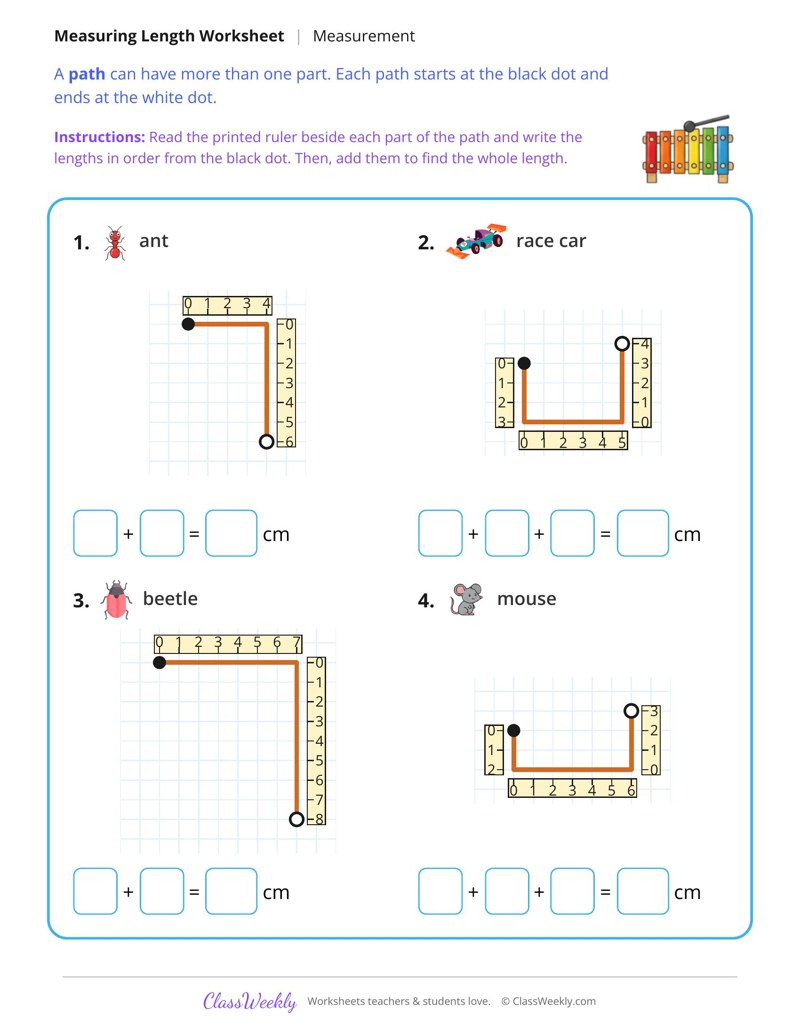
2nd grade math worksheet: measure each part of an ant, race car, beetle and mouse path in centimeters and add for the total. Answer key included. Part of our measurement collection. Aligned to Common Core standards.
How do I use this worksheet?
Before handing out the worksheet, briefly introduce the concept with a short oral warm-up or a visual model on the board. Let students work through it independently after a quick group example, checking in with a partner if they get stuck, encouraging them to talk through their thinking: "What strategy are you using? How do you know that is right?" After completing the worksheet, review any missed problems together and discuss the reasoning rather than just the answer. For extra support, let students use manipulatives or draw pictures alongside the written problems. These measurement worksheets work well as daily practice, homework, or a focused review activity.
What students will practice
- Students will measure each part of 4 paths for an ant, race car, beetle and mouse.
- Students will write the part lengths in order from the black dot.
- Students will add the parts to find each whole path, from 10 to 15 cm.
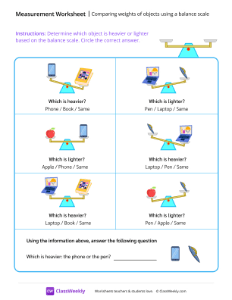
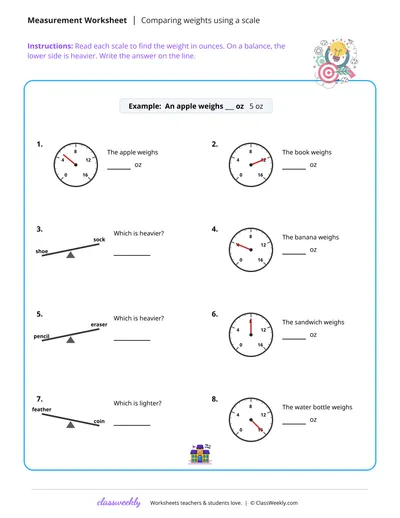
Comparing weights of objects using a balance scale

Estimating and measuring (inches)

Using a benchmark to estimate lengths (inches)

Using a benchmark to estimate lengths (metric)

Measuring in non-standard units & inches

Measuring in non-standard units & centimeters

Measuring in inches and cm

Estimating and measuring (centimeters)
Curriculum Links
Common Core State Standards
Measurement and Data · 2nd Grade
Standard: Measure the length of an object by selecting and using appropriate tools such as rulers, yardsticks, meter sticks, and measuring tapes.
View all 2.MD.A.1 worksheets →Find this in the curriculum
Browse the grade, subject, and topic this belongs to.
FAQ
How do I use this measurement worksheet?
⌄
Before handing out the worksheet, briefly introduce the concept with a short oral warm-up or a visual model on the board. Let students work through it independently after a quick group example, checking in with a partner if they get stuck, encouraging them to talk through their thinking: "What strategy are you using? How do you know that is right?" After completing the worksheet, review any missed problems together and discuss the reasoning rather than just the answer. For extra support, let students use manipulatives or draw pictures alongside the written problems. These measurement worksheets work well as daily practice, homework, or a focused review activity.
What does this worksheet teach?
⌄
Measure each part of an ant, race car, beetle and mouse path in centimeters and add for the total. A path can have more than one part. Each path starts at the black dot and ends at the white dot. The directions on the page read: Read the printed ruler beside each part of the path and write the lengths in order from the black dot. Then, add them to find the whole length. An answer key is included.
Can I use this measurement worksheet for homeschool or classroom?
⌄
Yes, both. We made it for 2nd Grade measurement, and the page works the same whether it lands on a kitchen table or a center rotation. At home, most families go through it together and talk the answers out loud, and that talking is where most of the learning happens. In class it runs well as independent work while you pull a small group. Print one copy or thirty, whichever the day needs.
How do you know whether to add or subtract in a length problem?
⌄
Add when lengths are put together, like two parts of a path. Subtract when a piece is cut off or when you need to know how much longer or taller one thing is.
How does a number line help with length problems?
⌄
Start at the first length and jump forward to add or back to take away. A 30 cm ribbon plus 25 cm is jumps of 10, 10 and 5, landing on 55.
Is there an answer key for each worksheet?
⌄
3 of the 4 sheets have an answer key. The balance scale page does not have one.
What measurement skills should second graders master?
⌄
Second graders should measure and estimate lengths in standard units including inches, feet, centimeters, and meters (CCSS 2.MD.A.1-4). They should measure the length of an object using two different units and understand that the smaller unit produces a larger measurement number. They should also estimate lengths before measuring and solve addition and subtraction word problems involving lengths. Worksheets that provide images of objects alongside rulers help children practice reading measurements accurately. Students at this level also learn to measure the same object with different tools and compare results, building the understanding that the unit of measure affects the number. This is a significant step up from first-grade non-standard measurement.
How do you teach second graders to use a ruler?
⌄
Start by reviewing that measurement means counting equal-sized units. Show that the marks on a ruler are like equally spaced blocks lined up end to end. Demonstrate aligning the zero mark (not the edge) of the ruler with one end of the object. Read the number at the other end. Practice measuring classroom objects and recording measurements in both inches and centimeters. Worksheets with printed rulers alongside objects to measure let children practice without handling physical rulers. Common errors include starting at 1 instead of 0 and misreading the marks between whole numbers. Address these by having children point to zero first every time and by using worksheets that zoom in on the ruler markings.
Why do second graders measure with both inches and centimeters?
⌄
Measuring the same object with different units teaches an important mathematical concept: the measurement number depends on the size of the unit used. A table might be 30 inches long or about 76 centimeters long. The table did not change; the unit did. This understanding prevents the misconception that measurements are fixed properties of objects. It also introduces the two measurement systems (customary and metric) that students will use throughout their education and lives. Worksheets that ask children to measure one object with both inches and centimeters, then compare the two numbers, build this conceptual understanding. Second grade is the ideal time for this comparison because children have enough number sense to reason about why the numbers differ.
Ratings & Reviews
No reviews yet. Be the first to share what you think.
Reviews are for ClassWeekly members.
Make a Request
Spotted something to fix, or want a worksheet we don't have yet? Tell us and we'll make it.
Worksheet Details
| Grade | 2nd Grade |
| Subject | Math |
| Topic | Measurement |
| Standard | 2.MD.A.1 |
| Pages | 1 page |
| Difficulty | Medium |
Learn More
What is ClassWeekly?
ClassWeekly offers free worksheets and printable learning resources for kids in preschool to grade 5. All worksheets are aligned to Common Core, NGSS, and C3 Framework standards and designed by educators. Become a member to access the full library and download unlimited PDFs.
Comparing weights of objects using a balance scale
Estimating and measuring (inches)
Using a benchmark to estimate lengths (inches)
Using a benchmark to estimate lengths (metric)
Measuring in non-standard units & inches
Measuring in non-standard units & centimeters
Measuring in inches and cm
Estimating and measuring (centimeters)