Draw Quarter Past Half Past and Quarter To
Written by Adi Ackerman, Head Teacher
"Draw Quarter Past Half Past and Quarter To" is written for 2nd Grade (Ages 7-8), and it covers Common Core 2.MD.C.7. If your little one is a year younger but already steady on telling time, the page still works. You may just need to read the instructions out loud. And if they are older and draw the time (quarter hours) never quite stuck, this is a short review rather than busywork.
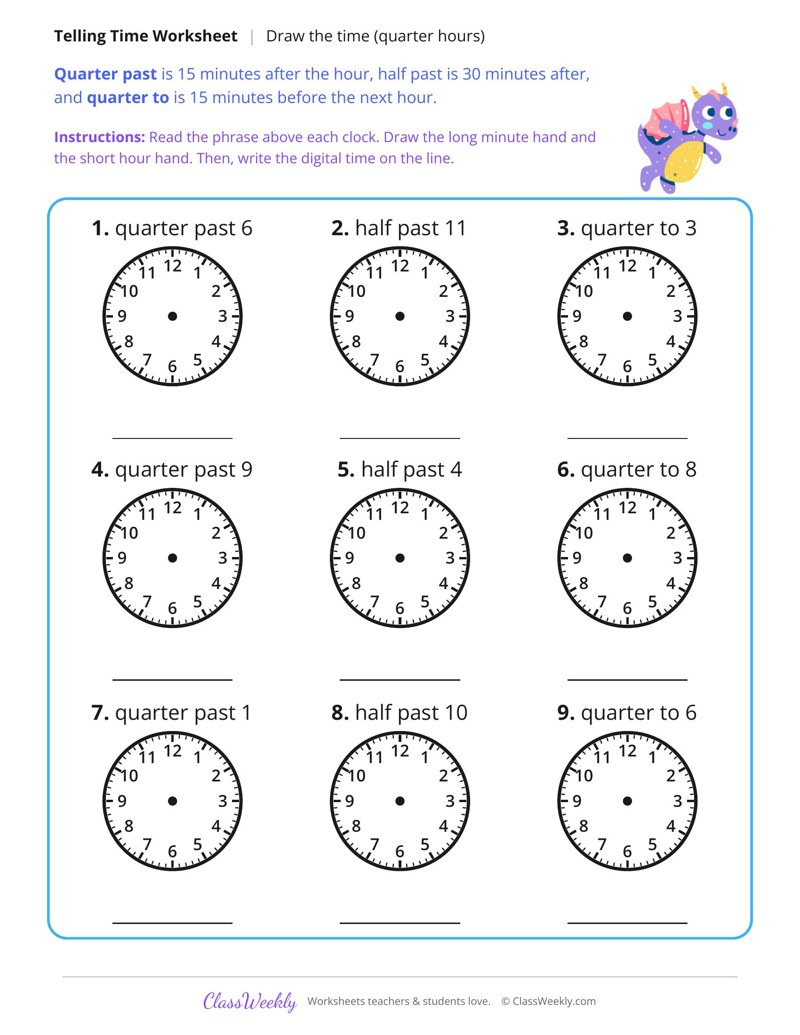
2nd grade math worksheet: draw both hands for quarter past, half past and quarter to on 9 clocks and write the time. Answer key included. Part of our draw the time (quarter hours) collection. Aligned to Common Core standards.
How do I use this worksheet?
Before handing out the worksheet, briefly introduce the concept with a short oral warm-up or a visual model on the board. Let students work through it independently after a quick group example, checking in with a partner if they get stuck, encouraging them to talk through their thinking: "What strategy are you using? How do you know that is right?" After completing the worksheet, review any missed problems together and discuss the reasoning rather than just the answer. For extra support, let students use manipulatives or draw pictures alongside the written problems. These draw the time (quarter hours) worksheets work well as daily practice, homework, or a focused review activity.
What students will practice
- Students will read 9 phrases such as quarter past 6, half past 11 and quarter to 3.
- Students will draw the minute hand and the hour hand for each phrase.
- Students will write each quarter hour time in digital form, like 2:45.


Curriculum Links
Common Core State Standards
Measurement and Data · 2nd Grade
Standard: Tell and write time from analog and digital clocks to the nearest five minutes, using a.m. and p.m.
View all 2.MD.C.7 worksheets →Find this in the curriculum
Browse the grade, subject, and topic this belongs to.
FAQ
How do I use this draw the time (quarter hours) worksheet?
⌄
Before handing out the worksheet, briefly introduce the concept with a short oral warm-up or a visual model on the board. Let students work through it independently after a quick group example, checking in with a partner if they get stuck, encouraging them to talk through their thinking: "What strategy are you using? How do you know that is right?" After completing the worksheet, review any missed problems together and discuss the reasoning rather than just the answer. For extra support, let students use manipulatives or draw pictures alongside the written problems. These draw the time (quarter hours) worksheets work well as daily practice, homework, or a focused review activity.
What does this worksheet teach?
⌄
Draw both hands for quarter past, half past and quarter to on 9 clocks and write the time. Quarter past is 15 minutes after the hour, half past is 30 minutes after, and quarter to is 15 minutes before the next hour. The directions on the page read: Read the phrase above each clock. Draw the long minute hand and the short hour hand. Then, write the digital time on the line. An answer key is included.
Can I use this draw the time (quarter hours) worksheet for homeschool or classroom?
⌄
Yes, both. We made it for 2nd Grade telling time, and the page works the same whether it lands on a kitchen table or a center rotation. At home, most families go through it together and talk the answers out loud, and that talking is where most of the learning happens with draw the time (quarter hours). In class it runs well as independent work while you pull a small group. Print one copy or thirty, whichever the day needs.
What are the three key positions students must learn for drawing quarter-hour times?
⌄
Students draw the minute hand at the 3 (for :15), the 6 (for :30), or the 9 (for :45), and adjust the hour hand to the correct position between numbers accordingly.
How does the hour hand position differ at :15 versus :45?
⌄
At :15, the hour hand is just past the hour number; at :45, it is three-quarters of the way toward the next number - precisely positioning the hour hand at these times is a key skill this activity develops.
Can draw-the-time quarter-hour worksheets be used as quick formative checks?
⌄
Yes - these worksheets are compact and self-evaluating (students can check their own work against a reference clock), making them efficient for exit tickets or warm-up checks.
What time-telling skills should second graders master?
⌄
Second graders should tell and write time to the nearest five minutes using both analog and digital clocks, and use a.m. and p.m. appropriately (CCSS 2.MD.C.7). They should understand that there are 60 minutes in an hour and know what the minute hand means at each number on the clock face (the 3 means 15 minutes, the 6 means 30 minutes, and so on). Students should also solve simple word problems involving time, such as determining what time it will be in 30 minutes. Worksheets that present analog clock faces and ask children to write the time in digital format, and vice versa, build fluency in reading both clock types. This skill extends the first-grade focus on hours and half hours to the more precise five-minute intervals.
How do you teach telling time to the nearest five minutes?
⌄
Build on first-grade skills by reviewing o'clock and half-past times. Then introduce the minute numbers around the clock: point out that each number represents 5 minutes (1 means 5 minutes, 2 means 10 minutes, and so on through 12 meaning 60 minutes). Practice skip counting by 5s around the clock face. Use a demonstration clock with movable hands and count the minutes as you move the minute hand from number to number. Worksheets that label the 5-minute intervals on the clock face help children who are still memorizing the positions. Practice with real-life scenarios ("soccer practice starts at 4:15") connects the skill to daily life. Consistent daily clock reading during classroom transitions reinforces the skill naturally.
What is the difference between a.m. and p.m. and when do second graders learn this?
⌄
A.m. (ante meridiem) covers midnight to noon, and p.m. (post meridiem) covers noon to midnight. Second graders learn this distinction as part of CCSS 2.MD.C.7. The concept is best taught through daily routines: breakfast at 7:00 a.m., school starts at 8:30 a.m., lunch at 12:00 p.m., dinner at 6:00 p.m., bedtime at 8:00 p.m. Children struggle with this concept because 12:00 can be either noon or midnight, and the transition from a.m. to p.m. at noon is not intuitive. Worksheets that list daily activities and ask students to label each with a.m. or p.m. connect the concept to real life. Discussing what would be strange (eating dinner at 6:00 a.m.) helps children reason about the distinction logically.
Ratings & Reviews
No reviews yet. Be the first to share what you think.
Reviews are for ClassWeekly members.
Make a Request
Spotted something to fix, or want a worksheet we don't have yet? Tell us and we'll make it.
Worksheet Details
| Grade | 2nd Grade |
| Subject | Math |
| Topic | Telling Time |
| Standard | 2.MD.C.7 |
| Pages | 1 page |
| Difficulty | Medium |
Learn More
What is ClassWeekly?
ClassWeekly offers free worksheets and printable learning resources for kids in preschool to grade 5. All worksheets are aligned to Common Core, NGSS, and C3 Framework standards and designed by educators. Become a member to access the full library and download unlimited PDFs.