Measure Crayons to the Half Inch and Make a Line Plot
Written by Adi Ackerman, Head Teacher
"Measure Crayons to the Half Inch and Make a Line Plot" is written for 3rd Grade (Ages 8-9), and it covers Common Core 3.MD.B.4. If your little one is a year younger but already steady on data & graphing, the page still works. You may just need to read the instructions out loud. And if they are older and making line plots never quite stuck, this is a short review rather than busywork.
2 pages in this set
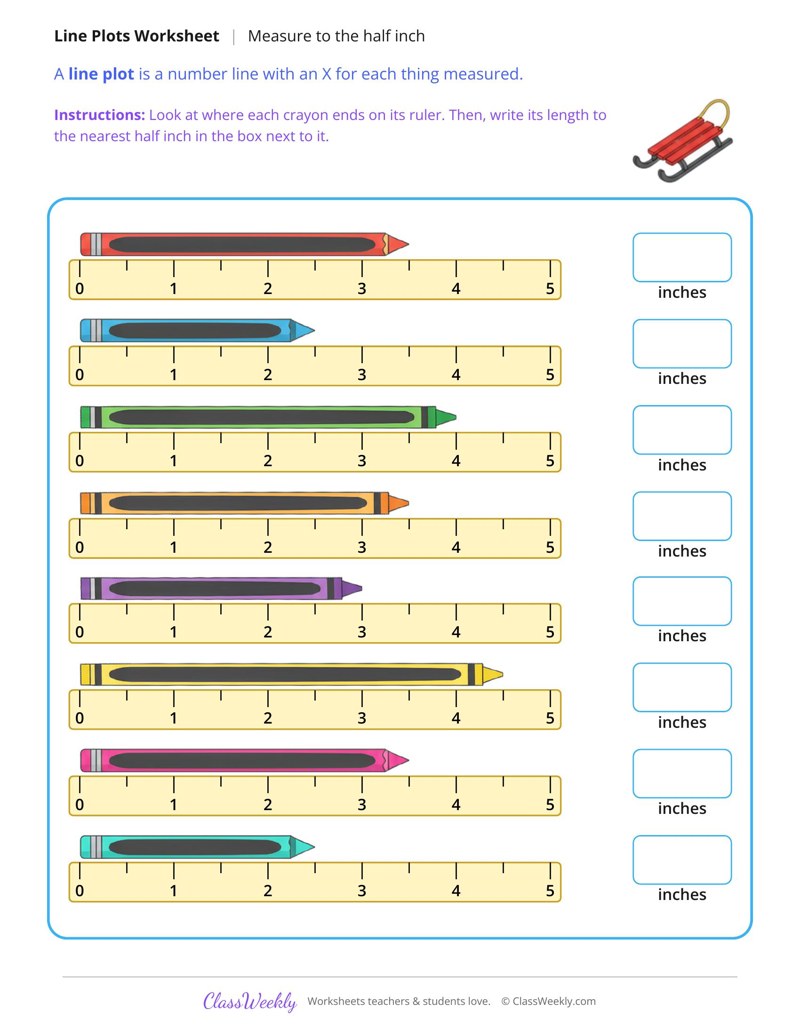
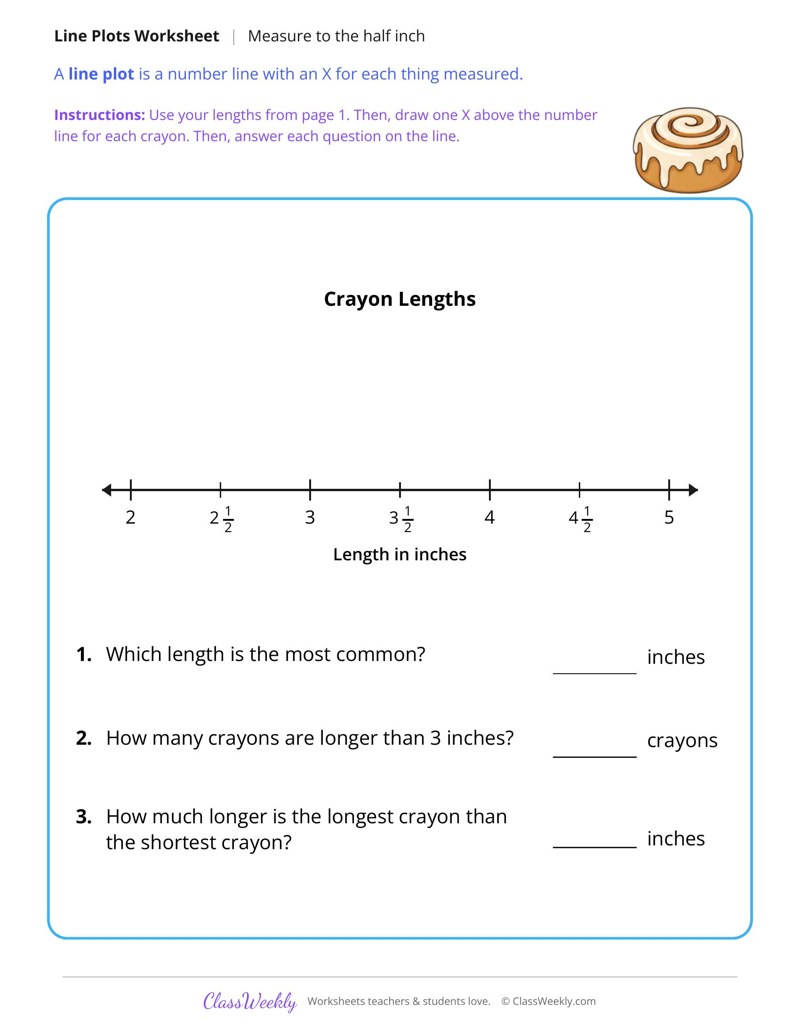
3rd grade math worksheet: measure 8 crayons to the nearest half inch, make a line plot and answer 3 questions about the lengths. Answer key included. Part of our making line plots data & graphing collection. Aligned to Common Core standards.
How do I use this worksheet?
Before handing out the worksheet, briefly introduce the concept with a short oral warm-up or a visual model on the board. Let students work through it independently, using a partner or small group only if they want to talk through their thinking, encouraging them to talk through their thinking: "What strategy are you using? How do you know that is right?" After completing the worksheet, review any missed problems together and discuss the reasoning rather than just the answer. For extra support, let students use manipulatives or draw pictures alongside the written problems. These making line plots worksheets work well as daily practice, homework, or a focused review activity.
What students will practice
- Students will measure 8 crayons to the nearest half inch.
- Students will draw one X for each crayon on a line plot in half inches.
- Students will find the most common length and how many crayons are longer than 3 inches.


Curriculum Links
Common Core State Standards
Measurement and Data · 3rd Grade
Standard: Generate measurement data by measuring lengths using rulers marked with halves and fourths of an inch.
View all 3.MD.B.4 worksheets →Find this in the curriculum
Browse the grade, subject, and topic this belongs to.
FAQ
How do I use this making line plots worksheet?
⌄
Before handing out the worksheet, briefly introduce the concept with a short oral warm-up or a visual model on the board. Let students work through it independently, using a partner or small group only if they want to talk through their thinking, encouraging them to talk through their thinking: "What strategy are you using? How do you know that is right?" After completing the worksheet, review any missed problems together and discuss the reasoning rather than just the answer. For extra support, let students use manipulatives or draw pictures alongside the written problems. These making line plots worksheets work well as daily practice, homework, or a focused review activity.
What does this worksheet teach?
⌄
Measure 8 crayons to the nearest half inch, make a line plot and answer 3 questions about the lengths. A line plot is a number line with an X for each thing measured. The directions on the page read: Look at where each crayon ends on its ruler. Then, write its length to the nearest half inch in the box next to it. On page 2: Use your lengths from page 1. Then, draw one X above the number line for each crayon. Then, answer each question on the line. An answer key is included.
Can I use this making line plots worksheet for homeschool or classroom?
⌄
Yes, both. We made it for 3rd Grade data & graphing, and the page works the same whether it lands on a kitchen table or a center rotation. At home, most families go through it together and talk the answers out loud, and that talking is where most of the learning happens with making line plots. In class it runs well as independent work while you pull a small group. Print one copy or thirty, whichever the day needs.
What steps do students follow to make a line plot from raw data?
⌄
Find the shortest and longest lengths, check that the number line covers them in halves or fourths of an inch, then draw one X above the mark for each length in the data. Crossing off each length as it is plotted, and counting the Xs at the end, keeps the plot right.
What types of measurement data do students typically plot in 3rd grade?
⌄
Common data sets include lengths of objects in inches or centimeters, recorded temperatures, plant growth measurements, or survey responses - all collected in class or given in the worksheet.
How does making a line plot develop data literacy skills beyond just graphing?
⌄
The act of organizing raw numbers into a visual display builds a deeper understanding of how data distributions look - spotting clusters, gaps, and outliers in a personally constructed graph is more meaningful than reading a pre-made one.
What data and graphing skills do 3rd graders learn?
⌄
CCSS 3.MD.B.3 asks 3rd graders to draw scaled picture graphs and scaled bar graphs and to solve one and two step how many more and how many less problems from them. CCSS 3.MD.B.4 adds measuring lengths to the nearest half and quarter inch and showing the data on a line plot.
How do you read a scaled picture graph?
⌄
Read the key first. If one ticket stands for 10, then 7 tickets stand for 70. Half a picture stands for half the key, so with a key of 2, half a book is 1 book.
What is a two step problem on a bar graph?
⌄
A two step problem needs two operations, such as adding the minutes for Tuesday and Thursday, adding the minutes for Monday and Wednesday, then subtracting to find how many more. Writing down the first answer before the second step keeps the work clear.
Do these worksheets have answer keys?
⌄
Yes. All 27 3rd grade data and graphing sheets have an answer key.
Ratings & Reviews
No reviews yet. Be the first to share what you think.
Reviews are for ClassWeekly members.
Make a Request
Spotted something to fix, or want a worksheet we don't have yet? Tell us and we'll make it.
Worksheet Details
| Grade | 3rd Grade |
| Subject | Math |
| Topic | Data & Graphing |
| Standard | 3.MD.B.4 |
| Pages | 2 pages |
| Difficulty | Medium |
Learn More
What is ClassWeekly?
ClassWeekly offers free worksheets and printable learning resources for kids in preschool to grade 5. All worksheets are aligned to Common Core, NGSS, and C3 Framework standards and designed by educators. Become a member to access the full library and download unlimited PDFs.