Features of a Myth About Why the Seasons Change
Written by Adi Ackerman, Head Teacher
"Features of a Myth About Why the Seasons Change" is written for 5th Grade (Ages 10-11), and it covers Common Core RL.5.2. If your little one is a year younger but already steady on fables, the page still works. You may just need to read the instructions out loud. And if they are older and myths, fables and folktales never quite stuck, this is a short review rather than busywork.
2 pages in this set
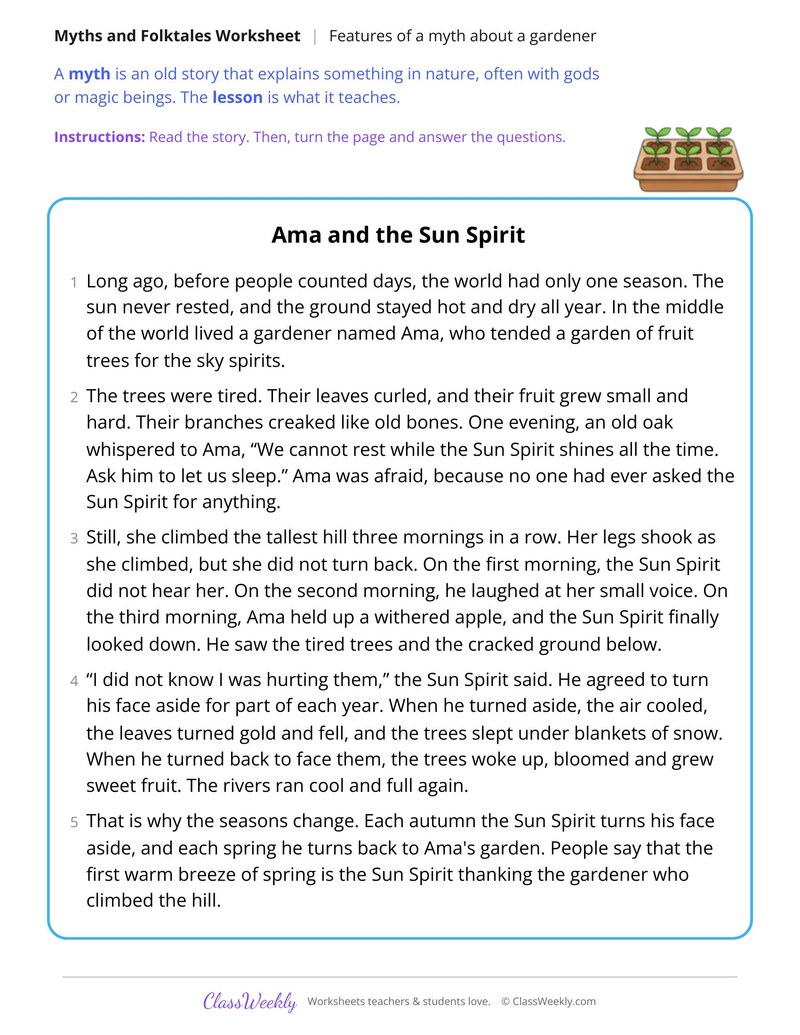
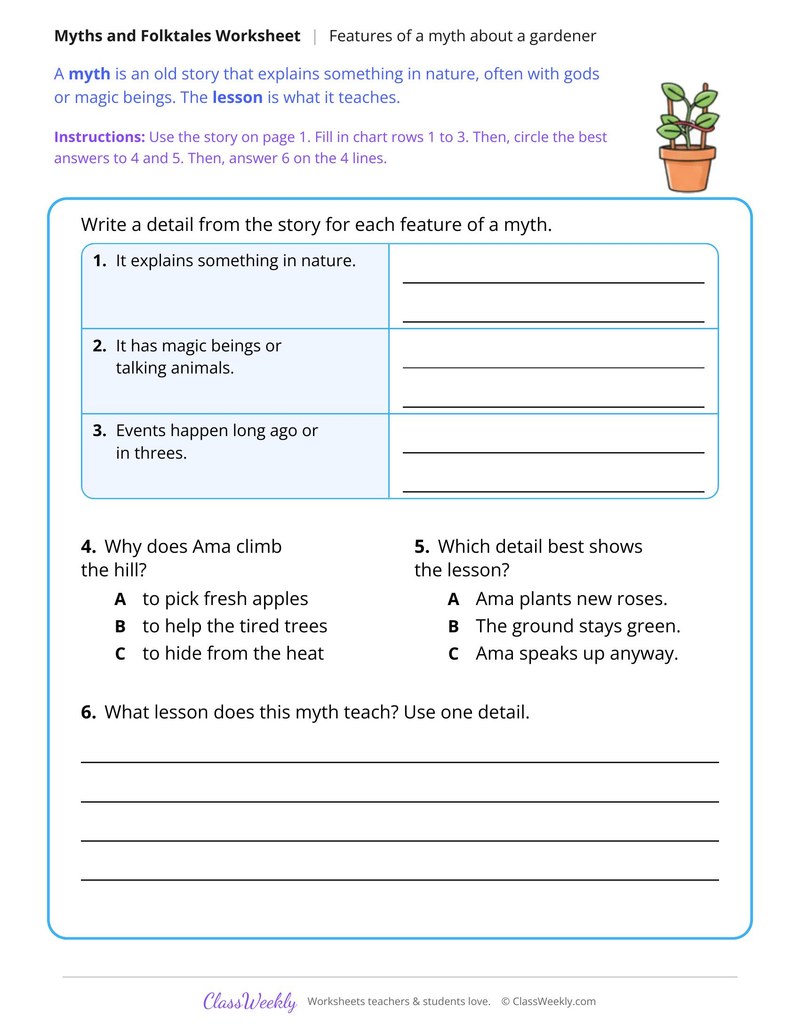
5th grade reading worksheet: find myth features in a tale about how the gardener Ama asked the Sun Spirit for the seasons. Answer key included. Part of our myths, fables and folktales collection. Aligned to Common Core standards.
How do I use this worksheet?
Before your child writes the lesson, ask what the main character did and what happened because of it. A lesson should fit people too, not just the animals in the tale. Check that the answer names one detail from the story.
What students will practice
- Students will state the lesson of a myth, fable or folktale and support it with a detail.
- Students will identify the features of a myth, such as explaining something in nature.
- Students will compare how two tellings treat a similar lesson.


Curriculum Links
Common Core State Standards
Reading: Literature · 5th Grade
Standard: Determine a theme of a story, drama, or poem from details in the text, including how characters in a story or drama respond to challenges or how the speaker in a poem reflects upon a topic; summarize the text.
View all RL.5.2 worksheets →Find this in the curriculum
Browse the grade, subject, and topic this belongs to.
FAQ
How do I use this myths, fables and folktales worksheet?
⌄
Before your child writes the lesson, ask what the main character did and what happened because of it. A lesson should fit people too, not just the animals in the tale. Check that the answer names one detail from the story.
What does this worksheet teach?
⌄
Find myth features in a tale about how the gardener Ama asked the Sun Spirit for the seasons. A myth is an old story that explains something in nature, often with gods or magic beings. The lesson is what it teaches. The directions on the page read: Read the story. Then, turn the page and answer the questions. On page 2: Use the story on page 1. Fill in chart rows 1 to 3. Then, circle the best answers to 4 and 5. Then, answer 6 on the 4 lines. The answer key covers the questions on page 2.
Can I use this myths, fables and folktales worksheet for homeschool or classroom?
⌄
Yes, both. We made it for 5th Grade fables, and the page works the same whether it lands on a kitchen table or a center rotation. At home, most families go through it together and talk the answers out loud, and that talking is where most of the learning happens with myths, fables and folktales. In class it runs well as independent work while you pull a small group. Print one copy or thirty, whichever the day needs.
What is the difference between a myth, a fable and a folktale?
⌄
A myth explains something in nature, often with spirits or magic beings, like the Sun Spirit who brings the seasons. A fable is a short tale, often with talking animals, that ends in a lesson, like the proud Rooster who thinks his crowing makes the sun rise. A folktale is a story passed down by people over time, like a trickster tale about Spider or Coyote.
What is a pourquoi tale?
⌄
Pourquoi is French for why. A pourquoi tale explains why something in nature is the way it is. On one sheet, children chart how Giraffe looked at first, what went wrong, what she did and how she changed.
How do the compare pages work?
⌄
Children read two short tellings on page one and fill a chart for each: who the judge or main character is, what goes wrong and how it ends. Then they find what is true of only one telling and explain how the two lessons are alike, with a detail from each. Comparing stories of the same type is RL.5.9.
Is there an answer key for each worksheet?
⌄
Yes. All nine sheets have an answer key. For the lesson questions, the key gives a model answer and lists other lessons the tale supports.
How many 5th Grade myths, fables and folktales worksheets are there?
⌄
9 printable worksheets, all free to preview. Downloads are included with a ClassWeekly free trial, and every page prints on standard 8.5 x 11 paper.
What age are myths, fables and folktales worksheets for?
⌄
These are written for 5th Grade students, roughly ages 10-11. Many teachers also use them a grade up for review or a grade down as an extension, so use the preview to judge the fit for a particular child.
Are these myths, fables and folktales worksheets aligned to Common Core?
⌄
Yes. Each one shows the Common Core code it covers on its own page, so you can check the alignment yourself rather than taking our word for it.
Ratings & Reviews
No reviews yet. Be the first to share what you think.
Reviews are for ClassWeekly members.
Make a Request
Spotted something to fix, or want a worksheet we don't have yet? Tell us and we'll make it.
What is ClassWeekly?
ClassWeekly offers free worksheets and printable learning resources for kids in preschool to grade 5. All worksheets are aligned to Common Core, NGSS, and C3 Framework standards and designed by educators. Become a member to access the full library and download unlimited PDFs.